
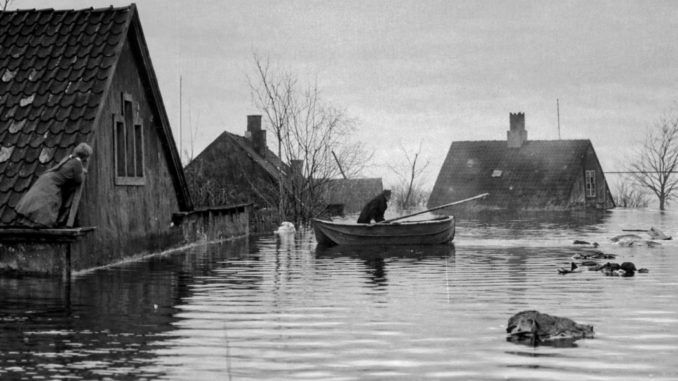
Disaster movies are often associated with the seventies, kicking off with Airport in 1970. But the genre has been around considerably longer. For almost as long as there has been film cameras, people have been pointing them at disasters, and putting exclamation points on the end of their titles. This probably began with James Williamson in 1901, whose Fire! was… Oh, figure it out. The first of many films based on the sinking of the Titanic, came out a remarkable twenty-nine days after the actual disaster in 1912. Saved from the Titanic ran ten minutes, is now as lost as the vessel, and starred actress Dorothy Gibson. She was an actual survivor, having been on the first lifeboat. It featured her telling her story, while wearing the clothes she had on that night.
The entire Titanic genre illustrates a middle ground between the two main schools of disaster movies. These can basically be separated into “Act of God” and “Act of Man”, depending on whether they are the result of natural phenomena or human action. Ship disaster movies, also including the likes of The Poseidon Adventure, are a bit of both: we are the ones building the ship, putting them in harm’s way and, on occasion, demonstrating hubris by pronouncing them “unsinkable.” If the subsequent problems were the result of shoddy workmanship, as in The Towering Inferno, they’d be solidly in the “Act of Man” camp. But at sea, you will usually find that icebergs, giant waves and the like, represent a bigger threat than contracting out to the lowest bidder.
In the “Act of God” sub-genre, there is a significant overlap between the disaster movie and the horror genre. Both are, in the end, designed to trigger the same sense of second-hand fear in the viewer. Whether an entry qualifies is largely down to the approach taken by the film-maker, and the nature of the threat. If it’s paranormal, such as in The Birds or World War Z, then you are probably crossing over into horror. The entire Godzilla franchise could fall into this area, though there is significant variation between entries. You’ll never convince me Godzilla Minus One is other than horror, but I will concede something like Rebirth of Mothra – indeed, just about anything with Her Flappy Highness – is considerably more fringe.
It’s also interesting to see how the threats have evolved over time. The fifties, for example, were big on nuclear annihilation, with extraterrestrials – in the shape of aliens or, as in When Worlds Collide, their planets – also frequently of concern. As the Cold War peaked in the early eighties, atomic armageddon came back into fashion. Although on both sides of the Atlantic, the small screen provided the most memorable examples, in The Day After and Threads) It took aliens a decade longer, both categories of peril from space enjoying a resurgence in the late nineties, courtesy of Independence Day and Armageddon. And, of course, since 2020, the end has been particularly nigh through various flavours of pandemic.
However, we’re interested here in the earlier days of the genre. Below, we cover at least one entry from each decade for the tens through the sixties, and rather more from the last two.
The End of the World (1916)
Rating: C+
Dir: August Blom.
Star: Olaf Fønss, Ebba Thomsen, K. Zimmerman, Thorleif Lund.
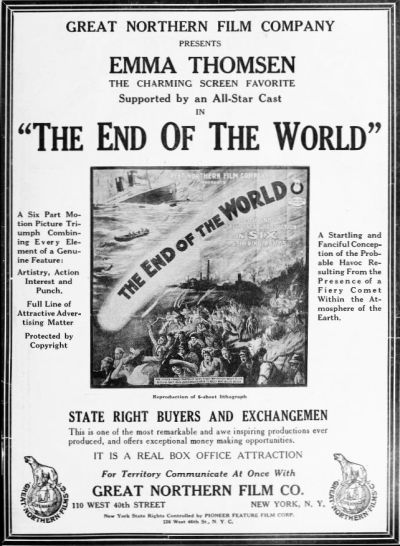
This is likely the first feature-length disaster movie ever made. It was inspired largely by the passing of Halley’s Comet through the solar system in 1910 – an event which caused some panic and fears of annihilation, after the press misrepresented the discovery of cyanogen gas in the comet’s tail. What I found particularly interesting, was how many of the common tropes of the modern disaster movie, seem to have sprung, fully-fledged in this initial example. It starts off with the almost obligatory mixing of everyday drama with the disaster porn. Here, the early going is mostly concerned with the romantic entanglements of Dina (Thomsen), the daughter of a mine manager. She falls for, elopes with (and presumably marries) mine owner Frank Stoll (Fønss), though the relationship is not a particularly happy one.
Years later, a new comet is discovered by Professor Wisemann (Zimmerman). His prediction that it could enter the Earth’s atmosphere leads to concern as the comet approaches, gradually getting larger and more prominent in the sky during the film’s outdoor scenes. Stoll is also the Professor’s cousin, which gives him the inside scoop on the upcoming disaster. In another touchstone of the genre, the truth is being kept from the press to avoid causing widespread panic, allowing Stoll to manipulate the stock market to his benefit. He then returns to Dina’s home town, and prepares a bunker deep in the mine, where he and his chosen companions can ride things out. “If we are saved,” he says, “It will be we who will found the new world, and be its masters.”
 However, this brings him back into conflict with Dina’s ex-boyfriend Flint (Lund), who still harbours a grudge. He whips up the population unto a revolutionary fervour (“Let us take back what the rich have stolen from us!” must have hit differently, the year before the Russian Revolution), while Stoll, in rather poor taste, holds a pre-apocalypse party. This includes an interpretive dance routine by Dina, as the first embers from the comet begin to fall on the town. But, as happens so often over the century-plus that follows, the rest of humanity is an equal threat, Flint’s mob attacking Stoll’s mansion.
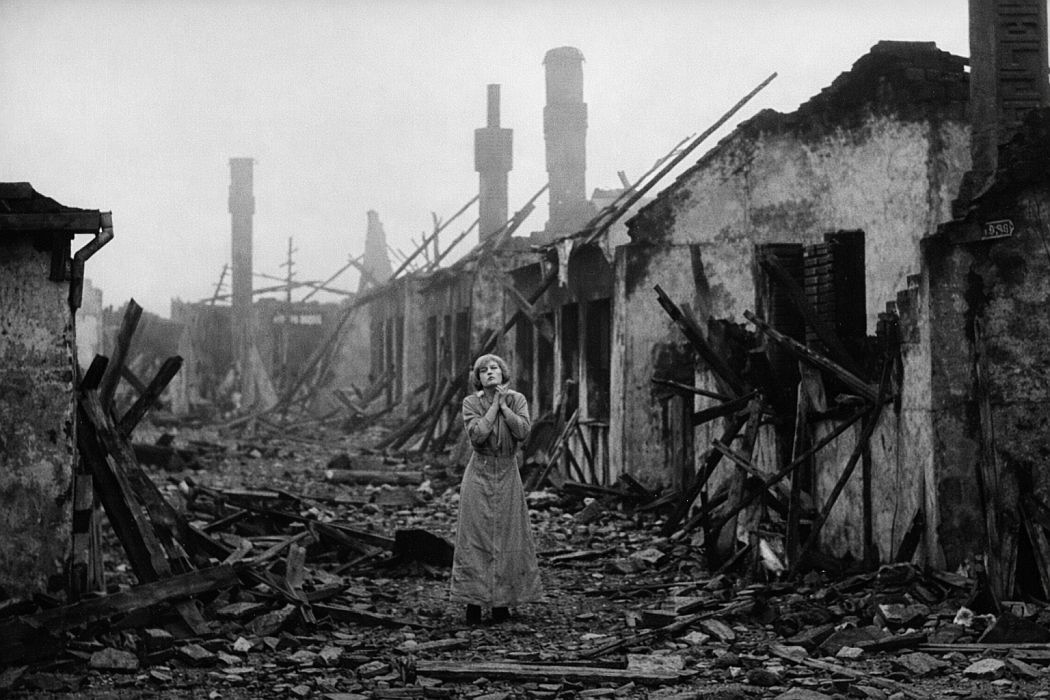
Naturally, even this first disaster film realized audiences needed a pay-off, and the final twenty minutes deliver in effective fashion. The sky darkens as cometary fragments pound the earth, toxic gases are released, and the ocean levels rise dramatically. Most of the major characters meet unpleasant fates, and we instead follow Dina’s sister Edith (Johanne Fritz-Petersen), as she wanders through the destruction (top): there’s some genuinely impressive work here, such as a full-scale set of a flooded town. I do suspect the earlier suggestion this is a punishment from God reflects the maker’s intentions, the virtuous Edith avoiding the fate of her slutty sibling. This end of the world has one final element in common with its modern descendants: the best part is undeniably the destruction.
Noah’s Ark (1928)
Rating: C
Dir: Michael Curtiz.
Star: George O’Brien, Dolores Costello, Noah Beery, Louise Fazenda.
This is interesting, in that it manages to be both a Bible story, and a disaster movie. It begins with the return to land of Noah’s Ark, and draws a direct line from there, through the Tower of Babel and the Fatted Calf, to contemporary greed. Thereafter, it moves back and forth between action centred around World War I and Biblical times, with the story of Noah. The lead actors play different roles in the two halves: for example, O’Brien is both a soldier in the trenches, and Noah’s son, Japheth. Costello is the woman he loves and has to protect in both eras: German actress Marie, and Miriam, a handmaiden of Noah chosen for sacrifice to a pagan deity. [Future star Myrna Loy also pulls double duty, in minor roles]
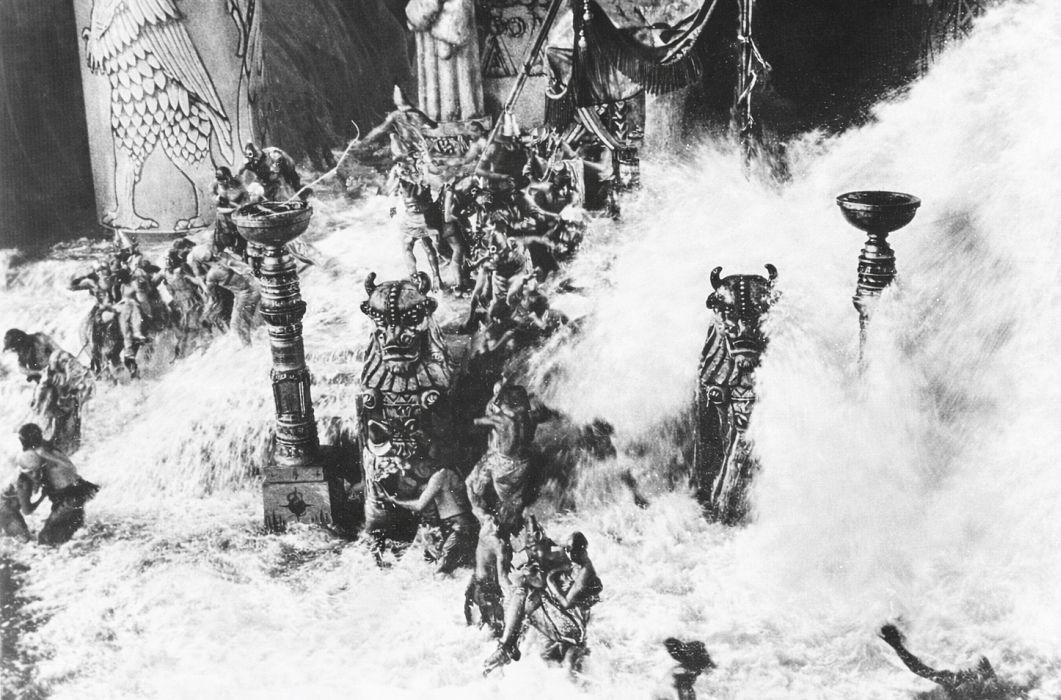
Curtiz, who would go on to fame by directing Casablanca, had already mined the Bible – public domain, of course! – back in his native Germany, with films like Sodom and Gomorrah. But it ended up having to be hastily converted into at least a part-talkie, focusing this element on the scenes in the modern era – though even here, it’s intermittent. However, the movie is particularly notorious for the climax depicting the flood, which involved the use of half a million gallons of water. When suddenly released, the resulting torrent reportedly drowned three people, injured so many that 35 ambulances were needed to transport the wounded, and led to stricter controls on set safety. John Wayne was supposedly among the extras used in the sequence.
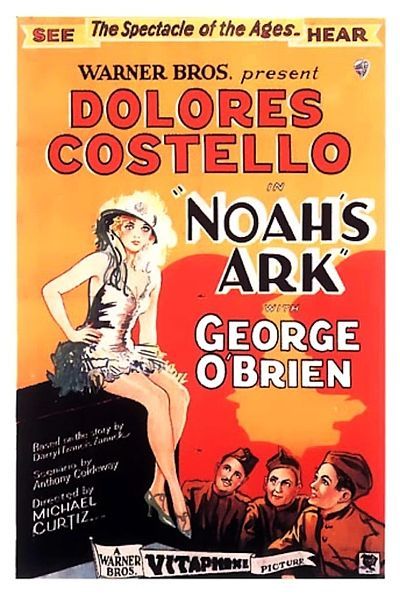 You will therefore understand why I was making hurry-up gestures at the screen throughout all the World War I stuff, which is a combination of generic patriotism, heroism and loss (Travis accidentally killing his friend Al), with unconvincing romance across the lines. An evil Russian (Beery) tries to have Marie shot as a spy. Travis, who is part of the firing squad, recognizes her, but they get trapped beneath a collapsed building. Which gets us, after almost an hour, to the Biblical side of affairs. Things perk up, at least from the point of view of sheer spectacle. At a cost of over $1 million, this was the most expensive Warner Bros. movie to that point, and it shows. Big sets! Thousands of extras! Wrath of God!
I do wonder if Curtiz was mixing up his stories: I thought the burning bush and the stone tablets were Moses, not Noah? But it’s impressive stuff: the ark genuinely looks like it is big enough to hold two of every animal, and the palace of evil King Nephilim (also Beery) is no less grandiose. The lack of dialogue doesn’t get in the way of the carnage. The flood still hits like a tidal-wave – the “35 ambulances” thing seems quite credible. I would be thoroughly down for an entire feature of nothing but Biblical disaster porn, depicting large-scale smiting, sundering and great wroth. Shame the first sixty minutes here are as tepid as a tea-party, and it makes sense why it was quickly cut down from an original running time of 135 minutes.
Deluge (1933)
Rating: C+
Dir: Felix E. Feist.
Star: Peggy Shannon, Sidney Blackmer, Lois Wilson, Matt Moore.
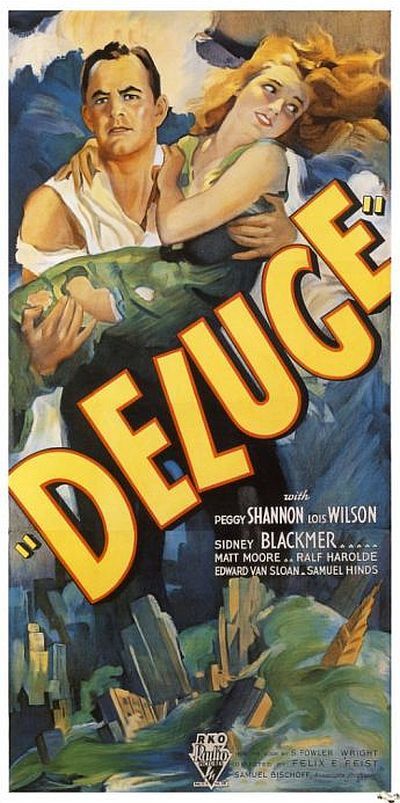
This is not a film I would have expected to be made by RKO, being considerably more ambitious in scale than most of their content. Early on, it does bypass the need for special effects, relying instead on things like newspaper headlines (“Earth Doomed!”) , reading messages off a teletype, emergency news broadcasts, and that old standby, stock footage. However, it’s edited together with such breathless intensity, it helps paper over the lack of actual disaster. The main focus is on the struggles of Martin (Blackmer) and Helen Webster (Wilson), as they struggle to survive, both during the disaster and in the post-apocalyptic world. This combination isn’t something you see often: it’s typically one or the other.
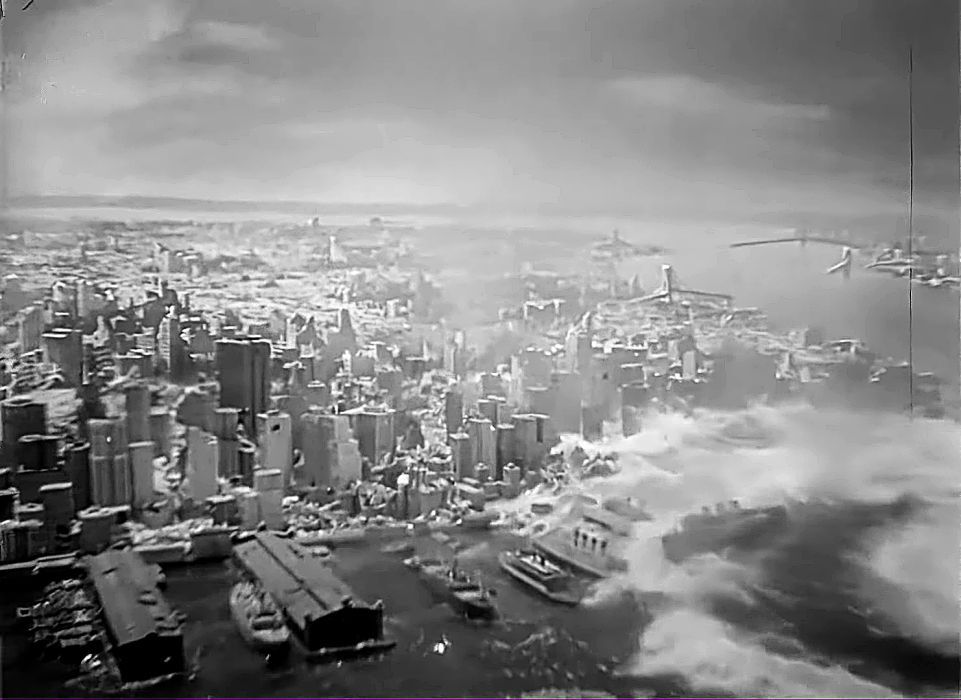
After about a quarter of an hour, we do get to see the destruction of New York by a tidal wave. Though, to quote Monty Python: “It’s only a model.” The pure model work is fairly decent (top); the efforts to combine it with footage of fleeing citizens, considerably less so. In the deluge, Martin is split up from Helen, and believes his wife and children are dead. Martin ends up saving swimmer Claire Arlington (Shannon), and the two fall in love. However, they come to the attention of the inevitable post-apocalyptic gang of thugs, with designs on Claire which I’m sure you can guess. Meanwhile, Helen has joined up with a group of survivors, who are trying to rebuild society under the leadership of Tom (Moore).
 Eventually, the husband and wife are re-united. This is particularly awkward for Martin – because, unlike him, Helen has stoically refused the advances of Tom, refusing to believe her spouse has died. The resulting love triangle plays out against the backdrop of recovery, though outside of the marauding gang, it doesn’t seem like the new, moister world is particularly rough. Or maybe it’s just that in the thirties, lifestyle expectations were considerably lower for most people. Roof over your head? Adequate nutrition? That’ll do. Avocado toast, influencers and fur babies are all notable here by their absence. I do find myself wishing that a larger studio had committed to the project. After the genuine flood of Noah’s Ark, this is barely damp in comparison.
The film as a whole was lost for decades (though some of the effects footage shows up in later Republic serials like King of the Rocket Men). An English-language print did not resurface until 2016, thirty-five years after an Italian version was found, that apparently belonged to Luigi Cozzi. I’m fairly glad it was recovered. For it works better on the human level than Noah’s Ark. What you get is a fairly simple story of survival, as is necessary. We don’t meed the Websters for a while, and it only runs 76 minutes in total, so things in between are kept fairly basic. There’s a genuine poignancy to the ending. While I won’t spoil it in detail here, it’s enhanced by knowing that Shannon would be dead through chronic alcoholism just a few years later.
Titanic (1943)
Rating: C-
Dir: Herbert Selpin.
Star: Hans Nielsen, Sybille Schmitz, Kirsten Heiberg, E.F. Fürbringer.
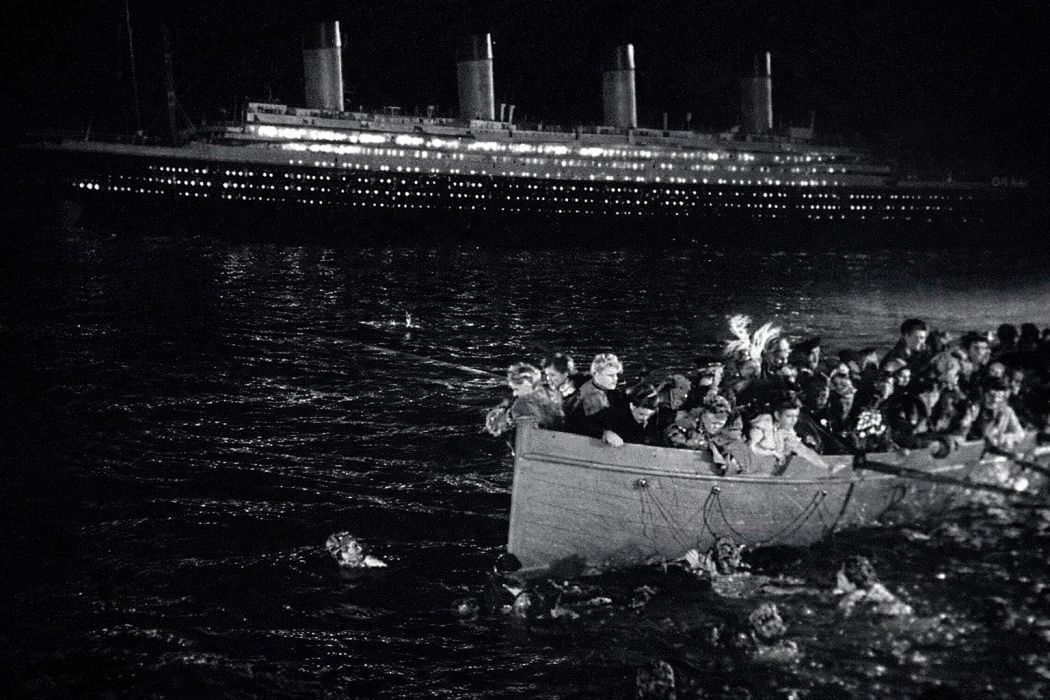
Not to be confused with the other Titanic obviously, this is a wartime film made in Nazi Germany. Naturally, it fabricates a heroic German member of the crew, First Officer Petersen (Nielsen), who behaves like a hero in the ensuing disaster. The same goes for any other Germans among the passengers. Meanwhile, the collision with the iceberg is a direct result of the machinations of J. Bruce Ismay (Fürbringer), the slimy chairman of White Star Lines. If the ship can set a record trans-Atlantic pace, all the company shares he and the board have bought up will skyrocket in value. Nothing can be allowed to prevent a speedy arrival, regardless of the resulting risk.
Like the James Cameron version, this was a troubled production, costs ballooning out of control to become the most expensive German production to that point. Though at least, Cameron was not arrested by the Gestapo and Epsteined in his prison cell, after critical comments about navy officers working as consultants on the movie. Selpin was, the film being completed after his “suicide” by another director. When finished, it was then rejected by Joseph Goebbels, who decided disaster porn was not in the best morale interests of a Germany under increasingly heavy Allied bombing. Even after the war, it was banned in the British occupied zone, though some footage ended up recycled into 1958’s A Night to Remember. Completing the curse, the ship playing the Titanic, SS Cap Arcona, was sunk by the RAF late in the war, killing thousands of concentration camp survivors aboard.
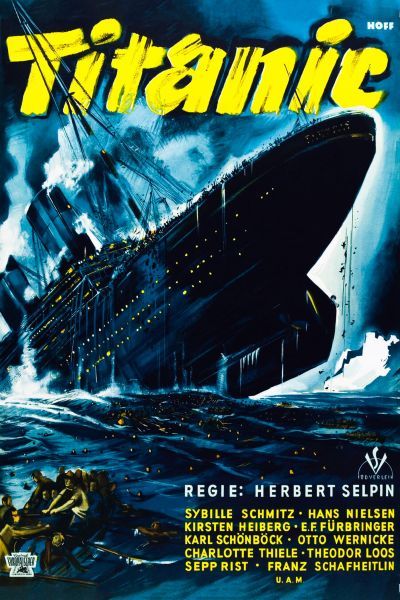 Apart from Ismay, there are representations of other historical figures who were aboard, such as Captain Edward Smith, and John Astor, then one of the richest men in the world. But beyond the basic iceberg-related facts, this is largely a polemic against capitalism, clearly informed by the “Socialist” in “National Socialist”. After Ismay is cleared of all responsibility, conveniently scapegoating the dead Captain Smith, we get a particularly scathing final caption: “The deaths of 1,500 people remain unatoned for, an eternal condemnation of England’s endless quest for profit.” As depicted here, possibly the only thing worse than the British upper classes above deck, are the animalistic working classes, rioting their way through steerage.
There are some other, curious parallels to the Cameron version, such a subplot involving stolen jewellery. But this doesn’t achieve the same sense of spectacle, with some unconvincing model work for the sinking vessel, which appears to have been filmed in a child’s padding pool. It instead relies largely on crowds milling aimlessly from place to place, until the crew are literally told “Every man for himself,” at which point the milling really kicks in. Petersen rescues a little girl trapped in her cabin, but unlike Jack Dawson, doesn’t need to sacrifice himself so that his love, broke Russian countess Sigrid Olinsky (Schmitz), can survive. Perhaps it’s knowing about the background, but this never feels less than manipulative, and not particularly well-done manipulation at that.
The Lost Missile (1958)
Rating: C-
Dir: Lester Wm. Berke.
Star: Robert Loggia, Ellen Parker, Philip Pine, Larry Kerr.
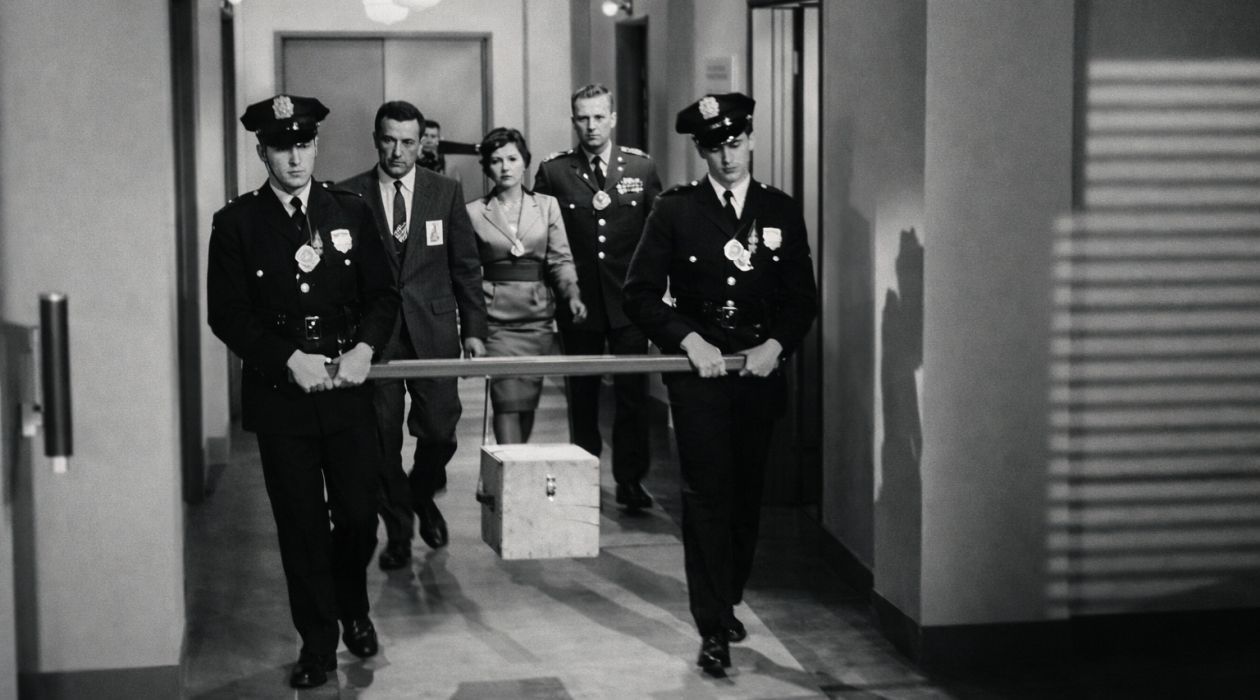
This certainly doesn’t hang around. We begin with a missile of unknown origin already orbiting the globe at an altitude of five miles, leaving a trail of destruction – the finest stock footage money can buy – beneath it. Albeit not very much money. Meanwhile atomic scientist Dr. David Loring (Loggia) and his assistant Joan Woods (Parker) have other concerns. David’s work on the Jove rocket have previously taken priority over their marriage plans, forcing the wedding to be pushed back repeatedly. But today is the day, lost missile or no lost missile. Well, until it isn’t, and Joan stalks off in a huff, telling David, “Marry your hydrogen warhead… You’ll have to find somebody else for both marriages.”
With the missile’s course taking it over New York, a solution needs to be found. But, first, we discover it’s not just Dr. Loring who is having to make sacrifices. His colleague, Dr. Freed (Pine) is unable to be with his wife, who is about to go into labour. In this film, I note, women are basically good for pouting about weddings and having babies. That’s it. Meanwhile, all the men are Very Serious and wear suits. There may be pipe-smoking involved, with the message very much being that the American military and scientists have got this. There is certainly no shortage of stock footage, with almost all of the military clips clearly having nothing to do with the actors.
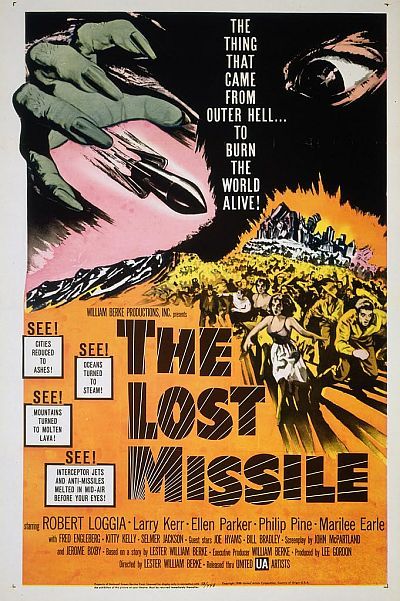 While the basic premise here is a little like A House of Dynamite, there are few moments here where the government response is credible. It’s somewhat more interesting, at least, when depicting how everyday citizens react to the alerts: some concern, but they follow instruction, without question or real panic. A bit of shoving and yelling is largely the extent of it. “You will obey all police and civil defense officers,” goes the unidentified voice over the public loudspeakers. And people do. It may be this which dates it most, to a time where you did not question your government, because they knew best. “New Yorkers have been conditioned by practiced alerts,” goes the voice-over, which is only slightly less omnipresent than the stock footage. “They know what to do.”
Arguably, they know better than those in charge, because there are certainly some questionable decisions here. In particular, Dr. Loring’s decision to drive around in a jeep with Joan and a nuclear core, seems a poor one in hindsight. Still, it provides an opportunity for heroic sacrifice, in a way familiar to anyone who watched Chernobyl. Poor Joan is left sobbing, literally at the side of the road, as the inhabitants of the Big Apple await their fate. The film does finally acquire the necessary energy towards the end, as they race to get the Jove rocket ready for a last-ditch interception, hoping to save New York. If you’ve seen the way Fail-Safe ends, you’ll understand there is good reason to be concerned.

The World, the Flesh and the Devil (1959)
Rating: C+
Dir: Ranald MacDougall
Star: Harry Belafonte, Inger Stevens, Mel Ferrer
This has a great first half, let down by an underwhelming second half. You can tell this means well. But it appears it didn’t end up satisfying anyone at the time, and certain elements of it have not aged well. In this case, the apocalypse happens entirely off-screen. Mine engineer Ralph Burton (Belafonte) is trapped by a cave-in deep underground, and it’s several days before he is able to dig himself out. Returning to the surface, he finds nobody around. Convenient newspapers, with headlines like “Millions Flee From Cities! End Of The World” inform him that clouds of radioactive sodium wiped out just about everyone while he was underground, before decaying into harmless material.
He heads to New York in search of survivors. While initially unsuccessful, his technical knowledge allows him to restore electrical power to one building, for example. Eventually, he encounters another person, Sarah Crandall (Stevens), who survived in a decompression chamber. Their relationship is initially cordial, although Ralph chooses to remain at a distance – they live in different apartment blocks. The film does a remarkable job of depicting a deserted New York, with Ralph wandering through a deserted Times Square, which feels an influence on what 28 Days Later did in London. A radio broadcast says the city was “completely evacuated” before the radiation arrived. Not that it helped – but this does manage to get round the pesky “Shouldn’t there be eight million corpses?” question you might have been asking.
 Then Sarah calls herself “Free, white, and 21”, and it all goes pear-shaped. Ralph, you see, is black. The film suddenly goes from being refreshingly free of race as an issue, to being entirely about race as an issue. I get that the late fifties was a different era, still five years before the Civil Right Act. But it appears this was also made before the invention of subtlety. A third survivor, Benson Thacker (Ferrer) shows up, and the inevitable competition for Sarah’s affections becomes much more of its time. To quote Ralph, “If you’re squeamish about words, I’m colored. And if you face facts, I’m a negro, and if you’re a polite southerner, I’m a negra, and I’m a nigger if you’re not.”
What if you don’t care, there being considerably more pressing, apocalypse-shaped matters to hand? And Ferrer is half-Cuban too. The Stockholm-born Stevens is the only person here who is unequivocally white. While you’re figuring out all this, things collapse into Ralph and Benson hunting each other through the streets of New York. An especially risible turning point is where one of them reads a Bible quote on the wall opposite the UN – the one about beating swords into ploughshares – and unilaterally decides to give up. Probably counts as the UN’s biggest ever contribution to peace. It finishes in a way which I suspect was intended to be uplifting – the final caption is not “The End” but “The Beginning” – and likely failed to convince anybody.
The Last Voyage (1960)
Rating: B+
Dir: Andrew L. Stone.
Star: Robert Stack, George Sanders, Dorothy Malone, Edmond O’Brien.
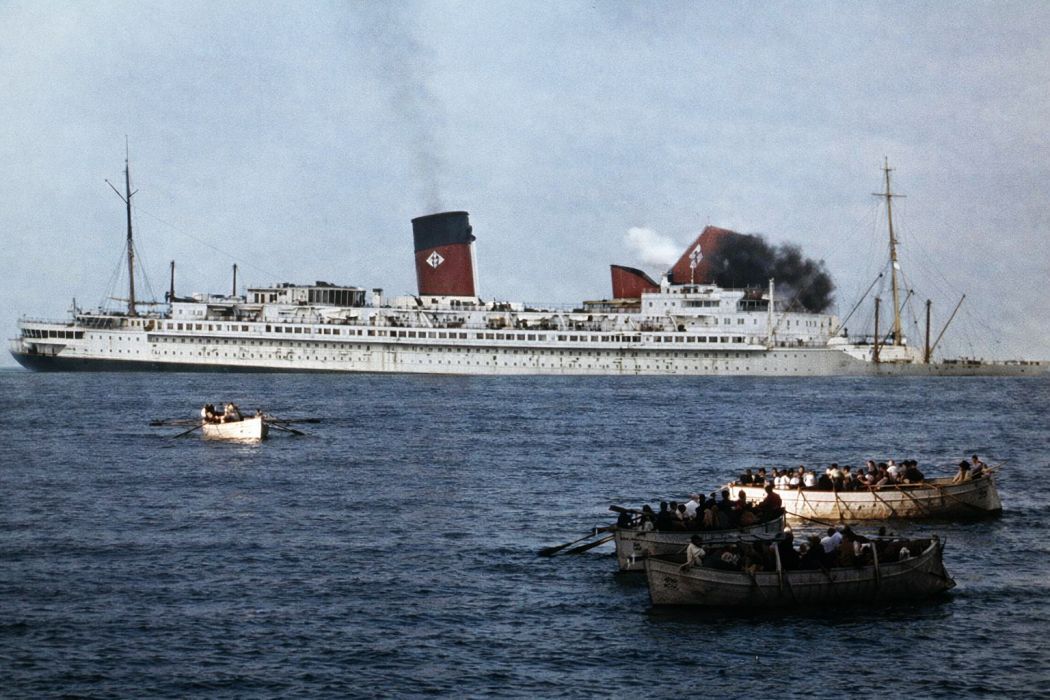
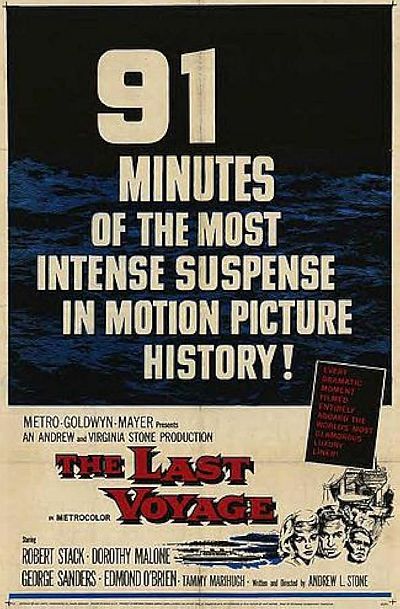
This is among my favourite disaster movies, because it is absolutely goddamn relentless. It begins immediately, literally a few seconds in, with a fire in the engine room of the SS Claridon. It’s an aging ocean liner, being nursed for a few more voyages by its captain, Robert Adams (Sanders) before being scrapped. Fate has other plans. A stuck boiler valve leads to an explosion, and a slow yet inevitable demise. This happens despite the best efforts of second engineer Walsh (O’Brien), and Capt. Adams’s robust attempt to keep the ship afloat through pure denial. Trapped in the explosion is Laurie Henderson (Malone), whose husband Cliff (Stack) refuses to abandon his wife to a moist death.
I said “slow,” but that’s one thing this is not. It unfolds in real time, with Cliff’s efforts to free Laurie running alongside Walsh’s efforts to shore up a bulkhead, which is virtually the only thing keeping the boat above the water. This all looks extraordinarily real, and that’s because it was. For the production rented an actual 800-ft liner, the SS Ile de France, from a Japanese scrapyard. This was then wrecked, flooded and genuinely almost sunk, for the purposes of the movie. The previous owners were less than impressed by their vessel’s new career in Hollywood, and required all trace of its previous life and name to get erased. It definitely did not die in vain.
 The breathless pace means there’s not much time devoted specifically to character building, yet it does the job. Cliff is loyal to a fault, first rescuing their young daughter, in a disturbing scene which had us wondering if they were using a tiny stuntperson. Laurie, meanwhile, has her own moment, reaching for a shard of glass to kill herself, knowing it’s the only way her husband will leave. As the water rises, her position becomes genuinely concerning. This was based on a real incident during an earlier liner sinking, the SS Andrea Doria in 1956, where passenger Martha Peterson was trapped by debris in her cabin. Weirdly, the ship which picked up most of the survivors that day? The SS Ile de France.
Meanwhile, Captain Adams is a bit of a dick, to put it mildly. He’s more concerned about his future position in the shipping company, than the safety of his crew and passengers. It’s especially notable in the early stages, where the travellers are dining and partying above decks, while the boat is in flames below. Also notable: the way the Hendersons just dump their child off at a puppet show, then head off for martinis and dancing. Hey, it was the sixties. Child endangerment aside, this feels as if somebody took James Cameron’s Titanic, ruthlessly editing out all the boring bits and Celine Dion. The Oscar nomination for Best Special Effects was fully deserved. Its loss to The Time Machine proves poor judgment in the Academy is not a new invention.
Voyage to the Bottom of the Sea (1961)
Rating: C+
Dir: Irwin Allen.
Star: Walter Pidgeon, Robert Sterling, Peter Lorre, Joan Fontaine.
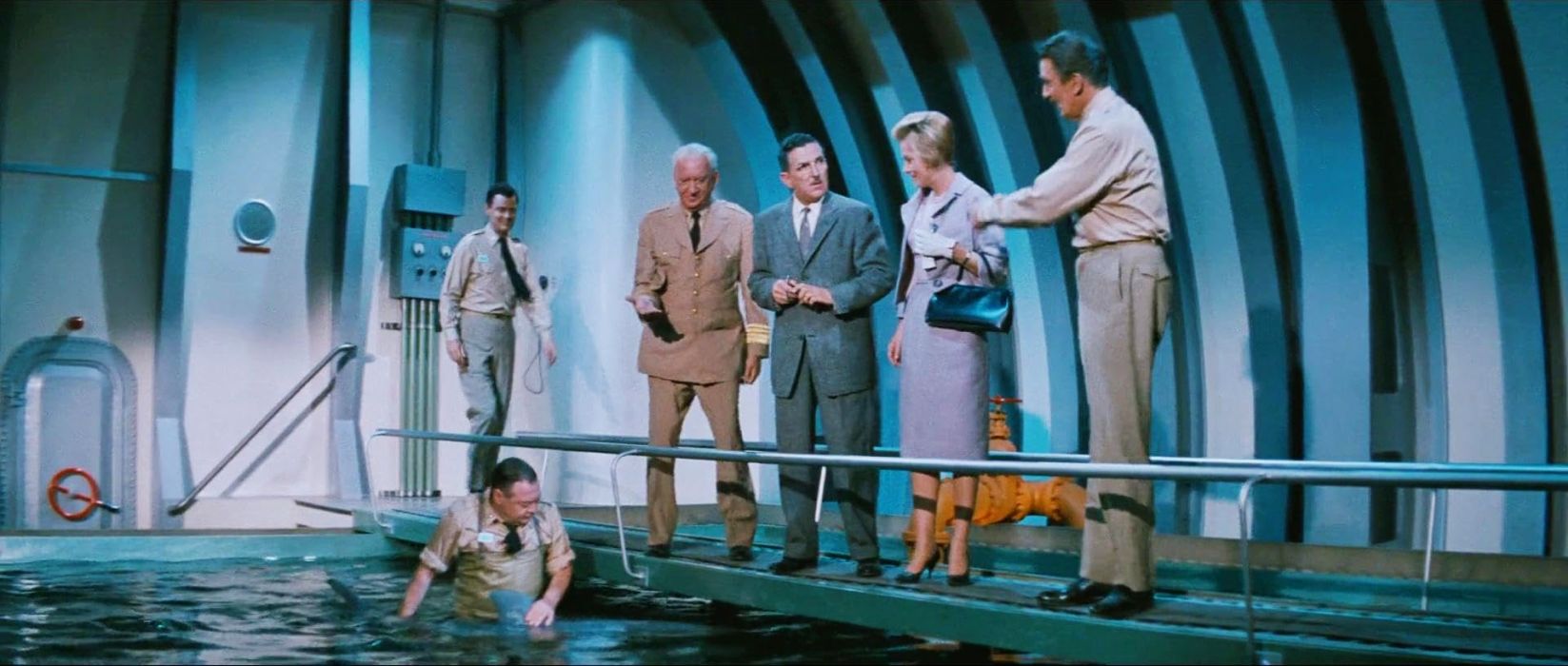
Allen’s name is now inextricably linked with the disaster movie genre, and this was his first foray into the field. But he had been involved in film production since the fifties. His directorial debut in 1953 was surprising in a couple of ways. Firstly, it was a documentary, The Sea Around Us, based on conservationist Rachel Carson’s book. Secondly, while largely assembled out of stock footage – a common feature of Allen’s early work – it won him the Academy Award for Best Documentary. Although Carson hated it so much, she refused to sell film rights to her work thereafter. Allen moved on to 20th Century Fox, and Voyage was his second film there, after The Lost World.
In this, there is a revolutionary new American submarine, the Seaview, designed by Admiral Harriman Nelson (Pidgeon), with Captain Lee Crane (Sterling) in charge. It’s undergoing tests in the Arctic, when the Van Allen radiation belts catch fire [to be fair, they had only been discovered a couple of years previously, so conceivably might have been made of dry straw]. The resulting global warming will reach lethal levels in mere weeks. This being America in the sixties, the solution is obvious: chuck a nuke at it. The rest of the world is unconvinced. But rather than wait for consensus, Nelson opts to rush to the calculated launch point in the Seaview, and get permission later. If at all. Guess nobody respected the UN back then either.
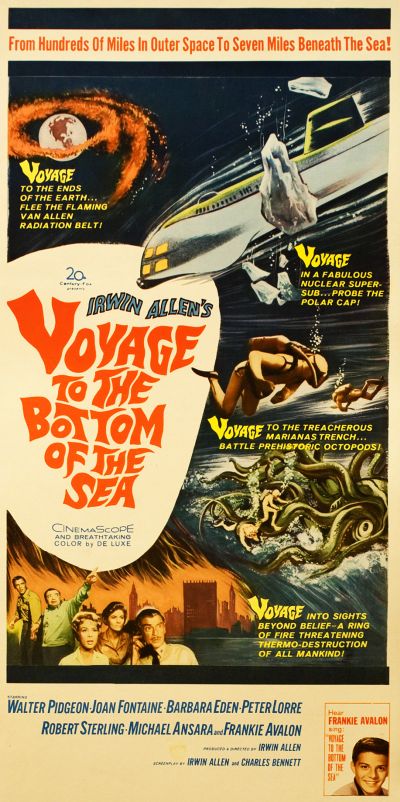 Submarines were hip at the time, the Nautilus having recently reached the North Pole. Which explains the lengthy tour around the vessel which opens proceedings. The Seaview is impressively capacious, allows smoking, has a frickin’ shark tank (top) and two women among the crew! Plus Frankie Avalon, who sings the theme, and does not much else. One of these things – not Avalon – may be significant later, in dealing with some of the people on board who are trying to stop the mission. For the threats here, are as much coming from inside the
 house submarine, as the mines, giant squid and hunter subs found outside. Allen recycled some of that footage – albeit in black and white – and the sets too, when he turned the idea into a TV series later in the decade.
I note both this and The Day The Earth Caught Fire, released just a few months later, use global warming as their threat, fifteen years before the term entered the lexicon. I think Earth does a better job, in part because you experience the disaster there. Here, it is described rather than seen, save for an ominously glowing sky. It’s easy to forget there’s an existential threat in the upper atmosphere when you are, indeed, at the bottom of the sea. But a good cast, also including Barbara Eden and Michael Ansara, keep things interesting enough. Though things like submarines and scuba diving are no longer quite as fascinating as the movie appears to believe.
Fail Safe (1964)
Rating: B+
Dir: Sidney Lumet.
Star: Dan O’Herlihy, Walter Matthau, Frank Overton, Henry Fonda.
Between this and Dr. Strangelove, it was quite the year for movies about the looming threat of nuclear war. Indeed, there was a bit of a plagiarism spat between the creators of the two films. It ended in Columbia, the producers of Strangelove, buying and releasing Fail Safe – but only putting it out after their own movie. Understandably, the box-office for a deadly serious take on the topic was chilled by the ridiculous farce of Strangelove which preceded it. But time has been kinder, and Fail Safe is now regarded as a classic of the genre. And rightfully so: while clearly informed by recent events like the Cuban missile crisis, this barely feels dated at all.
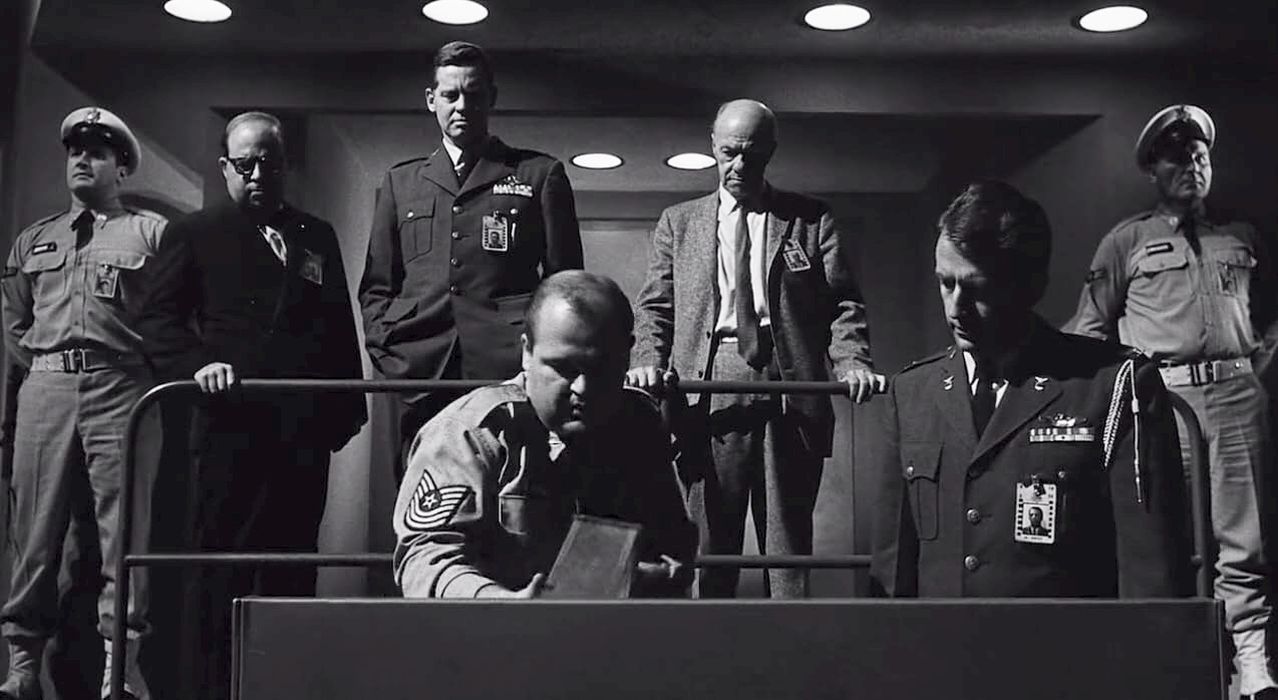
It unfolds after a technical glitch sends an American bomber group on an errant mission to drop their 20 megaton nukes on Moscow. Russian jamming prevents them from being able to contact their base and learn the truth; efforts by America to shoot them down also fail. It’s then up to the President (Fonda) to try and work with the Soviets to prevent things from escalating into all-out nuclear war. Around him are an ensemble cast, including military officers such as Brigadier General Black (O’Herlihy) and General Bogan (Overton), plus civilian advisors like the staunchly anti-Communist Professor Groeteschele (Matthau). This all unfolds in stark black-and-white, with no musical score at all: one was composed, but Lumet decided to go without it.
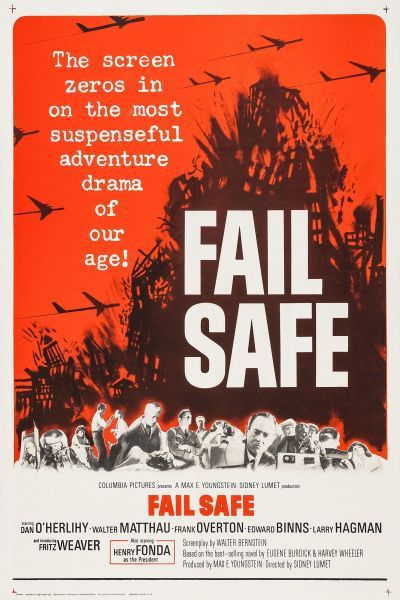 While it’s the scenario which drives things, there’s a lot to like about the characters, who are given depth in small but significant ways. Black, for instance, is troubled by a persistent dream of a bullfight. But is he the matador or the bull? Groeteschele – reportedly modelled on Henry Kissinger – is also a highly interesting figure, who advocates for war. Though when a woman comes onto him as a result, proclaiming “We all know we’re going to die, but you make a game out of it, a marvellous game that includes the whole world… You make death an entertainment,” he literally slaps her down (hey, it was the sixties!). The Professor replies, sarcastically, “I make death into a game for people like you to get excited about.” It’s all weirdly kinky.
The early sections are quite chatty. But once the bombers go off their position, that starts a relentlessly ticking clock which doesn’t stop until the end credits roll. I found myself increasingly invested, especially after the President made his decision about what to do if his aircraft delivered their payload [the President’s interpreter is played by a young Larry Hagman]. It was also notable how the Russians are not portrayed as “bad guys”; their leader wants to believe this is all a terrible accident, but “Sorry” isn’t really sufficient when you’ve nuked a city. There’s a disclaimer at the end from the military, saying “occurrences such as those depicted in this story cannot happen” – it was made without their co-operation. Yet I tend to think if World War III happens, it might well start with somebody going “Oops!”
Crack in the World (1965)
Rating: C-
Dir: Andrew Marton.
Star: Dana Andrews, Janette Scott, Kieron Moore, Alexander Knox.
There was a point in these films where it appears the solution to any issue was, “Chuck a nuke at it.” We already saw this with Voyage to the Bottom of the Sea, and this offers another, arguably still more ludicrous, example. Not least because this one was made after films like Fail Safe, which depicted the potential negative consequences of nuclear weapons. That gives this a naivete which is more annoying than charming. This unfolds in West Africa where Dr. Stephen Sorenson (Andrews) and wife Maggie (Scott) is trying to drill through the Earth’s crust, in order to tap magma for use in generating electricity. Only, the final barrier is proving impermeable. Any guesses how mankind might get through?
Despite the qualms of colleague Dr. Ted Rampion (Moore), a 10-megaton missile is fired at the problem. To the surprise of everyone bar Rampion, this goes pear-shaped, a hidden cache of hydrogen force-multiplying the explosion in a way only sixties scientists can hope to understand. The result starts a chain-reaction running around a fault-line in the planet’s crust which, if not stopped, will tear Earth apart. It’s to Rampion’s credit that the words “Told”, “you” and “so” do not escape his lips at any point. Further nuke-chucking only diverts the crack’s progress, sending it back towards the project’s base in East Africa. It’s 50/50 whether this or Stephen’s terminal cancer will prove to be the solution to the love triangle between him, Maggie and Ted.
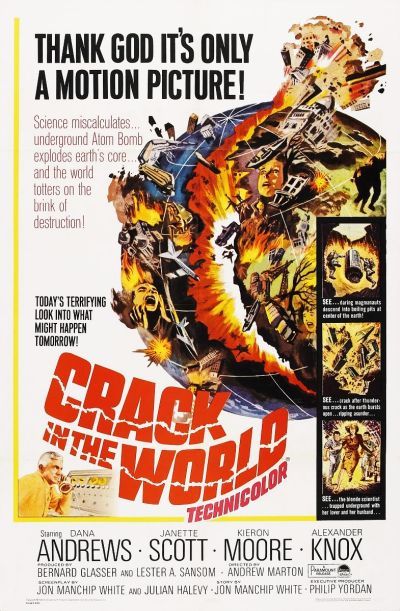 This demonstrates that all the disaster porn in the world, will have no emotional impact at all, if you aren’t able to care about the characters. Here, there are basically no everyday citizens. We are trapped in a circle of hell, populated entirely by boffins, bigwigs and military men with impressive mustaches. About the only time we see normal people, is on a train which plummets into the crack. But they’re all darkies, so clearly don’t matter. [I’d like to point out that Spain is not a very convincing stand-in for Tanzania] It also has lines like, “Kutamauan has been hit by a violent tremor and a tidal wave. Wiped out! Loss of life: seven thousand.” Oh, come on… Show, don’t tell!
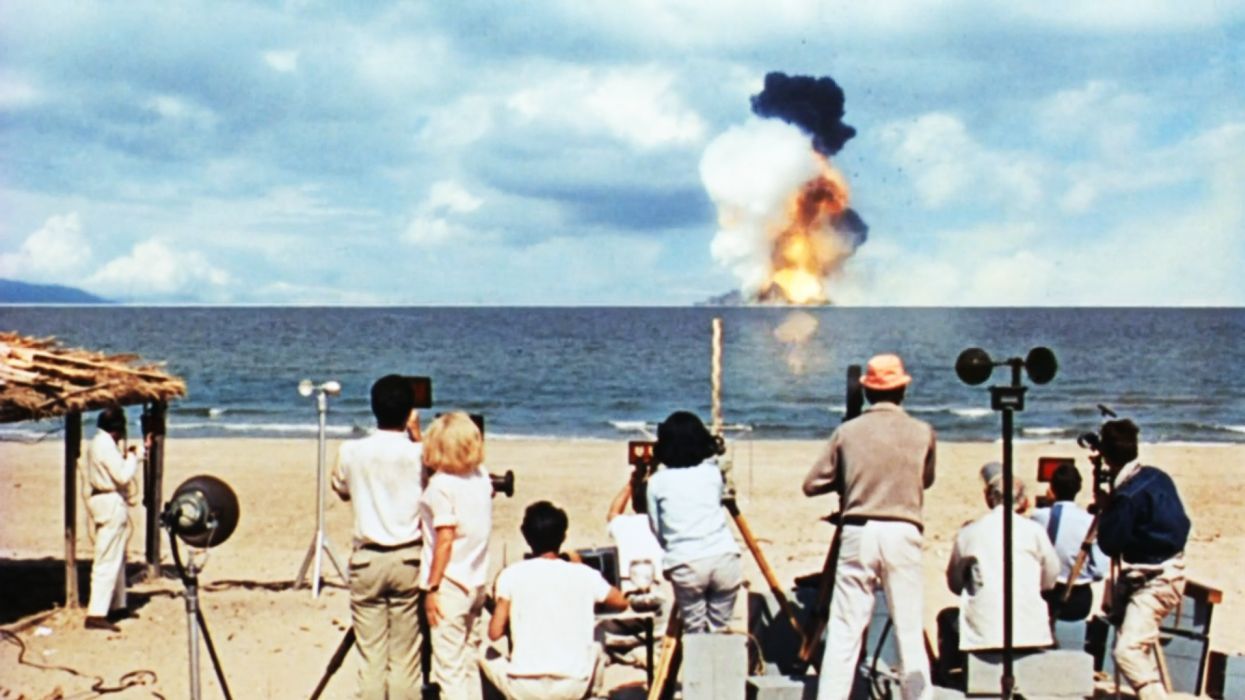
There are some moments of decent spectacle, mostly around the descent into a volcano with nuke #2. But when it is detonated, observed from a boat well off-shore (top), all I could think was, “Why are we seeing and hearing the explosions simultaneously?”, followed swiftly by, “My, that grainy stock footage of nuclear tests isn’t very well integrated.” Although some of the model work is good, the film also leans heavily on purchased footage of volcanic eruptions and galloping African wildlife, none of which is remotely convincing. While co-stars Andrews and Scott would subsequently get mentioned in Rocky Horror‘s song “Science Fiction,” both references are for their roles in other movies. This was apparently too dumb even for Richard O’Brien, and that’s saying something.