
Rating: B+
Dir: Sidney Lumet.
Star: Dan O’Herlihy, Walter Matthau, Frank Overton, Henry Fonda.
Between this and Dr. Strangelove, it was quite the year for movies about the looming threat of nuclear war. Indeed, there was a bit of a plagiarism spat between the creators of the two films. It ended in Columbia, the producers of Strangelove, buying and releasing Fail Safe – but only putting it out after their own movie. Understandably, the box-office for a deadly serious take on the topic was chilled by the ridiculous farce of Strangelove which preceded it. But time has been kinder, and Fail Safe is now regarded as a classic of the genre. And rightfully so: while clearly informed by recent events like the Cuban missile crisis, this barely feels dated at all.
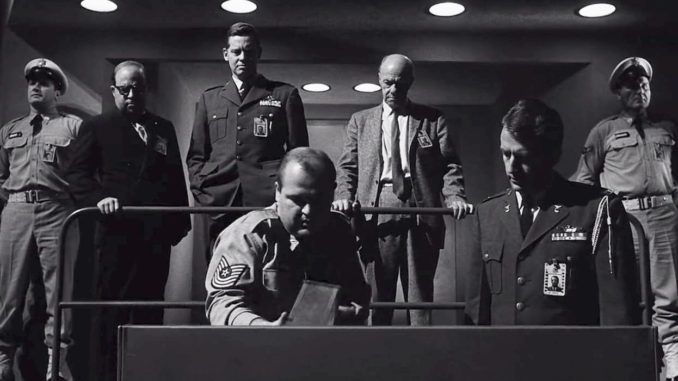
It unfolds after a technical glitch sends an American bomber group on an errant mission to drop their 20 megaton nukes on Moscow. Russian jamming prevents them from being able to contact their base and learn the truth; efforts by America to shoot them down also fail. It’s then up to the President (Fonda) to try and work with the Soviets to prevent things from escalating into all-out nuclear war. Around him are an ensemble cast, including military officers such as Brigadier General Black (O’Herlihy) and General Bogan (Overton), plus civilian advisors like the staunchly anti-Communist Professor Groeteschele (Matthau). This all unfolds in stark black-and-white, with no musical score at all: one was composed, but Lumet decided to go without it.
 While it’s the scenario which drives things, there’s a lot to like about the characters, who are given depth in small but significant ways. Black, for instance, is troubled by a persistent dream of a bullfight. But is he the matador or the bull? Groeteschele – reportedly modelled on Henry Kissinger – is also a highly interesting figure, who advocates for war. Though when a woman comes onto him as a result, proclaiming “We all know we’re going to die, but you make a game out of it, a marvellous game that includes the whole world… You make death an entertainment,” he literally slaps her down (hey, it was the sixties!). The Professor replies, sarcastically, “I make death into a game for people like you to get excited about.” It’s all weirdly kinky.
The early sections are quite chatty. But once the bombers go off their position, that starts a relentlessly ticking clock which doesn’t stop until the end credits roll. I found myself increasingly invested, especially after the President made his decision about what to do if his aircraft delivered their payload [the President’s interpreter is played by a young Larry Hagman]. It was also notable how the Russians are not portrayed as “bad guys”; their leader wants to believe this is all a terrible accident, but “Sorry” isn’t really sufficient when you’ve nuked a city. There’s a disclaimer at the end from the military, saying “occurrences such as those depicted in this story cannot happen” – it was made without their co-operation. Yet I tend to think if World War III happens, it might well start with somebody going “Oops!”