
Rating: C+
Dir: August Blom.
Star: Olaf Fønss, Ebba Thomsen, K. Zimmerman, Thorleif Lund.
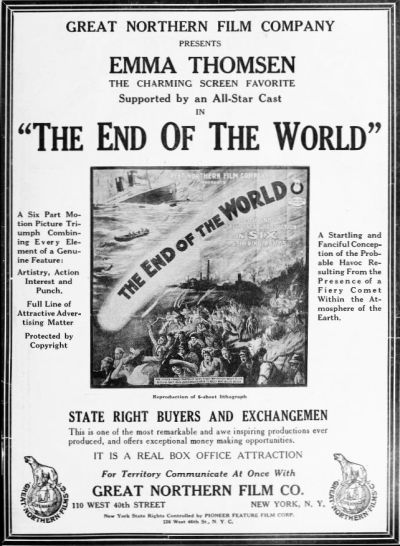
This is likely the first feature-length disaster movie ever made. It was inspired largely by the passing of Halley’s Comet through the solar system in 1910 – an event which caused some panic and fears of annihilation, after the press misrepresented the discovery of cyanogen gas in the comet’s tail. What I found particularly interesting, was how many of the common tropes of the modern disaster movie, seem to have sprung, fully-fledged in this initial example. It starts off with the almost obligatory mixing of everyday drama with the disaster porn. Here, the early going is mostly concerned with the romantic entanglements of Dina (Thomsen), the daughter of a mine manager. She falls for, elopes with (and presumably marries) mine owner Frank Stoll (Fønss), though the relationship is not a particularly happy one.
Years later, a new comet is discovered by Professor Wisemann (Zimmerman). His prediction that it could enter the Earth’s atmosphere leads to concern as the comet approaches, gradually getting larger and more prominent in the sky during the film’s outdoor scenes. Stoll is also the Professor’s cousin, which gives him the inside scoop on the upcoming disaster. In another touchstone of the genre, the truth is being kept from the press to avoid causing widespread panic, allowing Stoll to manipulate the stock market to his benefit. He then returns to Dina’s home town, and prepares a bunker deep in the mine, where he and his chosen companions can ride things out. “If we are saved,” he says, “It will be we who will found the new world, and be its masters.”
 However, this brings him back into conflict with Dina’s ex-boyfriend Flint (Lund), who still harbours a grudge. He whips up the population unto a revolutionary fervour (“Let us take back what the rich have stolen from us!” must have hit differently, the year before the Russian Revolution), while Stoll, in rather poor taste, holds a pre-apocalypse party. This includes an interpretive dance routine by Dina, as the first embers from the comet begin to fall on the town. But, as happens so often over the century-plus that follows, the rest of humanity is an equal threat, Flint’s mob attacking Stoll’s mansion.
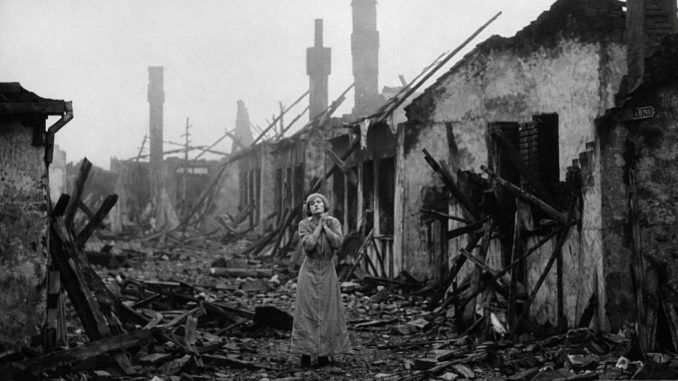
Naturally, even this first disaster film realized audiences needed a pay-off, and the final twenty minutes deliver in effective fashion. The sky darkens as cometary fragments pound the earth, toxic gases are released, and the ocean levels rise dramatically. Most of the major characters meet unpleasant fates, and we instead follow Dina’s sister Edith (Johanne Fritz-Petersen), as she wanders through the destruction (top): there’s some genuinely impressive work here, such as a full-scale set of a flooded town. I do suspect the earlier suggestion this is a punishment from God reflects the maker’s intentions, the virtuous Edith avoiding the fate of her slutty sibling. This end of the world has one final element in common with its modern descendants: the best part is undeniably the destruction.