
Rating: C+
Dir: Irwin Allen.
Star: Walter Pidgeon, Robert Sterling, Peter Lorre, Joan Fontaine.
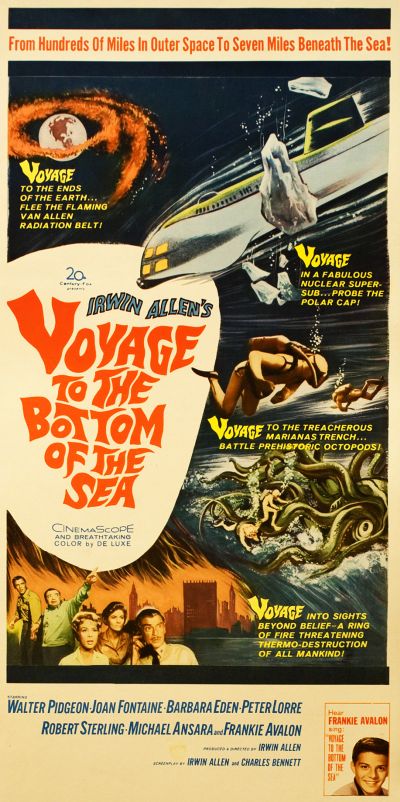
Allen’s name is now inextricably linked with the disaster movie genre, and this was his first foray into the field. But he had been involved in film production since the fifties. His directorial debut in 1953 was surprising in a couple of ways. Firstly, it was a documentary, The Sea Around Us, based on conservationist Rachel Carson’s book. Secondly, while largely assembled out of stock footage – a common feature of Allen’s early work – it won him the Academy Award for Best Documentary. Although Carson hated it so much, she refused to sell film rights to her work thereafter. Allen moved on to 20th Century Fox, and Voyage was his second film there, after The Lost World.
In this, there is a revolutionary new American submarine, the Seaview, designed by Admiral Harriman Nelson (Pidgeon), with Captain Lee Crane (Sterling) in charge. It’s undergoing tests in the Arctic, when the Van Allen radiation belts catch fire [to be fair, they had only been discovered a couple of years previously, so conceivably might have been made of dry straw]. The resulting global warming will reach lethal levels in mere weeks. This being America in the sixties, the solution is obvious: chuck a nuke at it. The rest of the world is unconvinced. But rather than wait for consensus, Nelson opts to rush to the calculated launch point in the Seaview, and get permission later. If at all. Guess nobody respected the UN back then either.
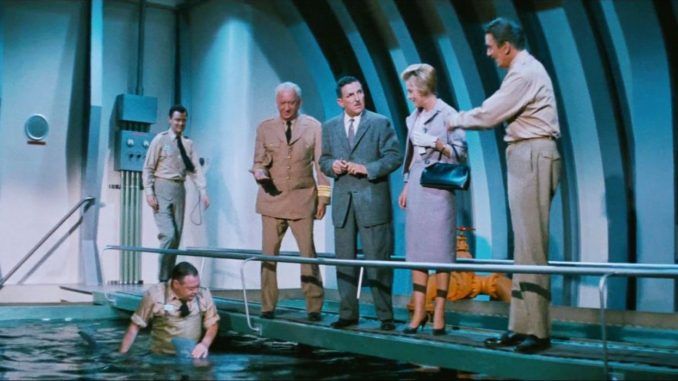
 Submarines were hip at the time, the Nautilus having recently reached the North Pole. Which explains the lengthy tour around the vessel which opens proceedings. The Seaview is impressively capacious, allows smoking, has a frickin’ shark tank (top) and two women among the crew! Plus Frankie Avalon, who sings the theme, and does not much else. One of these things – not Avalon – may be significant later, in dealing with some of the people on board who are trying to stop the mission. For the threats here, are as much coming from inside the
 house submarine, as the mines, giant squid and hunter subs found outside. Allen recycled some of that footage – albeit in black and white – and the sets too, when he turned the idea into a TV series later in the decade.
I note both this and The Day The Earth Caught Fire, released just a few months later, use global warming as their threat, fifteen years before the term entered the lexicon. I think Earth does a better job, in part because you experience the disaster there. Here, it is described rather than seen, save for an ominously glowing sky. It’s easy to forget there’s an existential threat in the upper atmosphere when you are, indeed, at the bottom of the sea. But a good cast, also including Barbara Eden and Michael Ansara, keep things interesting enough. Though things like submarines and scuba diving are no longer quite as fascinating as the movie appears to believe.