
Rating: C+
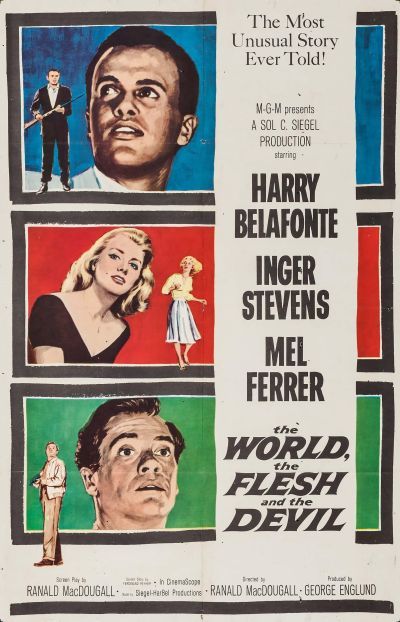
Dir: Ranald MacDougall
Star: Harry Belafonte, Inger Stevens, Mel Ferrer
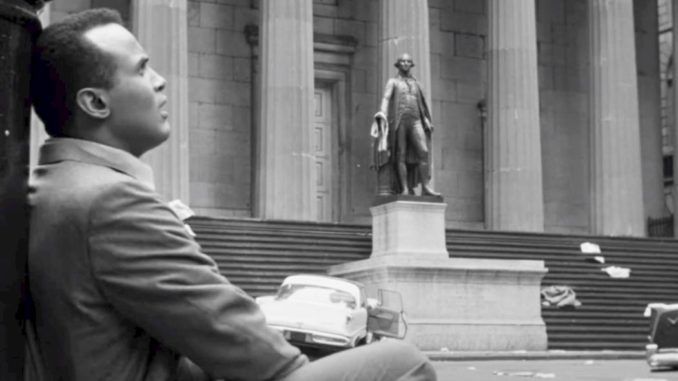
This has a great first half, let down by an underwhelming second half. You can tell this means well. But it appears it didn’t end up satisfying anyone at the time, and certain elements of it have not aged well. In this case, the apocalypse happens entirely off-screen. Mine engineer Ralph Burton (Belafonte) is trapped by a cave-in deep underground, and it’s several days before he is able to dig himself out. Returning to the surface, he finds nobody around. Convenient newspapers, with headlines like “Millions Flee From Cities! End Of The World” inform him that clouds of radioactive sodium wiped out just about everyone while he was underground, before decaying into harmless material.
He heads to New York in search of survivors. While initially unsuccessful, his technical knowledge allows him to restore electrical power to one building, for example. Eventually, he encounters another person, Sarah Crandall (Stevens), who survived in a decompression chamber. Their relationship is initially cordial, although Ralph chooses to remain at a distance – they live in different apartment blocks. The film does a remarkable job of depicting a deserted New York, with Ralph wandering through a deserted Times Square, which feels an influence on what 28 Days Later did in London. A radio broadcast says the city was “completely evacuated” before the radiation arrived. Not that it helped – but this does manage to get round the pesky “Shouldn’t there be eight million corpses?” question you might have been asking.
 Then Sarah calls herself “Free, white, and 21”, and it all goes pear-shaped. Ralph, you see, is black. The film suddenly goes from being refreshingly free of race as an issue, to being entirely about race as an issue. I get that the late fifties was a different era, still five years before the Civil Right Act. But it appears this was also made before the invention of subtlety. A third survivor, Benson Thacker (Ferrer) shows up, and the inevitable competition for Sarah’s affections becomes much more of its time. To quote Ralph, “If you’re squeamish about words, I’m colored. And if you face facts, I’m a negro, and if you’re a polite southerner, I’m a negra, and I’m a nigger if you’re not.”
What if you don’t care, there being considerably more pressing, apocalypse-shaped matters to hand? And Ferrer is half-Cuban too. The Stockholm-born Stevens is the only person here who is unequivocally white. While you’re figuring out all this, things collapse into Ralph and Benson hunting each other through the streets of New York. An especially risible turning point is where one of them reads a Bible quote on the wall opposite the UN – the one about beating swords into ploughshares – and unilaterally decides to give up. Probably counts as the UN’s biggest ever contribution to peace. It finishes in a way which I suspect was intended to be uplifting – the final caption is not “The End” but “The Beginning” – and likely failed to convince anybody.