
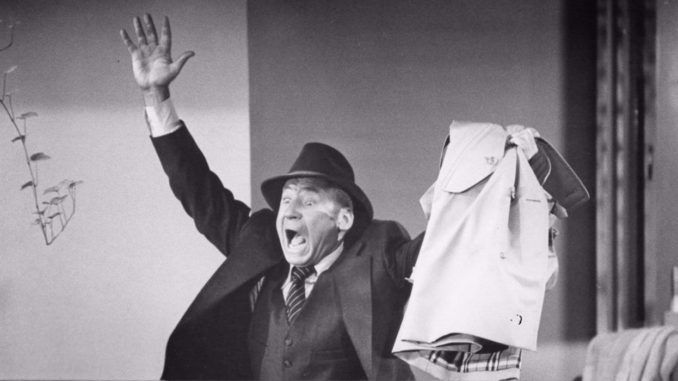
The words “national treasure” get used a lot, and there are probably few who genuinely deserve it. In Britain, we have the venerable David Attenborough and Dame Judi Dench. On the other side of the Atlantic, it’s a label which could be applied to Dolly Parton, the Grand Canyon and, I would suggest, to Mel Brooks. Born Melvin James Kaminsky in Brooklyn, he decided he would go into show business at the age of nine, after seeing a theatre performance of Anything Goes, and made his debut as a comedian when he was 16. He served as a combat engineer in the Army during World War II, before being honourably discharged in 1946.
Three years later, his friend Sid Caesar hired Brooks as a writer, beginning a career in show-business which is now in its eighth decade. As a performer, Mel achieved renown working with Carl Reiner. In particular, their “2000 Year Old Man” routine ended up becoming a comedy LP which sold over a million copies. He created the successful TV series Get Smart, with Buck Henry and later in the sixties directed his first feature film, The Producers. He won an Oscar for the screenplay, beating out 2001: A Space Odyssey. [Brooks is is one of just 22 people to have completed the “EGOT” – winning an Emmy, a Grammy, an Oscar, and a Tony]
The following decade likely saw Brooks at the peak of his fame. In 1974, he had the second- and third-biggest movies at the North America box-office, Blazing Saddles and Young Frankenstein trailing only The Towering Inferno. But he helped to produce a number of non-comedy films, though his company Brooksfilms, including The Elephant Man, 84 Charing Cross Road, and David Cronenberg’s remake of The Fly. Mel also was instrumental in turning The Producers – a film about staging a musical on Broadway – into a musical on Broadway, where it ran for more than six years and 2,500 performances.
The comedy legend turns 100 years old today, and remains active in a way which can only be admired. Next June will see the release of a sequel to Spaceballs (cunningly entitled, Spaceballs: The New One), in which Brooks reprises his twin roles as Yogurt and President Skroob. To mark Mel reaching three digits in age, we honour – for some loose definition of that term – him by reviewing all eleven feature movies which he directed.
The Producers (1967)
Rating: B
Dir: Mel Brooks.
Star: Zero Mostel, Gene Wilder, Kenneth Mars, Dick Shawn.
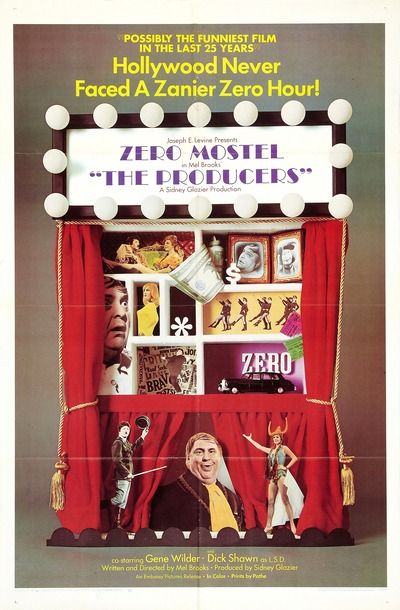
Given the concept, this unsurprisingly took a while to get made. Its origins date back to 1961, with Carry On star Kenneth Williams “under consideration for the leading role” according to the New York Times. A slew of studios and independent producers turned it down over the following years, before funding could be secured. At one point, Peter Sellers was going to play the role of neurotic accountant turned Broadway producer Leo Bloom, and Dustin Hoffman that of Nazi playwright Franz Liebkind. Would certainly have been different from Wilder and Mars. Though in general, it’s the parade of crazy characters and escalating lunacy which makes this a comedy classic. Remarkable, considering Brooks had never directed anything before.
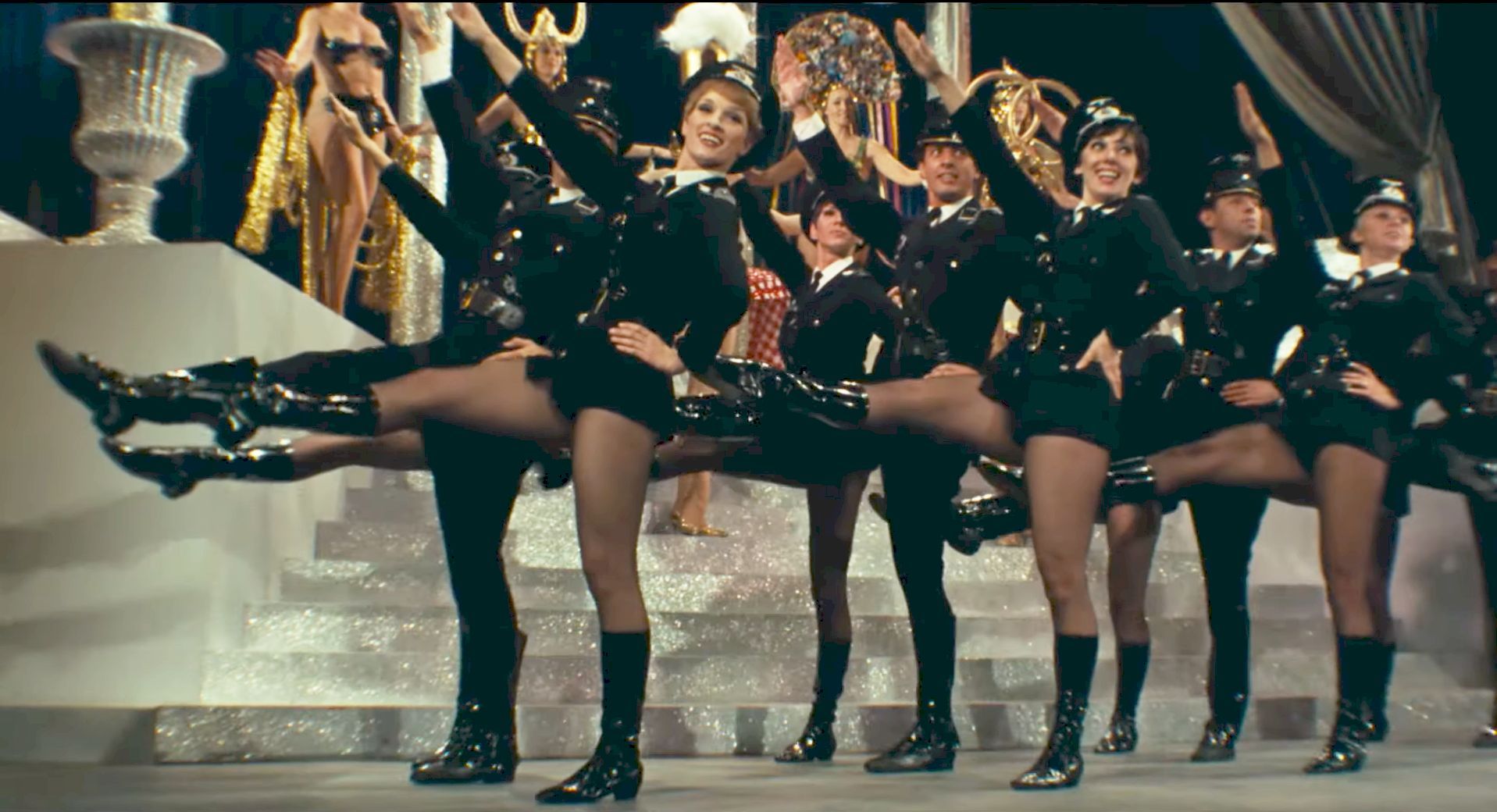
Former top-tier producer Max Bialystock (Mostel) is now reduced to seducing old ladies for investments. An by remark by Bloom (Wilder) gives him an idea. Oversell percentage points of profit, but if the play flops, nobody needs to get paid. To ensure that happens, they sign Liebkind (Mars) and his play, Springtime for Hitler: A Gay Romp with Adolf and Eva at Berchtesgaden. They then hire the stage’s worst director (a transvestite character inspired by Ed Wood), and get a hippie (Shawn) to play Hitler. Despite spectacularly bad taste Berkeley-esque musical numbers (“We’re marching to a faster pace. Look out, here comes the master race!”), the production is perceived as satire, and gets rave reviews. More extreme measures are required. Like blowing up the theatre.
 This may have been Brooks’s first film, but the basic principles of his comedy stylings are already clearly apparent. Parody, a mix of high-brow and low-brow humour, and a willingness to go after sacred cows with a chainsaw. This goes from quoting Franz Kafka, to an extended sequence of a faux “Swedish” secretary (played by the New Jersey born Lee Meredith) shaking her boobs. The willingness to make Nazi jokes is certainly laudable, though I’m not sure ridicule has ever brought down a dictator. Especially one already dead for over twenty years. This also came out more than two years after Hogan’s Heroes made the Third Reich a figure of fun on network television, so is not as groundbreaking as some claim.
There remains a lot to enjoy here, and I laughed out loud a lot. No, really: a lot. From little things, like Max’s cupboard filled with framed photos of his geriatric lady friends, or the weirdness of director Roger De Bris. That gay stereotype would probably be the most offensive thing to modern sensitivities. But it’s the unrepentant excess of Springtime For Hitler which cranks everything up to eleven. Much like the Bialystock and Bloom’s play, the movie was not well-received at first. It took a public appeal by Sellers to get it released at all, and barely broke even on its first run. Initial reviews were bemused, renowned critic Pauline Kael calling it “amateurishly crude.” Time has been kinder: that phrase now seems a badge of honour.
The Twelve Chairs (1970)
Rating: C
Dir: Mel Brooks.
Star: Ron Moody, Frank Langella, Dom DeLuise, Andreas Voutsinas.
I’m not going to lie. Neither I nor Chris had even heard of this entry in the Brooks filmography. Despite coming between the twin landmarks of The Producers and Blazing Saddles, this was a critical and commercial flop, and has almost entirely been forgotten. The number of IMDb ratings proves this. Producers? 64,000. Saddles? 163,000. This? A mere 7,600. And, having watched it… Yeah, I can kinda see why. It’s based on a Russian novel by Ilf and Petrov, published in 1928, and adapted to film more than a dozen times. Mostly in Russian, but also including Sharon Tate’s last movie, and George Formby film Keep Your Seats, Please, in which he performed his signature song, When I’m Cleaning Windows.
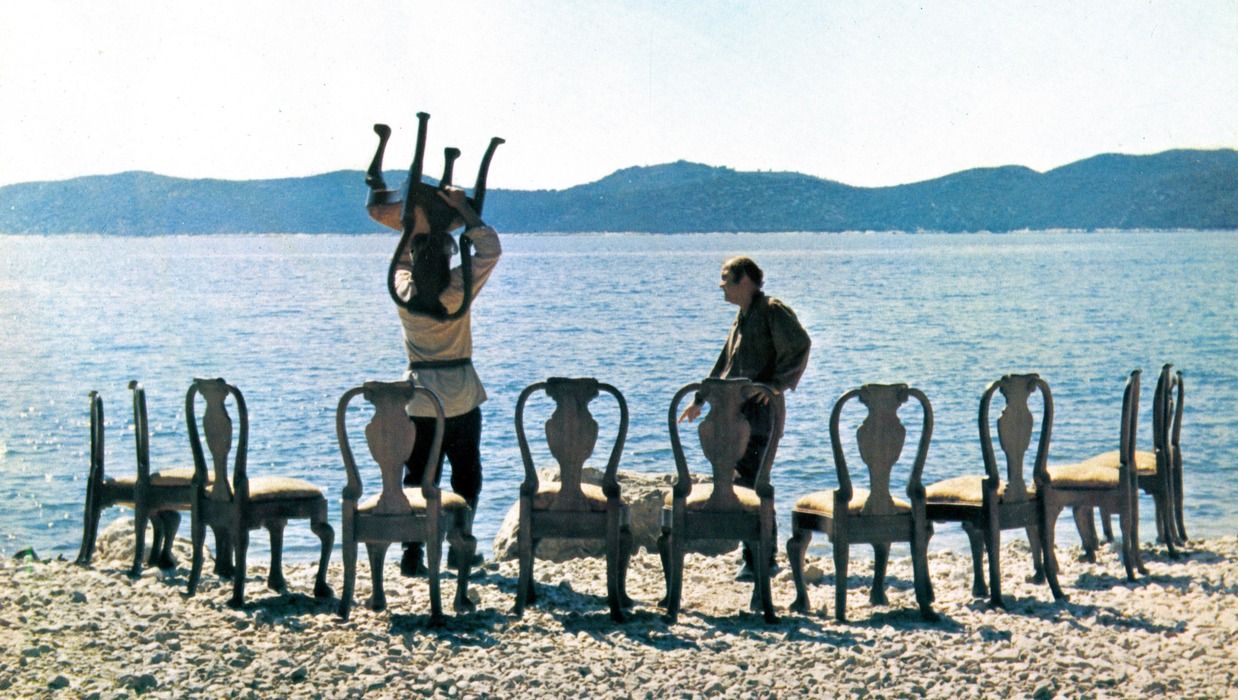
The basic premise is simple. Ippolit Vorobyaninov (Moody) overhears his mother-in-law confess on her deathbed about a fortune in jewels. This was hidden from the Bolsheviks, by being sewn into the seat of one of a set of a dozen chairs. Ippolit teams up with suave con-man Ostap Bender (Langella), to find the chairs, which were seized by the State after the Revolution. But they have a rival in the hunt, Father Fyodor (DeLuise), the priest who heard the confession. The resulting chase criss-crosses the entire Soviet Union, because the set has been split up. Though Brooks did change the novel’s ending, which originally saw Ippolit murder Ostap, to avoid the risk of sharing the loot. Ah, Russian literature: never change.
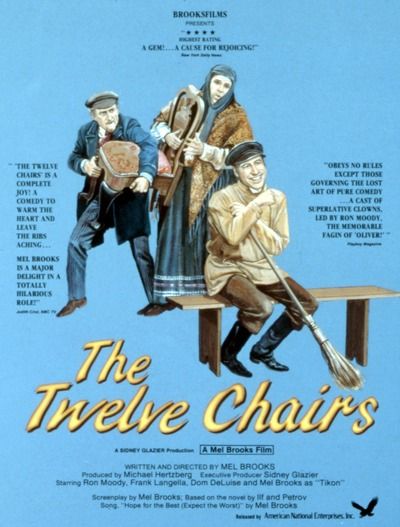 This generally fatalistic tone is captured in the movie’s opening song, a cheery ditty titled, “Hope for the best, expect the worst.” But I think the major problem is, the typical audience has no context in which to place this. This wasn’t Broadway or the Wild West. This was Communist Russia between the World Wars. I know I have nothing, and it’s quite possible the jokes simply went over my head. Oh, there were a few I got. The street name with Trotsky crossed out. Or when Ostap, trying to track the chairs, has to navigate the maze of Soviet-era bureaucracy. He goes past the “Bureau of Bureaus and Dressers”, eventually ending up in the Kafka-esque “Bureau of Furniture Not Listed in Other Bureaus.”
Chris thought it felt like a Carry On movie: Carry On Up the Revolution, perhaps. Oddly, she mentioned this in a scene featuring Diana Coupland, who would go on the next year to start playing Sid James’s wife in Bless This House. If I squint, I could imagine James in the Moody role, with Jim Dale as Langella, and Kenneth Connor replacing DeLuise. But beyond the occasional broader, slapstick elements – handled particularly well by DeLuise – this feels considerably more cerebral than the rest of Brooks’s work. Sex doesn’t raise its head either, save a brief moment where Ostap pretends to be giving a woman artificial respiration, in order to escape her husband. I’m guessing that probably wasn’t in the original Russian novel either. While Brooks considers it one of the films he’s most proud of, I suspect most viewers will be less impressed.
Blazing Saddles (1974)
Rating: B-
Dir: Mel Brooks.
Star: Cleavon Little, Gene Wilder, Harvey Korman, Madeline Kahn.
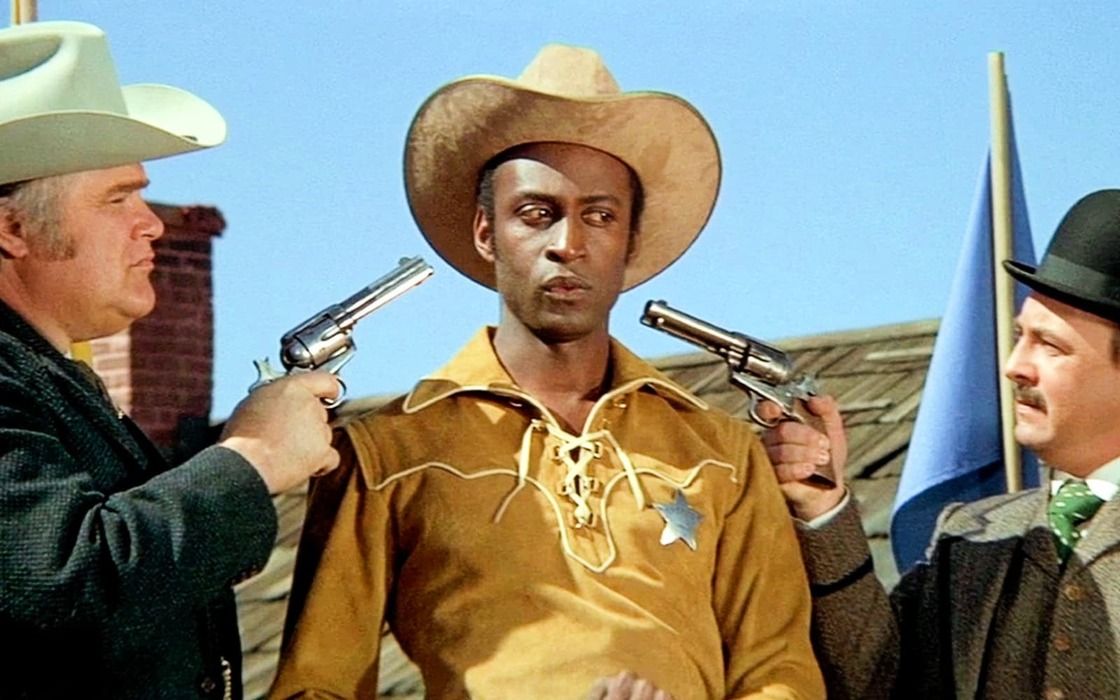
This is the quintessential “They couldn’t make this any more” film, but Brooks’s opinion on the matter seems to have changed over time. In 2017, the BBC asked whether his films could be made today. He answered, “Maybe a few. But never Blazing Saddles, because we have become stupidly politically correct, which is the death of comedy.” Earlier this year though, the Hollywood Reporter posed the same question. “Sure… There were so many different things in Blazing Saddles that were in questionable taste, but who cares?” Well, a lot of people, apparently. I watched this the day after a major fuss over the use of That Word at the BAFTAs. We’ve also seen teachers fired for reading That Word aloud from books.
Context and meaning are, apparently, no longer a defense, and nuance is dead. Though you might be surprised how little That Word is actually used here: only thirteen times, compared to 114 times in Django Unchained. The problem is, it overshadows the rest of the film, which is a broad parody of the Western genre. Bart (Little) is sent to Rock Ridge as the new sheriff. He has been set up to fail by the territory’s crooked AG Hedley Lamarr (Korman), who wants to force the residents out as part of a land-grab. But with the help of alcoholic gunslinger the Waco Kid (Wilder) and his own wits, Bart is able to overcome the townfolks’ racial prejudice and defeat Lamarr’s schemes.
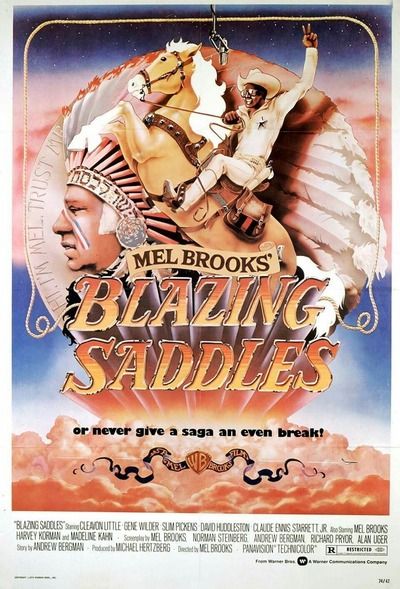 This swings wildly from remarkably smart, to almost impressively stupid. The campfire fart-fest might be the most well-known scene, but I kinda stopped finding flatulence funny at around age thirteen. So that is the comedy equivalent of flogging a dead horse. Far better are things like the glorious musical number of Lili Von Shtupp (Kahn), called “I’m Tired”. Like a lot of other comedy writers, e.g. the South Park guys, it seems like Brooks is a frustrated musical creator. Kahn got an Oscar nomination in the Best Supporting Actress category – ironic, given Korman says at one point he is “risking an almost certain Academy Award nomination for Best Supporting Actor.” Few films break the fourth wall as often, or as effectively.
Most memorably might be the finale, where a mass brawl breaks out around the Warner studio backlot, interrupting a musical number being filmed on another set. I do wonder how this might all have played, had Brooks got his original choice of Richard Pryor, rather than Little. [Wilder also took over after shooting started, replacing Gig Young, who was too drunk to perform adequately] It would probably have been rather more abrasive and confrontational: Little instead has a hopeful innocence about him, and a belief in mankind’s innate goodness that’s quite endearing. Indeed, the whole movie is inherently optimistic, showing that the entrenched racism of the Rock Ridge inhabitants is learned rather than innate, and can be overcome – admittedly with almost facile ease in this case.
Young Frankenstein (1974)
Rating: B+
Dir: Mel Brooks.
Star: Gene Wilder, Marty Feldman, Peter Boyle, Teri Garr.
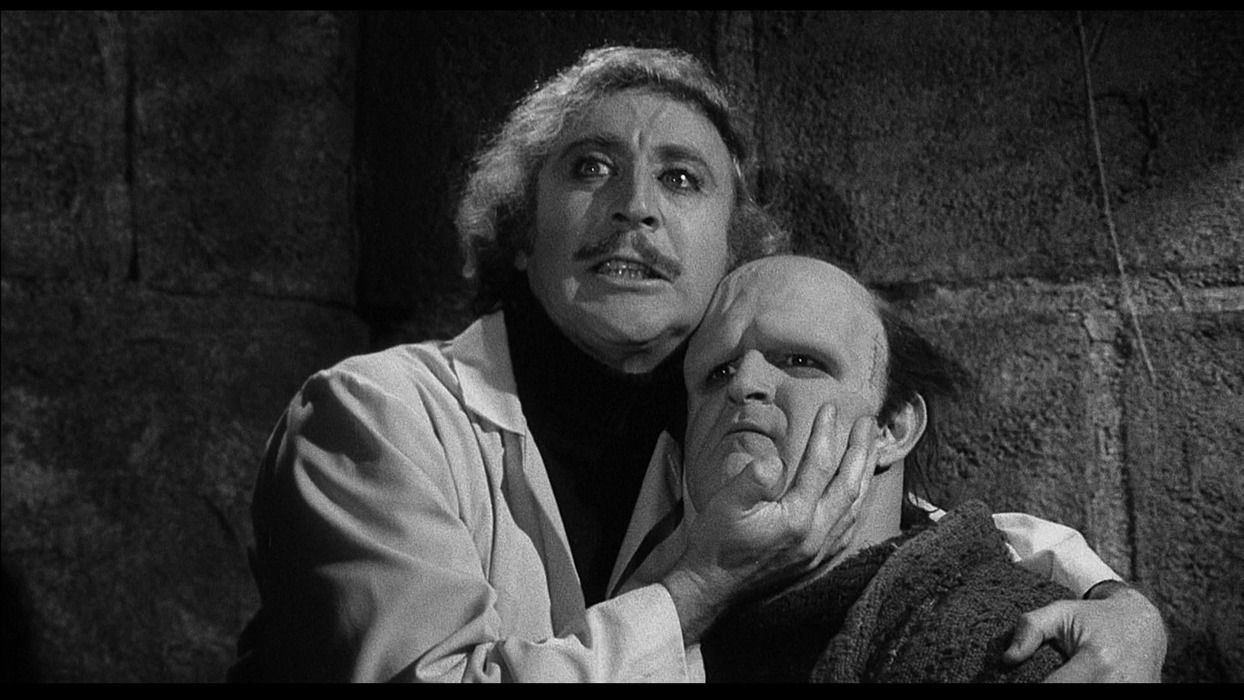
I’m just glad I watched this after reviewing many of the classic Universal movies for 31 Days of Vintage Horror. Because this deconstructs the myth of Frankenstein, in much the same way Monty Python and the Holy Grail does Arthurian legend. Not quite as relentlessly, mind you. Indeed, there are a number of points where Dr. Frederick Frankenstein (Wilder) could be appearing in a perfectly straight entry in the franchise. I mean, speeches such as: “Tonight, we shall hurl the gauntlet of science into the frightful face of death itself. Tonight, we shall ascend into the heavens. We shall mock the earthquake. We shall command the thunders, and penetrate into the very womb of impervious nature herself.” Close enough to Shelley.
There’s no question Brooks loves the films which this is a parodying, and does so with a huge amount of affection, including using the same lab equipment as James Whale’s Frankenstein. There are points where this may actually be better. Igor (Feldman) is a more-rounded character than any of the genuine movies: “It’s pronounced EYE-gor”. The monster (Boyle), too, is arguably more sympathetic. Witness his breaking the fourth wall and staring at the audience for help, when the little girl by the well asks him, “Nothing left. What shall we throw in now?” Notably, he does not go there, unlike his predecessor. So, while this is comedy, often of the most riotous kind, it’s not so far from being perfectly serviceable when taken seriously. Probably should remove the Putting on the Ritz number, admittedly.
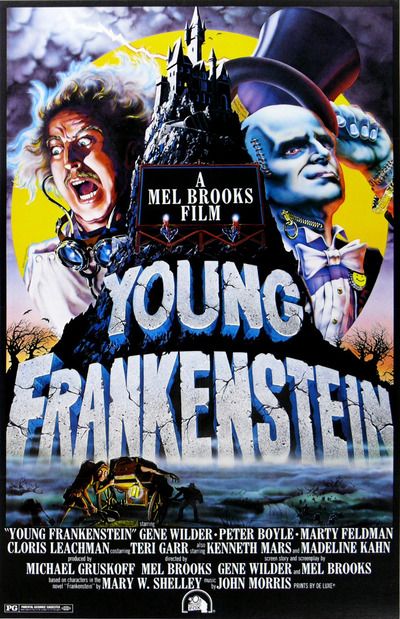 But there are any number of good reasons why this is the director’s highest-rated movie on the IMDb, and among the top comedies of the seventies. I’d say, it trails only Grail there, and both are similarly quotable. Just ask Aerosmith, who came up with the title of their best-known song, Walk This Way, after seeing this film in Times Square. What impressed me most, is its balance between visual and verbal gags, sometimes combining both in the same scene. Though I did feel like it lost a little pace after the glorious scene, lifted directly from Bride of Frankenstein, where the monster visits the blind woodsman, played surprisingly by Gene Hackman.
While Wilder is front and centre, the supporting cast are uniformly excellent. Feldman is a real standout, and it makes you wonder what he might have done, save his untimely early death. But the women – not just Garr and her knockers, Madeline Kahn and Cloris Leachman as well – are almost as impeccable. Though, for whatever reason, I think I laughed hardest at Inspector Kemp, with his false arm of 1,001 uses. This is the second time Kenneth Mars has stolen the show in a Brooks movie, after his turn as Nazi playwright Franz Liebkind in The Producers. It’s all almost entirely glorious, and will certainly ensure you won’t be able to watch the classics in quite the same way again. Or sing Putting On The Ritz either.
Silent Movie (1976)
Rating: C+
Dir: Mel Brooks.
Star: Mel Brooks, Marty Feldman, Dom DeLuise, Bernadette Peters.
This is basically the equivalent of a boxer choosing to fight with one hand tied behind his back. The weapon of verbal humour is removed from the arsenal, with Brooks looking to go back to the days of silent comedy. But it’s one thing to make a film without dialogue, because the technology doesn’t exist for sound yet. It’s another to surrender the option voluntarily, as he chooses to do here. While the visual side has always been a significant part of his comedy, so has witty verbal repartee. While I respect the effort to make a movie under a self-imposed limitation, I didn’t find the results as effective as those Brooks made with both hands free.
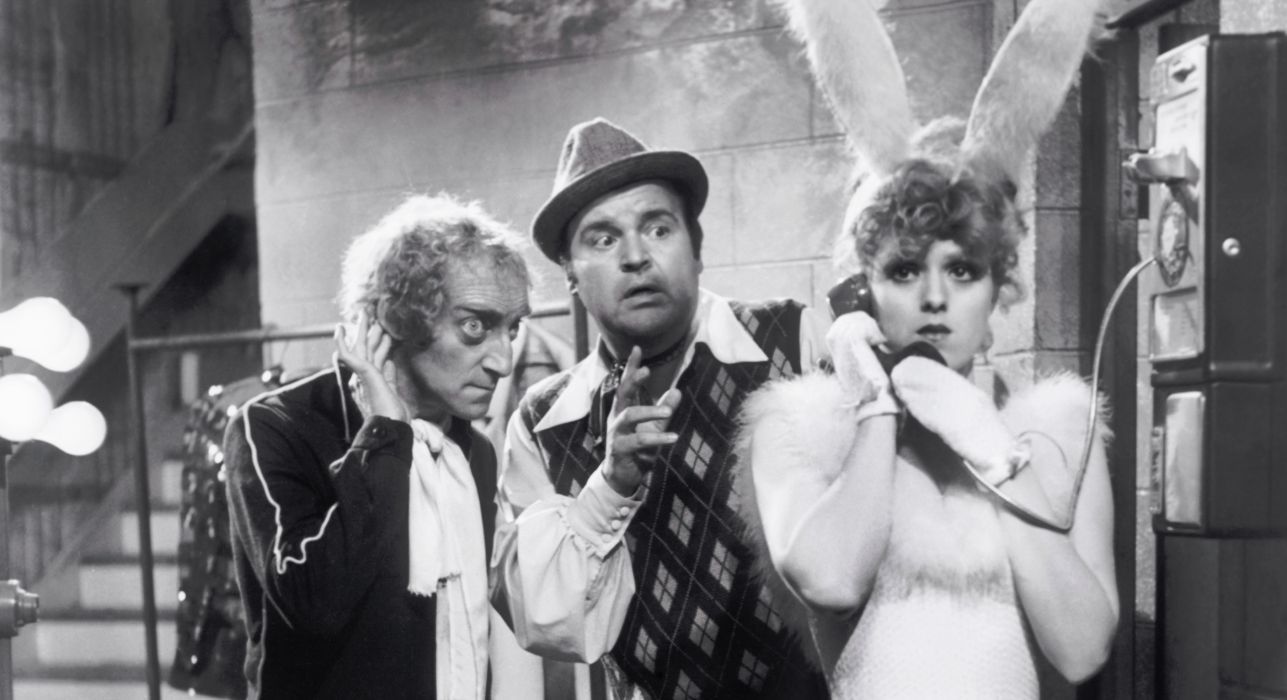
I also found it a bit self-referential for my tastes. For it unfolds in the world of Hollywood, where director Mel Funn (Brooks) is trying to get his own silent movie made, with the help of sidekicks Marty Eggs (Feldman) and Dom Bell (DeLuise). They get backing from Big Picture Studios, only if they can bring on board some big names. Cue cameos from Burt Reynolds, James Caan, Paul Newman, Liza Minnelli, and Mrs. Brooks, Anne Bancroft. [There’s also a pre-fame Erik Estrada] Plus, most famously, Marcel Marceau: the renowned mime gets the sole spoken word in the movie, responding to Mel’s offer with an emphatic “Non!” But conglomerate Engulf & Devour want to sabotage the production, fearing a successful film could save Big Picture from their takeover bid.
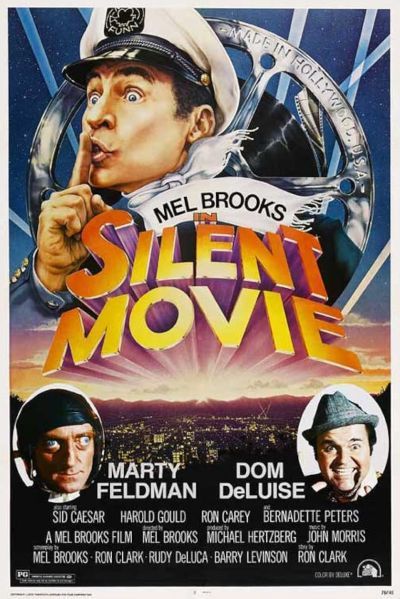 There are certainly jokes here. Some of them are funny. My favourite was the hospital monitor which turned into a Pong game. I had to check whether they existed in 1976: it came out in 1972. That demonstrates one of the problems here. Some of the humour is strictly of its time (Chris had to explain some of the jokes and performers), and another portion refers back to the silent era, a period with which I am largely unfamiliar. I guess it’s plausible that seventies cinema-goers would be more aware of those times? Though in general, I am not a particular fan of pure slapstick. I can take physical comedy as a punchline, e.g. Basil Fawlty thrashing his car with a branch. It just needs careful set-up.
I’m not sure of the need for Feldman and DeLuise either. I’m hard-pushed to say what either bring to the table, specifically. It may simply be that Brooks, starring for the first time, felt in need of experienced comic support. One might have been fine. But having both as companions makes it feel a bit like a dodgy episode of Dr. Who. Though especially lately, that show wouldn’t seek to mine humour from passers-by yelling “Fags!” at accidentally homoerotic situations, as we get here. Hey, it was the seventies. Nobody cared, and the film was a (surprising?) success, grossing almost ten times its budget – though less than half as much as Young Frankenstein. Seems about right.
High Anxiety (1977)
Rating: C+
Dir: Mel Brooks.
Star: Mel Brooks, Madeline Kahn, Cloris Leachman, Harvey Korman.
I do have to wonder if this is an example of being too close to your topic. This opens with a dedication to Alfred Hitchcock, who was also heavily involved as Brooks wrote the screenplay. It’s a spoof which is so respectful of the target, as to end up toothless as satire. Its subject sent Brooks a case of wine and a note of approval after the premiere, which says a lot. This is not a bad Hitchcock movie on its own terms. It adopts many of the tropes you’ll know, if you have a cursory knowledge of the works made by the master of suspense – such as the everyday man, caught up in evil machinations beyond his ken.
Here, it’s Dr. Richard Thorndyke (Brooks), newly appointed head of the Psycho-Neurotic Institute for the Very, Very Nervous. The previous head died in mysterious circumstances, and the behaviour of staff members Dr. Charles Montague (Korman) and head nurse Charlotte Diesel (Leachman) is particularly suspicious. While Thorndyke is attending a convention in San Francisco, the pair hatch a plan to dispose of him, framing him for murder. Complicating matters is Thorndyke’s vertigo, giving the film its title. The climax sees him having to face and overcome his fear, or plummet to his doom. Almost all of which feels like it could be taken wholesale from one or another of Hitchcock’s works.
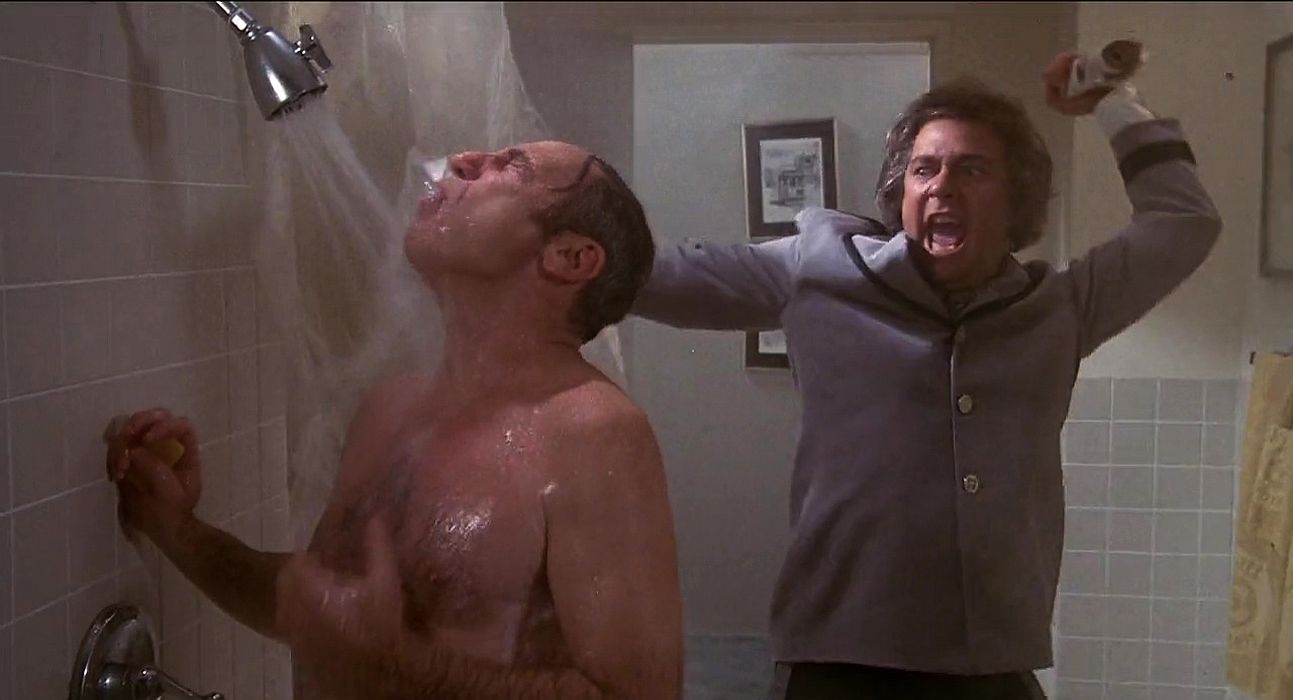
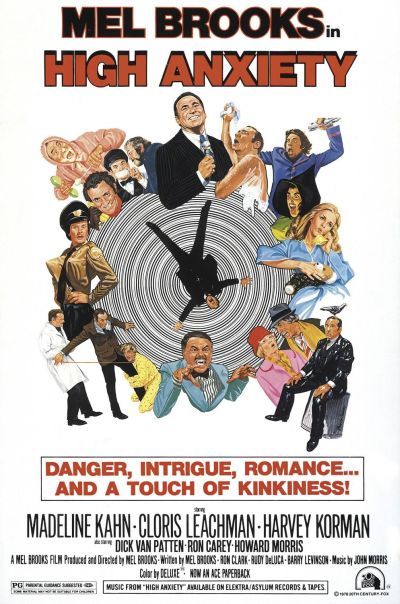 The comedy mostly comes around the edges, such as an undeniably inspired recreation of the shower scene from Psycho. In this version, a disgruntled hotel worker – played by future Oscar-winning director Barry Levinson – delivers a newspaper, replacing Norman Bates and his carving knife (top). It ends in ink from the paper running down the plug hole. Half the fun comes from the careful set-up, with the employee gradually pushed past his breaking point. Also as obvious, a scene from The Birds which ends in Thorndyke covered in pigeon shit. [According to Brooks’s autobiography, that was the only scene which made Hitchcock crack up at the premiere] I suspect there are likely others, but my knowledge of the director and his fifty-plus films is relatively shallow. This feels more specific than, say, Blazing Saddles, where the target was general, widespread Western tropes.
There are occasions where the movie is inventive on its own terms. The best moment for me, sees Thorndyke assessing a patient, while behind him, Montague is pretending to be a werewolf, complete with fake teeth. Understandably, this is freaking the patient out. But in general, this isn’t a parody, and certainly not a spoof, so much as a loving homage. Picking on Hitchcock makes sense, in that he was one of the few directors at the time who was genuinely “known”, this being before Spielberg, Coppola and Scorsese had taken full flight. Maybe Kubrick might have been a better choice. Between Dr. Strangelove, 2001, A Clockwork Orange, and his infamous working methods, there might have been more scope for satire.
History of the World: Part I (1981)
Rating: C+
Dir: Mel Brooks.
Star: Mel Brooks, Gregory Hines, Harvey Korman, Dom DeLuise.
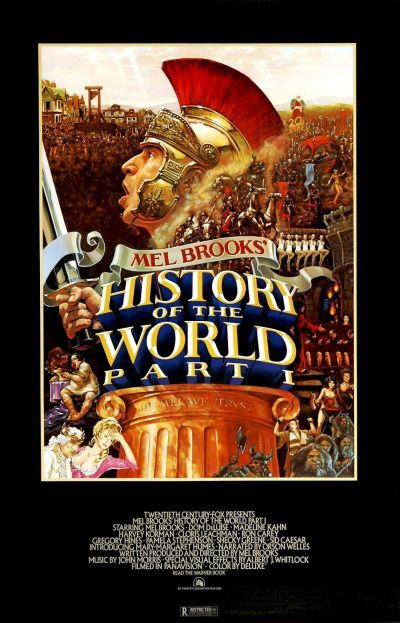
After the more focused parodies of his previous movies, Brooks went full shotgun here, covering different eras in human civilization, from prehistoric times up to the French Revolution. It took 42 years for Part 2 to show up, as a Hulu miniseries. I lasted precisely one episode of that, and it was a struggle. The original seems like Brooks was trying to emulate Monty Python. The whole Roman Empire section (which was a lot longer than I remembered) is clearly influenced by Life of Brian, and I trust I needn’t draw you a picture in respect to the Spanish Inquisition. Though getting Orson Welles act as narrator is certainly a coup, giving the project gravitas it then rejects entirely.
I honestly don’t remember much about the Prehistoric segment. Considering I finished watching the movie less than an hour ago, this is probably not a good sign. On the other hand, I remember far too much about the Roman Empire section. It feels like Brooks wanted to use as the basis for a whole movie, if only the Pythons hadn’t got there first. I did laugh at stand-up philosopher Comicus (Brooks) getting a gig at Caesar’s palace, only to pull up at the Vegas casino. It’s interesting to see Hines in his feature debut (a late replacement for Richard Pryor), and Madeline Kahn’s Empress Nympho is appropriately named. But a lot of the comedic impact here has been flattened by time. Or maybe it wasn’t that funny to begin with.
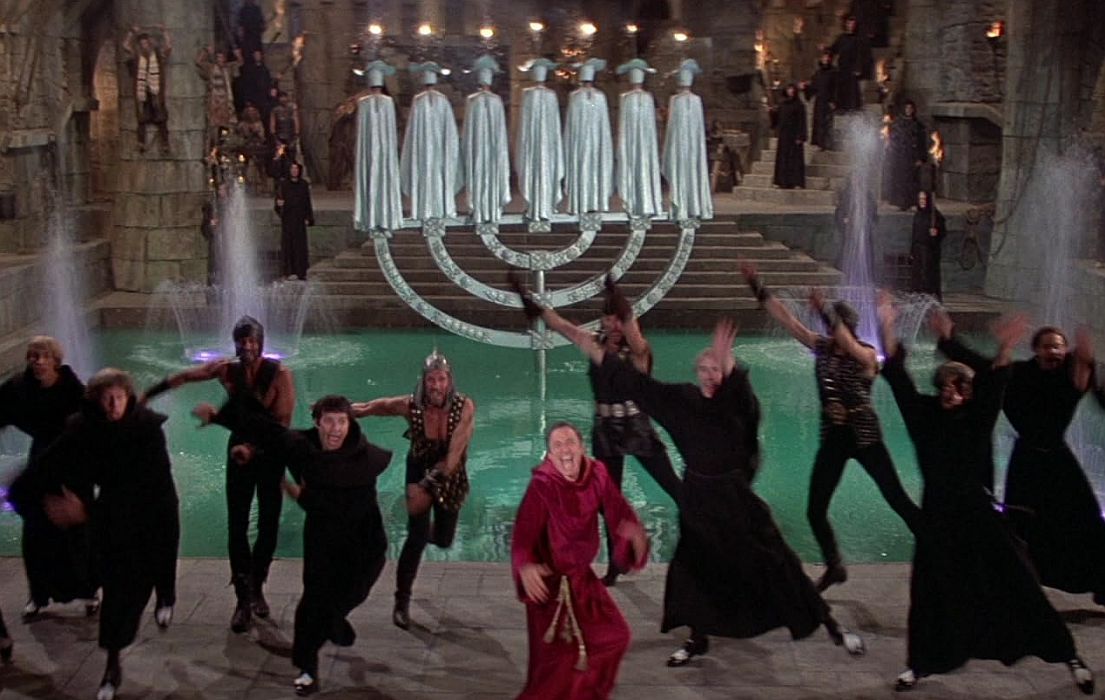
 Things improve with the Spanish Inquisition section – I didn’t expect that, hohoho. It’s largely a glorious, escalating song and dance number (top), with nuns ripping off their habits and plunging, Esther Williams style, into a pool which has risen out of the floor. But we also get the best pun in the whole Brooks universe. “Torquemada – do not ask him for forgiveness. Let’s face it, you can’t Torquemada anything!” We then move onto the French Revolution, which is most notable for a parade of British cameos, including Spike Milligan, Andrew Sachs, Nigel Hawthorne and Fiona Richmond. There should have been John Cleese as well, but scheduling prevented him from playing Count de Monet, so Korman took over instead.
It has been a while since I’d seen this, and in my mind, it was a greater selection of shorter skits. Turns out I was remembering the final part, which teases a part two, with segments like Hitler on Ice [I would have paid good money to see someone at the recent Winter Olympics come out dressed as Der Fuhrer. Bonus points if it was the German competitor]. In hindsight, Jews in Space feels like it was foreshadowing what was to come in six years, but we’ll get to that. For now this is, literally, all over the space-time continuum, both in terms of topic and effectiveness. To extend the Python comparison, it’s closer in quality to a grab-bag of episodes than any of their movies.
Spaceballs (1987)
Rating: C-
Dir: Mel Brooks.
Star: John Candy, Rick Moranis, Bill Pullman, Daphne Zuniga.
Judging by the IMDb ratings, this is the last great Brooks movie, and it’s all downhill from here. As we progress through his filmography, I can’t yet speak to the latter. But I can say, I didn’t find this to be all that amusing. It may be a problem that I’m not particularly a Star Wars fan. I am not prepared to swear I’ve even seen the entire original trilogy, and swore off the new stuff after the zombiefication of Peter Cushing. Disney really does turn everything to shit, doesn’t it? In theory, you might think this would make me amenable to a spoof.
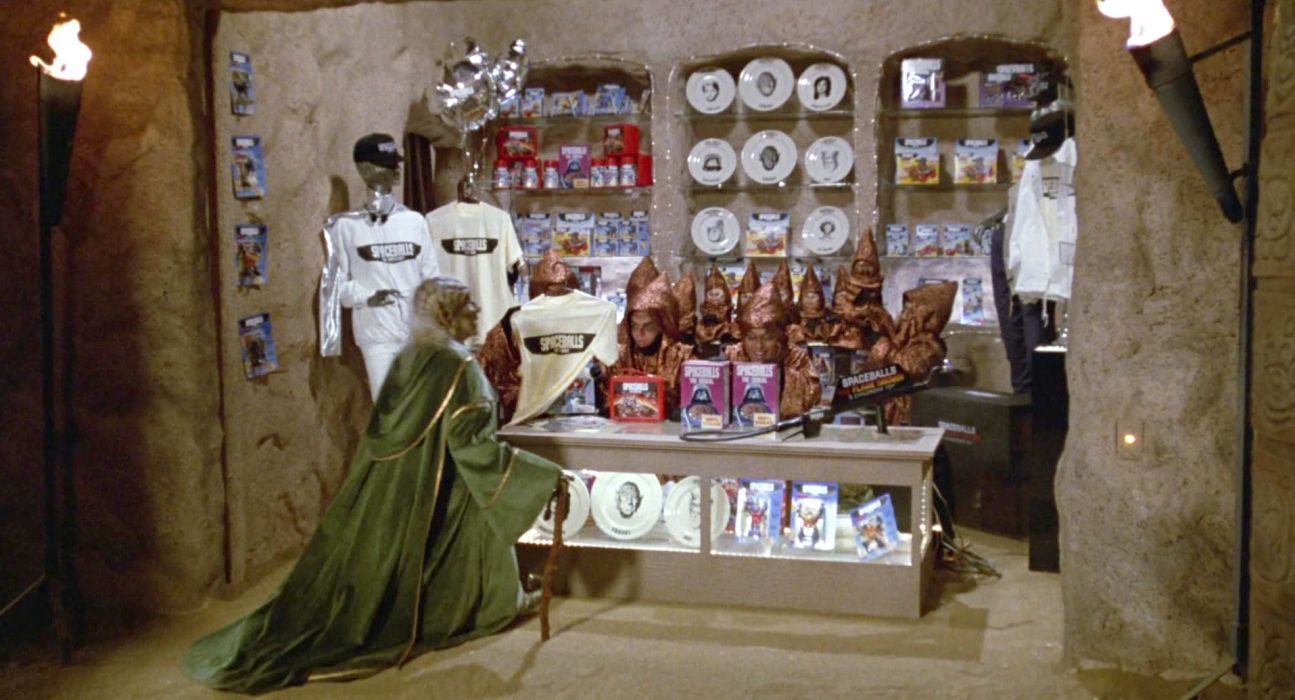
But this seems stuck in an unfortunate dead zone. Ten years after Star Wars, yet it basically ignores the sequels. It’s 12 years before The Phantom Menace, when the merchandising mocked here became the main purpose of the franchise. The scene where the wise Yogurt opens up the wall (top) to reveal Spaceballs: The Lunchbox, Colouring Book and Flamethrower, now comes over as prophetic, and a little sad. Too many of the other jokes here are just too damn obvious. A demand to “comb the desert” is followed by a giant comb being dragged across sand-dunes. It’s the kind of crap I might have come up with at the age of eight. This wasn’t a critical or commercial hit at the time – it won the Stinkers Bad Movie Award for Worst Picture of 1987 – but revisionists now proclaim it, “One of the greatest comedies of all time.”
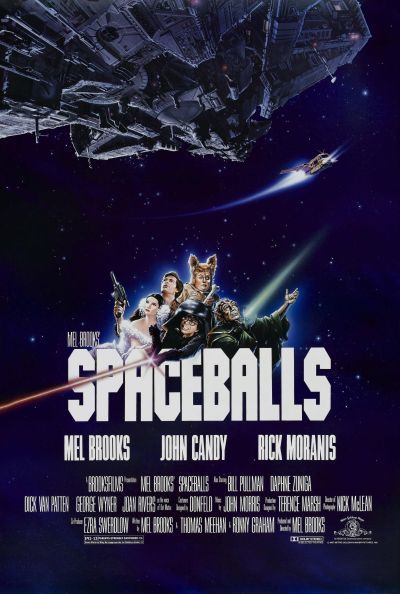 I strongly disagree. Here, in addition to Yoda. you have fairly basic parodies of Han Solo, Darth Vader, Chewbacca, and Princess Leia. These are Lone Starr (Pullman), Dark Helmet (Moranis), Barf (Candy) and Princess Vespa (Zuniga), plus a slew of minor characters. Dark Helmet has a very large helmet. Weirdly, there’s no equivalent to Luke Skywalker. The plot has Dark Helmet trying to suck up the air from Princess Vespa’s planet, Druidia, using Vespa as leverage. The name of the planet is mostly so we can get “Druish princess” jokes. She is rescued by Lone Star and Barf, but they then crash into a desert planet, where they meet Yoghurt (Brooks).
The funniest moment might be a parody inspired by Alien, not least because it includes John Hurt, reprising his famous demise. I was also fairly amused by the sequence where they acquire a tape of Spaceballs, and watch it up to the point where their own action are immediately replicated on the screen. Or the action sequence which ends in Helmet’s men capturing their not very convincing stunt doubles. That’s the kind of comedic invention I was expecting. Instead, we get characters called “Asshole”. It all ends in Yogurt saying, “God willing, we’ll all meet again in Spaceballs 2: The Search for More Money.” It took a while – forty years – but that sequel is now in production, for release next year. Never mind Brooks: Pullman will be seventy-three years old, and Zuniga sixty-four…
Life Stinks (1991)
Rating: C+
Dir: Mel Brooks.
Star: Mel Brooks, Lesley Ann Warren, Howard Morris, Jeffrey Tambor.
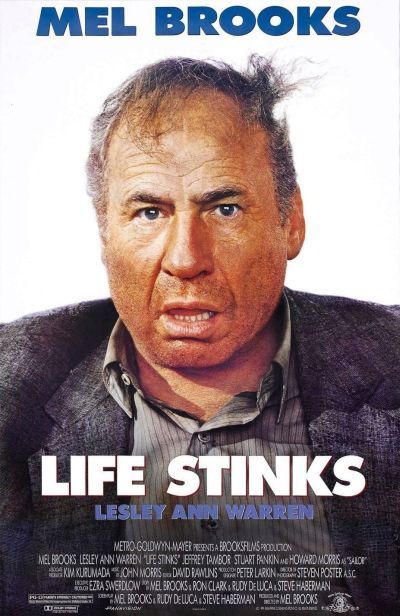
Credit Brooks for, at least trying something different. It may not be entirely successful – and that’s putting it mildly. But it’s not just Brooks making obvious, vaguely pop cultural references. Indeed, this is not a parody of any other cinematic genre or movie. It’s a comedy-drama, without most of the typical Brooks tropes. No breaking of the fourth wall, for instance. Nor are there many of the usual suspects in the cast. After eight Mondays of what felt like relentlessly increasing broad farce, this step back was a breath of fresh air. Of course, Brooks being Brooks, buttons must be pressed. Who else would dare make a comedy about poverty and homelessness?
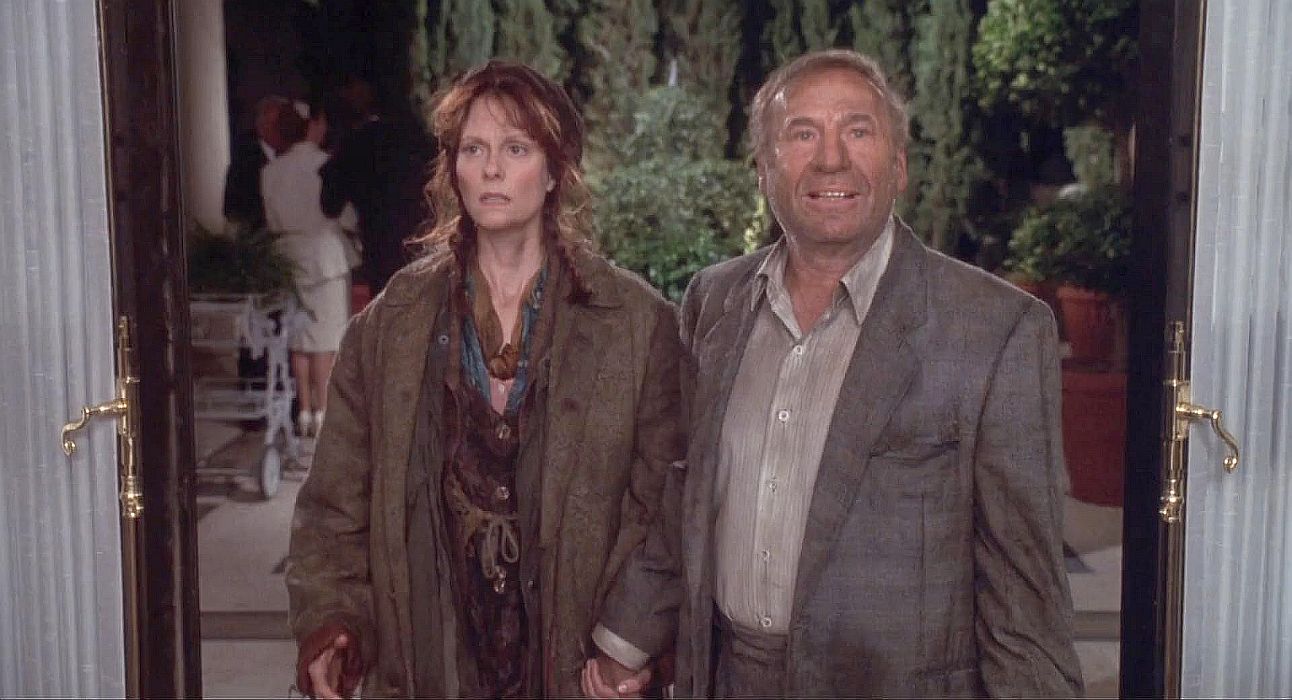
Mel plays Goddard Bolt, a CEO of no scruples, who is looking to take over a swathe of downtown LA, and redevelop it. The current residents? Who cares. But rival CEO, Vance Crasswell (Tambor), has his eye on the same turf. He talks Goddard into accepting a bet. If Bolt can survive thirty days in the area to be developed, on his own and without all the resources of his wealth, Crasswell will hand over his property to Bolt. Fail, and Bolt must do the reverse. It’s not long on the streets before Goddard is regretting his decision, and he’s taken under the wing of friendly bag-lady Molly (Warren). But will this be enough to counter the schemes of Crasswell, who intends to make Bolt’s homeless life as difficult as possible?
 Of course, there’s nothing particularly subtle here. It’s obvious from the get-go that Bolt is going to learn that there are more important things in life than money. I always love it when Hollywood millionaires lecture us on that topic. However, it’s about the journey rather than the destination, and if hardly realistic, this does a bang-up job of reminding us that homeless people are… Well, people. The ones shown here, such as Sailor (Howard Morris, one of the few recognizable members of the Brooks repertory company) and Fumes (Theodore Wilson) are given genuine character. It’s all the more poignant hearing the latter talk about wanting to return as a bird after he dies, knowing Wilson actually passed away a week before this opened.
It does paint itself into a corner, and consequently has to wield the “With one lawsuit, he was free” card. Though I did enjoy the fight between two pieces of construction machinery, driven by the CEOs. It’s like something out of a Ray Harryhausen movie, and was an unexpected pleasure. Warren is also excellent in her role, and the neo-magical dance between Molly and Goddard is definitely a rare moment of beauty – both in the film, and in Brooks’s filmography as a whole. Moments like these do enough to dilute the overall obvious, and rather saccharine nature of proceedings. The results may be uneven, and you can see why Brooks would head right back to familiar territory. Yet this is memorable, just because it is different.
Robin Hood: Men in Tights (1993)
Rating: B
Dir: Mel Brooks.
Star: Cary Elwes, Roger Rees, Richard Lewis, Amy Yasbeck.
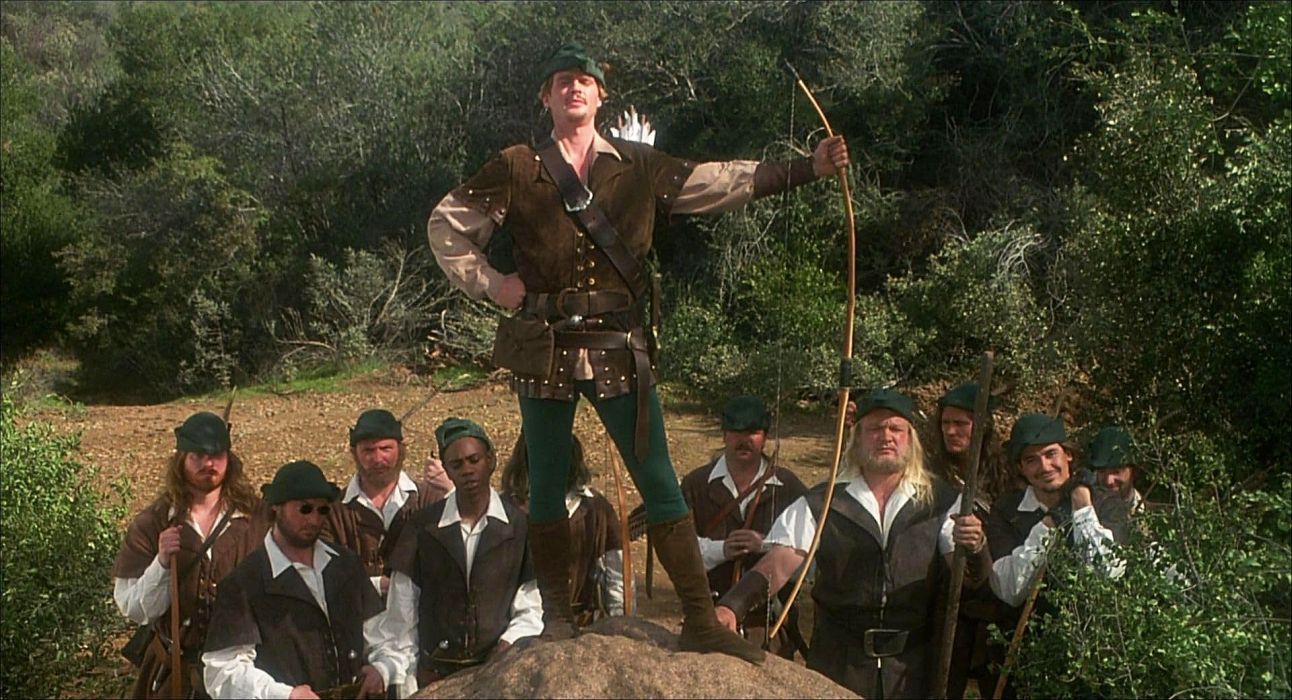
I enjoyed this one considerably more than Spaceballs, despite not having seen Prince of Thieves – or, indeed, any Robin Hood film in particular. I think the main reason for this is Elwes, whose lead performance hits it out of the park. It feels like he is running back his character from The Princess Bride, both playing homage to and making (gentle) fun of a role which was itself something of a parody. He’s certainly an improvement over Pullman as a hero. Indeed, it works better as a general depiction of the character. As Robin says in a pointed aside, “Unlike some other Robin Hoods, I can speak with an English accent.” [Though in the Hungarian dub, the line became, “Because unlike Kevin Costner, I have a shapely bottom,” mocking Costner’s use of a body double]
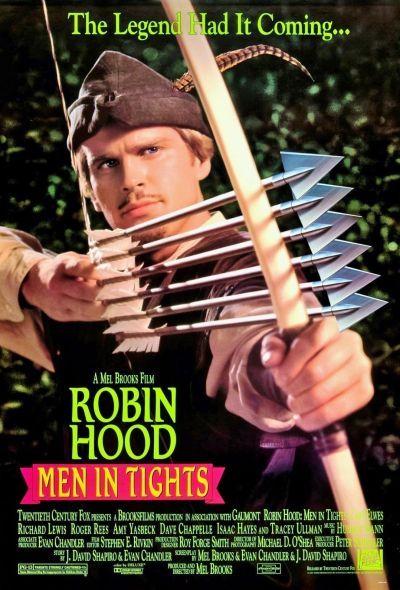 Despite my general ignorance of cinematic Robins, the story itself is easily familar enough, and hits many of the most well-known points, e.g. evil Sheriff of “Rottingham” (Rees), the archery contest, etc. Though as with the Roman scene in History of the World, there are scenes where it feels like Monty Python got there first. In particular, the one where Robin has to battle Little John to cross a bridge, seems very much inspired by the Black Knight scene in Holy Grail. Then again, Brooks is also riffing off his own back catalogue by this point, recycling lines like “It’s good to be the king.” To some, that may seem lazy. I found it an amusing acknowledgement of what has gone before. It helps that the supporting cast are excellent, from a very early Dave Chappelle appearance, through to Dom DeLuise’s pitch-perfect imitation of Marlon Brando as Don Corleone. Yet there is more here than simply pop-culture references. I find the actual jokes here superior to Spaceballs. Witness the exchange between Robin and his servant, detailing all the tragedies while Robin was away, building to:
“My goldfish, Goldie?
“Eaten by the cat.”
“My cat?”
“Choked on the goldfish.”
Brooks’ fondness for a good musical number rears its head again, and I think to better effect. This begins right at the start, with a troupe of black Merry Men delivering the Sherwood Forest Rap: “”Hey nonny nonny, and a ho ho ho!” It likely reaches its peak with Men In Tights: “We’re men, we’re men in tights. We roam around the forest looking for fights.” If you are hearing further echoes of Python there – and in particular The Lumberjack Song – you are not alone. It doesn’t have the tightness of peak Python, but given this came out a decade after that clan’s final movie, it’s still considerably better than nothing. I’m fine with the recycling of some jokes too – Igor’s movable hump becomes the nomadic mole on the face of Prince John (Lewis) – because, hey, they are still funny. The new stuff isn’t so bad either, and from Tracey Ullman to Isaac Hayes, I can’t think of anyone here who is not giving their all.
Dracula: Dead and Loving It (1995)
Rating: C+
Dir: Mel Brooks.
Star: Leslie Nielsen, Mel Brooks, Peter MacNicol, Steven Weber.
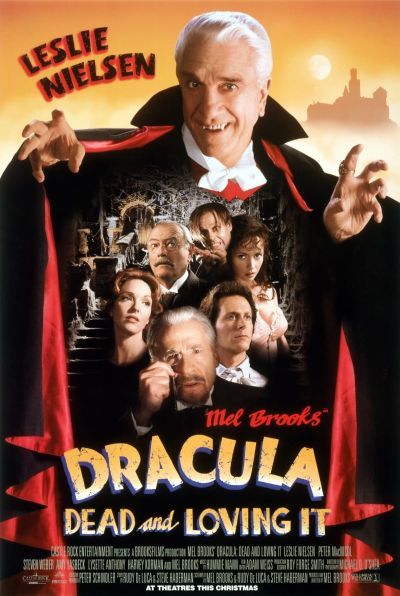
My main surprise is, I didn’t hate this. Despite poor critical reaction, it’s a perfectly functional horror-comedy. If some way short of Brooks’ better work in the latter category, it works better as the former than expected. My main question is, how the hell was the cost for this thirty million dollars? I get offering Kelsey Grammer $3 million to play Dracula was expensive. But it’s the equivalent of a $65 million budget in 2026 dollars. Wherever that went, it’s not obviously on the screen, and the rest of the cast don’t seem expensive. Oh, well. It is a fairly straightforward adaptation of Bram Stoker’s Dracula, albeit with tweaks. For instance, like in Dracula, it’s Renfield (MacNicol) rather than Jonathan Harker (Weber) who goes to Transylvania to see Count Dracula (Nielsen).
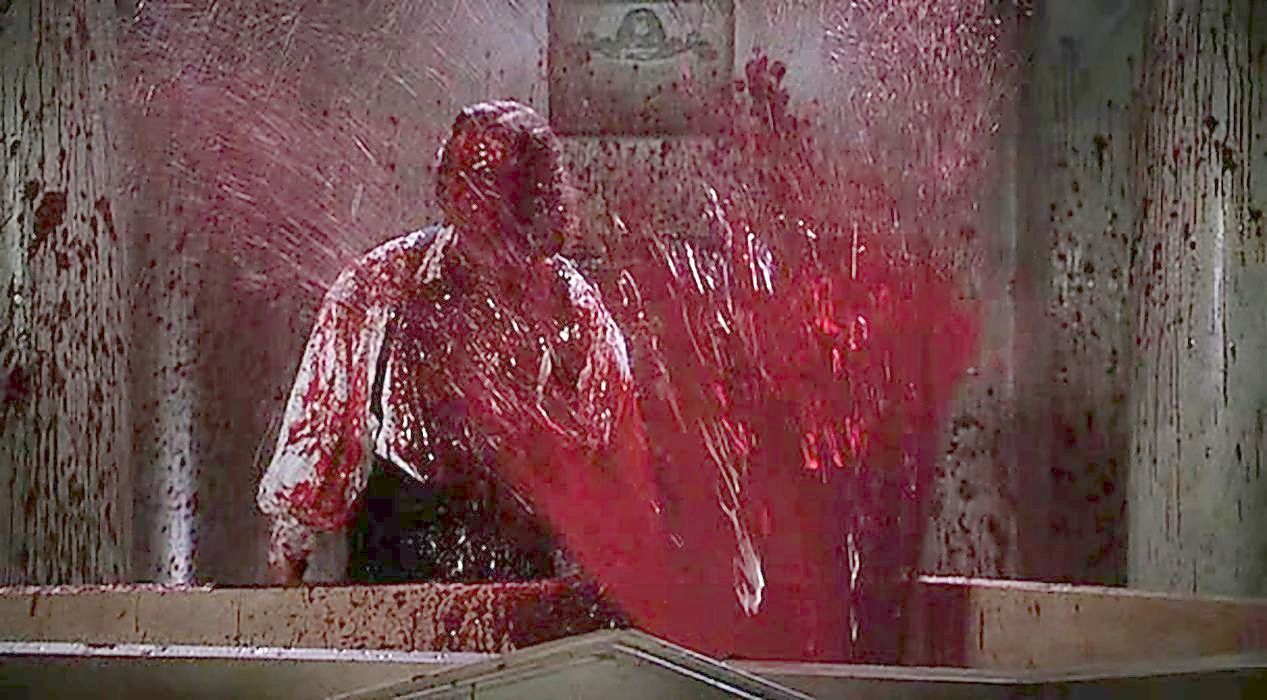
But in general, this hits most of the expected plot points. Dracula is clearly influenced by the Coppola version, especially in the hair – which is removable here. But Nielsen makes for quite a sympathetic vampire, who dreams of being able to walk in the sunshine and enjoy a drink of… wine. The main surprise might be Brooks who is genuinely good as Professor Van Helsing. He sells the concept of vampires well to Harker. Okay, he’s no Peter Cushing: then again, who is? Still, the sequence where the duo stake Lucy (a kinda hawt Lysette Anthony), releasing not one but two absolute gushers of blood (top), is awesome. In a 2013 interview, Brooks named it among his favorite all-time scenes – the only one he directed to make his list.
 Speaking of Lucy, there may not be a better distillation of the theme of repressed, Victorian sexuality in Dracula, than this exchange between Harker and the newest vampire bride:
Lucy: Jonathan, let me kiss you. Let me show you the deep, raw passion of unbridled, sexual frenzy.
Jonathan: But, Lucy… I’m British.
Lucy: So are these.
This seems to be part of the film’s comedic philosophy: the women are all sexpots, and the men are all idiots. Anthony said later, “I was just meant to be there, with my tits hanging out, looking ridiculously glamorous. And, no, I didn’t find it offensive being that sort of sexy foil.”
It bombed on release, sits at an eleven percent rating on Rotten Tomatoes, and is among the lowest-rated of all Brooks’ eleven movies on the IMDb. As a final movie, that might not exactly seem a great legacy, and given the cringeworthy title, I’d not blame anyone for avoiding it entirely. No Young Frankenstein, that’s for sure. However, I was still engaged considerably more than in Spaceballs. It helps that there’s enough going on beyond the comedy to sustain interest if the humour isn’t humourous enough. The set designs here are particularly impressive, and the performances do a better job of avoid the overacting and mugging which plagued Spaceballs. I guess if they needed that, they could have hired Keanu to reprise his character from the Coppola version.