
Rating: B
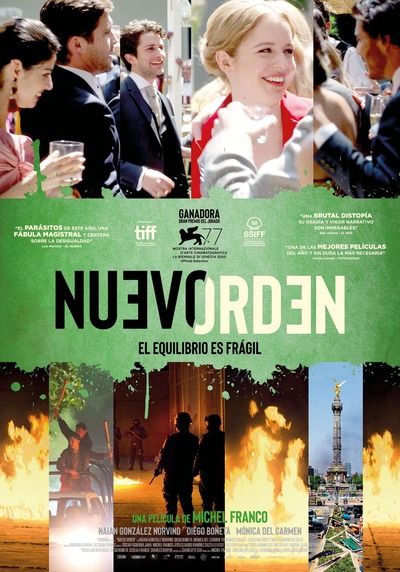
Dir: Michel Franco
Star: Naian González Norvind, Eligio Meléndez, Mónica Del Carmen, Dario Yazbek Bernal
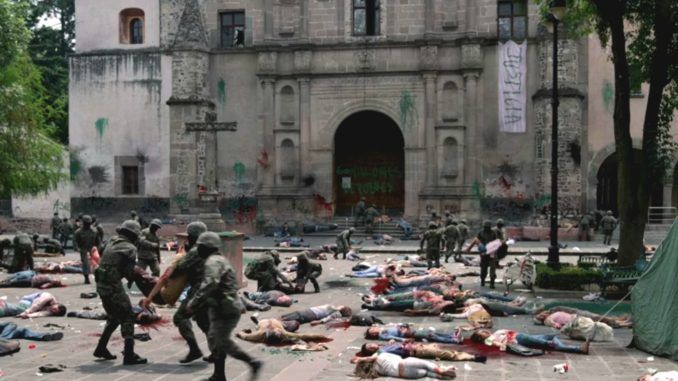
Any film capable of rustling the jimmies of the typical Letterboxd critic, is clearly doing something right. This provides an extremely jaded – but I suspect, entirely realistic – take on what would happen in Mexico, were there to be a working-class revolution, taking out their anger on the rich elite. The military would step in, bash heads with a refreshingly equal opportunity attitude, and things would get worse for everyone. There aren’t many “good guys” to be found here. The closest is probably Marianne (Norvind) – and because she’s rich and white(ish), that is unacceptable and an affront to the Cappuccino Communist Brigade. Her wedding day is brutally interrupted when the civil unrest literally spills over the walls of her family’s compound.
Marianne isn’t there, however. Former employee Rolando (Melendez) has shown up, cap in hand, needing funds for his wife’s operation. Marianne is the only member of the family prepared to commit to helping. She therefore misses the mob-driven massacre at the house. That’s as far as her luck goes. For she instead gets swept up by the military, who are carrying out a mass kidnapping scheme, of the most brutal nature. Word of their ransom demand makes its way through to her groom, Alan (Bernal). But it becomes increasingly questionable whether the kidnappers will hold up their end of the bargain. For it appears the director of this graduated with honours from the Michael Haneke School of Cinematic Cynicism.
 Yeah, nobody here comes out smelling of roses. The rich are depicted as out of touch, indifferent to anyone else, and elitist. The poor are brutal animals, lashing out in anger at anyone in their path, including each other (I kept thinking how riots and looting never occur in upper-class neighbourhoods). The military might be worse, because they are well-organized and generally competent. They are lawful evil, to the revolutionaries chaotic evil. On these lines, the upper classes would probably be designated as neutral useless. They rely completely on others for everything – including protection. When that safety net is suddenly taken away, the rich become defenseless victims. The realization they no longer have any purpose and have lost their position of power, is a harsh reality check.
Along similar lines, it begins almost as a Lifestyles of the Rich and Famous episode, before morphing relentlessly into a downward spiral of violence and retribution. The hell in which Marianne finds herself, is one where rape and summary execution are everyday events. Life isn’t much better on the streets, as Rolando finds out. It does become much looser in structure in the second half. Rather than development of plot or characters, it becomes a series of “Well, that just happened” vignettes. But I ain’t gonna lie: the casual savagery still packs an undeniable wallop. It all works as a cold reminder that change a) is not easy, and b) might not necessarily be in the direction you would like.