
Rating: B+
Dir: Nagisa Ōshima
Star: Tom Conti, David Bowie, Ryuichi Sakamoto, Takeshi Kitano
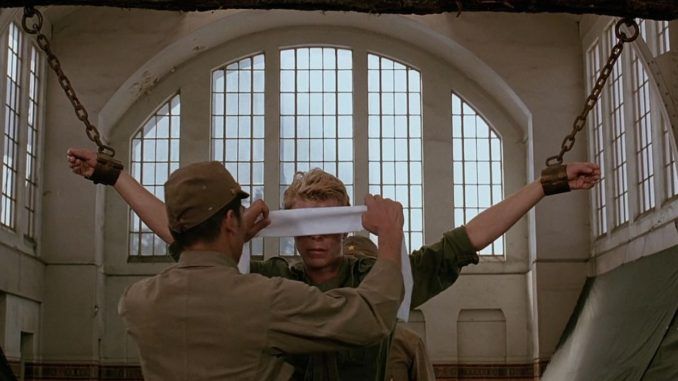
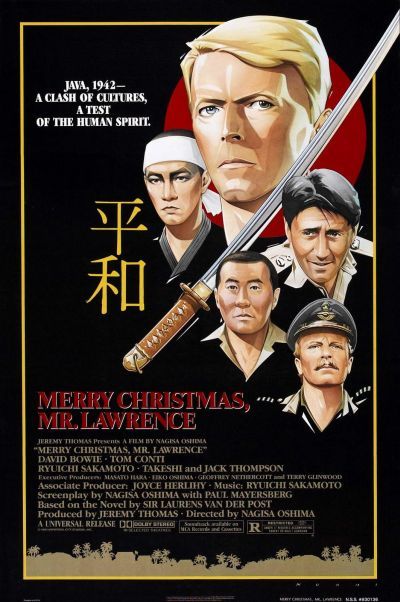
This feels like a war movie unlike any other war movie, and in the main, is all the better for being different. It largely unfolds in a Japanese POW camp in 1942, where Allied prisoners are held under the command of Captain Yonoi (Sakamoto, in his acting debut and much better known as a musician), and the sadistic Sergeant Hara (Kitano, in his feature debut, and then much better known as a TV comedian). Trying to keep the peace is Lieutenant-Colonel John Lawrence (Conti), the only Japanese speaker among the prisoners. But the uneasy truce is upended by the arrival of new inmate, the Australian Maj. Jack Celliers (Bowie), a charismatic individual – yet like Yonoi, a man with a troubled past.
I think where it differs most obviously from the standard, is being about relationships. In a standard entry – say, Bridge On the River Kwai – it’s the story which drives things. Here, it’s the way the characters interact, and how this changes over time, that moves things forward. The most complex pairing is the one between Yonoi and Celliers. It’s pretty damn homoerotic: again, not something you often see in the war movie genre. But given Yonoi looks like a refugee from a Takarazuka Revue show (did Japanese officers really wear so much make-up?), it’s not much of a shock. The two men also carry a burden of guilt: Yonoi for the disgrace of tangential involvement in a 1936 coup attempt, Celliers for having abandoned his younger brother.
 However, I was equally interested, if not more so, in the relationship between Hara and Lawrence. It’s clear that the Japanese soldier is cruel. But it seems to stem from a genuine belief that soldiers who let themselves be captured have no honour, and are less than human. He does respect Lawrence, seeking his approval for his brutal management of both prisoners and guards. Lawrence, meanwhile, has a foot in both camps, and tries to understand – with varying degrees of success – the Japanese and Western approaches. At the end, he tells Hara, “You’re the victim of men who think that they’re right… And the truth is, of course, that nobody’s right.” This nuance is, once more, not commonly seen in war films.
The structure does become a bit loosey-goosey down the stretch, more a series of scenes than a narrative flow. I also occasionally found Sakamoto’s electronic score a little distracting. While I’m a big fan of his work as part of Yellow Magic Orchestra, it felt somewhat out of place in a period piece like this. However, these are minor quibbles, and the top-notch performances kept me engrossed. [It’s also one of the few movies I’ve seen without a single actress present, in any form] To give you some idea of how engrossed I was, typically on Tubi, the advert breaks are a chance to check my phone, go get snacks, etc. This might be the first time I was genuinely annoyed by them.