
Rating: B
Dir: Kevin Brownlow and Andrew Mollo
Star: Pauline Murray, Sebastian Shaw, Bart Allison, Reginald Marsh
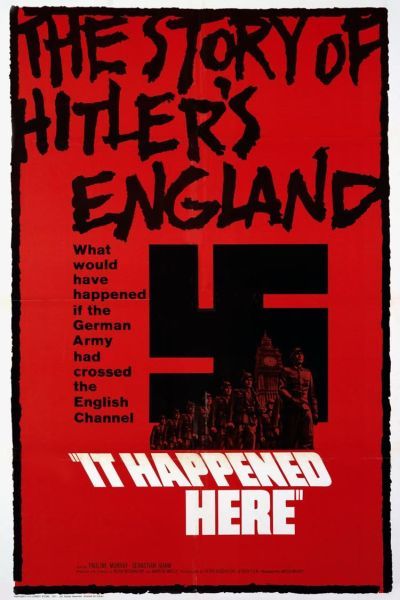
How this got made is, arguably, perhaps even more interesting than the film itself. It was shot over a period of eight years, with Brownlow and Mollo being mere teenagers when the project began. The cast of nine hundred were almost all volunteers, with help from people like veteran BBC announcer John Snagge, who provides a voice-over for newsreel footage, while Stanley Kubrick donated unused film from Dr. Strangelove. It depicts a Britain where the Nazis did not stop at the Channel in World War II, but invaded successfully. The country is now under their control, though partisan resistance is beginning to spring up with the help of the US.
The title is, I imagine, a response to Sinclair Lewis’s 1935 novel along similar lines, It Can’t Happen Here. And the most shocking thing is how normal things largely seem. People mostly appear to be trying to make the most of a bad situation. Some collaborate, either enthusiastically (the film’s cast included both former members of the British Union of Fascists, and German ex-servicemen) or out of simple pragmatism. Life is shown through the eyes of a district nurse, Pauline (Murray), who is evacuated into London due to increased resistance activity in the countryside. She reluctantly joins a paramilitary medical corps. But her friendship with a doctor (Shaw) who helps the partisans, gives her increasing pause for thought, especially after he and his wife are “disappeared.”
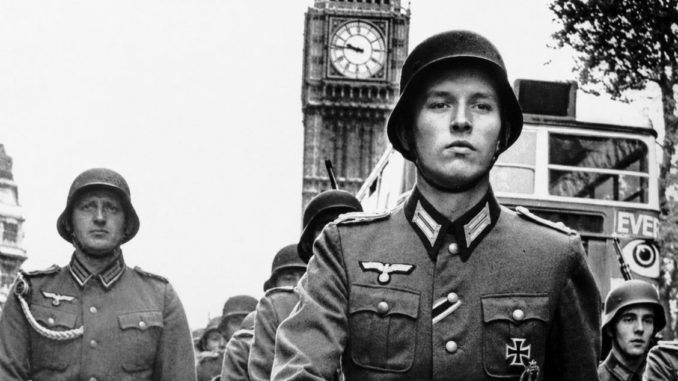
 Given the tiny budget and amateur production, it’s a stunning piece of work. The grainy footage, occasionally muffled audio and performances often (kindly) describable as “naturalistic”, actually work for the film. They enhance the sense of realism which is already highly unsettling. When you see Nazi soldiers marching past the Houses of Parliament (top), or having a rally in Trafalgar Square, it’s shocking imagery: your brain struggles to process it. Sneakily, the film begins with an atrocity against the civilian population, carried out by the partisans. That immediately goes against expectations, explains Pauline’s apolitical ambivalence to the occupation, and helps to provide a “both sides” narrative, which is further calculated to subvert the usual norms of war movies. Shooting at people doesn’t win their hearts and minds.
There are chunks here which are famously controversial, such as lectures by British fascists advocating against “the terrible, deadly grip of the imperialist Jews”. It might be considered ironic that one such monologue was removed for the initial release… after lobbying by the Board of Deputies of British Jews. It all has a moral complexity which is laudable. To quote Dr. Fletcher, “The appalling thing about fascism is, that you’ve got to use fascist methods to get rid of it.” Ah, the so-called paradox of tolerance – so called because it makes no logical sense. But he continues: “We’ve all got a bit of it in us. And it doesn’t take much to bring it to the surface.” Eight years very well spent, I’d say.