
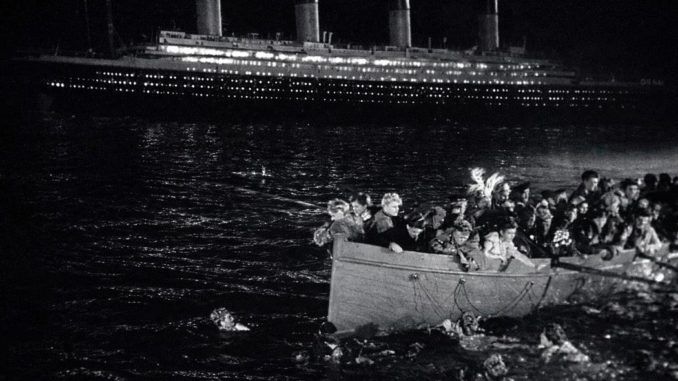
Rating: C-
Dir: Herbert Selpin.
Star: Hans Nielsen, Sybille Schmitz, Kirsten Heiberg, E.F. Fürbringer.
Not to be confused with the other Titanic obviously, this is a wartime film made in Nazi Germany. Naturally, it fabricates a heroic German member of the crew, First Officer Petersen (Nielsen), who behaves like a hero in the ensuing disaster. The same goes for any other Germans among the passengers. Meanwhile, the collision with the iceberg is a direct result of the machinations of J. Bruce Ismay (Fürbringer), the slimy chairman of White Star Lines. If the ship can set a record trans-Atlantic pace, all the company shares he and the board have bought up will skyrocket in value. Nothing can be allowed to prevent a speedy arrival, regardless of the resulting risk.
Like the James Cameron version, this was a troubled production, costs ballooning out of control to become the most expensive German production to that point. Though at least, Cameron was not arrested by the Gestapo and Epsteined in his prison cell, after critical comments about navy officers working as consultants on the movie. Selpin was, the film being completed after his “suicide” by another director. When finished, it was then rejected by Joseph Goebbels, who decided disaster porn was not in the best morale interests of a Germany under increasingly heavy Allied bombing. Even after the war, it was banned in the British occupied zone, though some footage ended up recycled into 1958’s A Night to Remember. Completing the curse, the ship playing the Titanic, SS Cap Arcona, was sunk by the RAF late in the war, killing thousands of concentration camp survivors aboard.
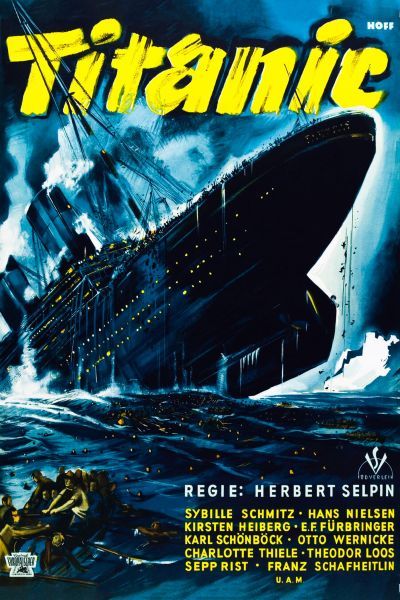 Apart from Ismay, there are representations of other historical figures who were aboard, such as Captain Edward Smith, and John Astor, then one of the richest men in the world. But beyond the basic iceberg-related facts, this is largely a polemic against capitalism, clearly informed by the “Socialist” in “National Socialist”. After Ismay is cleared of all responsibility, conveniently scapegoating the dead Captain Smith, we get a particularly scathing final caption: “The deaths of 1,500 people remain unatoned for, an eternal condemnation of England’s endless quest for profit.” As depicted here, possibly the only thing worse than the British upper classes above deck, are the animalistic working classes, rioting their way through steerage.
There are some other, curious parallels to the Cameron version, such a subplot involving stolen jewellery. But this doesn’t achieve the same sense of spectacle, with some unconvincing model work for the sinking vessel, which appears to have been filmed in a child’s padding pool. It instead relies largely on crowds milling aimlessly from place to place, until the crew are literally told “Every man for himself,” at which point the milling really kicks in. Petersen rescues a little girl trapped in her cabin, but unlike Jack Dawson, doesn’t need to sacrifice himself so that his love, broke Russian countess Sigrid Olinsky (Schmitz), can survive. Perhaps it’s knowing about the background, but this never feels less than manipulative, and not particularly well-done manipulation at that.