

Rating: C-
Dir: Gabriel Grieco, Nicanor Loreti.
Star: Malena Sánchez, Daria Panchenko, Sofía Gala Castiglione, Gabriel Grieco.
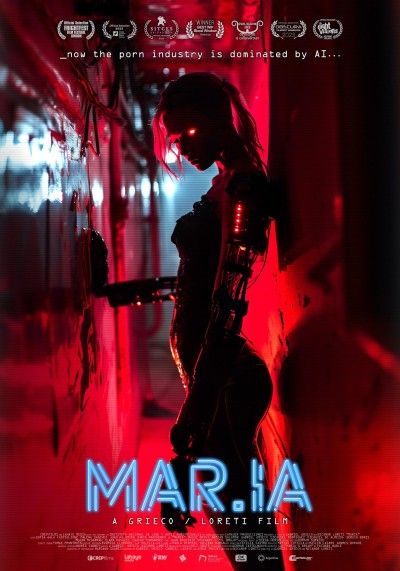
This feels in some ways like a throwback to “killer woman robot” from the VHS era such as Eve of Destruction, albeit filtered through the #MeToo era. Adult film-star Maria Black (Panchenko) has her career ended by a car accident, though her body subsequently disappears under mysterious circumstances. Three years later, she returns just as abruptly as she vanished, making her return in a film for director Darío Georges (Grieco). Also on set are sound recordist Alina (Sánchez) and make-up artist Mel (Castiglione), who’re appalled when Maria has a seizure and dies on set. That’s nothing compared to how they feel, when the actress’s corpse is sold off for “use” by a masked trio of businessmen.
By “use”, I mean exactly what you think, with Georges offering to sell the footage on the Dark Web. However, turns out Maria isn’t dead, as the first necrophile finds out. Don’t put your dick in vengeful, robotic porn-droid, it turns out. For Maria’s casual explanation of her extended absence as, “A group of Russian anarchist feminists saved me, and they transformed me into a cyborg with superhuman powers,” may be closer to the truth than it appeared at the time of delivery. Those who exploit women are in for an unpleasant experience at her hands (and robo-vag). But by allying themselves with Maria, Alina and Mel have made themselves the enemy as far as the men in the studio are concerned.
 It’s all a bit dodgy in terms of morality, considering there’s no evidence of coercion. Both before and after her resurrection, Maria seems quite happy in her sex-work career, something she chose of her own free will. Nobody’s forcing her, Mel or Alina to be there. Admittedly, the abuse of a corpse thing is a bit sketchy, to put it mildly. However, Maria is the one pretending to be a) human and b) dead. There could be an interesting debate to be had on the notion of how much human rights extend to somebody like Maria. You could also make the argument AI robots have the potential to reduce the problem of sex trafficking, by replacing exploited humans.
The film isn’t interested in any of that. It goes no deeper than a character trying to decide whether Maria is more like Robocop or The Terminator. Which is fine, of course. I’d have been perfectly fine with a shallow, mindless flick, having its cake of sex and violence, while simultaneously trying to critique it. Except it doesn’t quite manage this either, despite some impressive bits of gore. Maria largely vanishes in the middle, leaving it as Mel and Alina versus the men. This is less entertaining, in part because we’re not given much reason to root for them, beyond “They’re women.” As a result, when Maria is not kicking patriarchal arse, this feels under-resourced (occasionally wonky dubbing doesn’t help) and somewhat overstretched, despite a fairly brief 76-minute duration.