Rating: C+
Dir: Giordano Giulivi.
Star: Silvano Bertolin, Ferdinando D’Urbano, Duccio Giulivi, Carlotta Mazzoncini.
The creature of the title stems from a 19th century thought experiment, where Pierre-Simon Laplace suggested that if an entity was to know exactly the location and momentum of every particle in the universe, they could predict all future events with unerring accuracy. It’s against this background the movie unfolds. A team of scientists, led by Karlheinz (Bertolin) have been working on this, trying to predict into how many pieces a glass will shatter when dropped. Word of their work has reached Professor Cornelius, who invites them to his home on top of a remote island. But once they get there, the team quickly discover they are the guinea pigs in an experiment of Cornelius’s own devising.
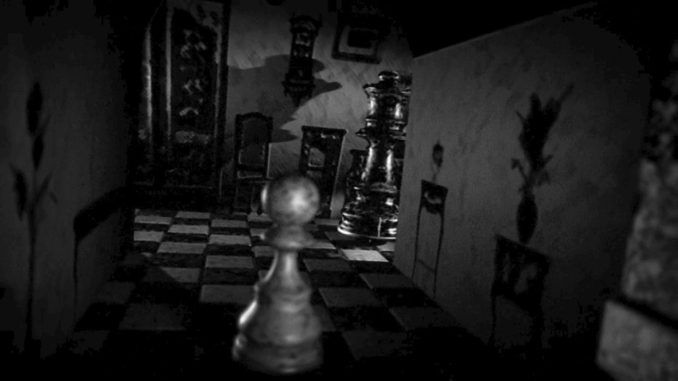
In particular, they find an impeccable model of the mansion, with white chess pawns moving by clockwork around it, in exact sync with their own movements. There are also videotapes left by the absent Professor through which (like classic Dr. Who episode, Blink) he communicates with them, because he has cracked the code and can predict their every action. But there is also a black queen roaming the model, preying on the pawns and consuming them. This feels like a cross between House on Haunted Hill and The Waves of Madness. While clearly pre-dating the latter, this is also a low-budget project shot in black-and-white. Both make heavy use of back projection to good effect, creating a slightly “uncanny valley” atmosphere of unease.
 It’s a grand idea, and parts of it work very well. The first time you watch things unfold, a pawn being implacably pursued round the model by the queen, I found myself genuinely invested in the fate of a chess piece (top). However, the novelty wears off quite quickly, and in the final analysis, there’s a lot of sitting around, watching people watching clockwork. When the nature of the queen is eventually revealed, I found it severely disappointing too, in a “Is that it? Really?” way. It’s definitely a case where not seeing it is considerably more effective. On the other hand, the script does a much better job of tidying things up than I expected, with an ending I found fully satisfying, if not particularly surprising.
In between, it’s a moderately interesting intellectual exercise: how can you win a game, when your opponent knows every move you will make, before you choose to make it? There’s a discussion about being chaotic, and attempting to remove conscious thought from the equation entirely, though this direction is not explored as much as I would have liked. In the end, it feels like the film goes all WarGames on us, with the only winning move being not to play. Or is there any winning move at all? For it could be argued that Laplace’s Demon is simply another name for God, and the universe only has room for one of those in its existence. An intellectual puzzle, and one which is adequately thought-provoking.