
Rating: B
Dir: Dzintars Dreibergs
Star: Oto Brantevics, Greta Trusina, Martins Vilsons, Raimonds Celms
a.k.a. The Rifleman
I’d never particularly thought about World War I having an Eastern front. Of course, I knew about the one in World War II. But I always kinda assumed the Great War was fought in Belgium and France, with Russia having other issues of its own at the time. Turns out, just like they did later, Germany was fighting an equally bloody war on the other side against Russia. That front was not quite as entrenched – pun entirely intentional – though still seems to have had its share of mud and brutality. It’s here this unfolds, with the story of 16-year-old Arturs Vanags (Brantevics). He joins up after his mother is gunned down by invading German soldiers, along with his father (Vilsons), a former sergeant-major.
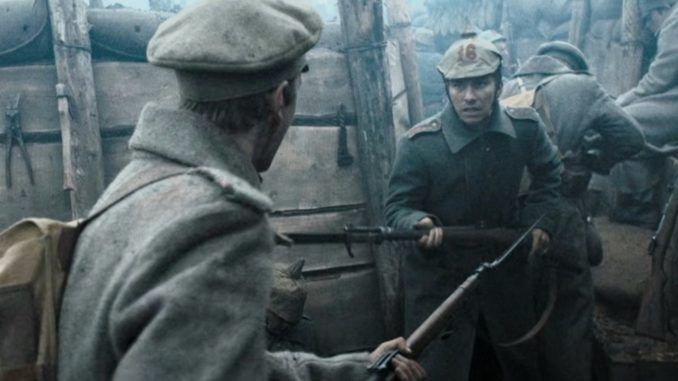
At the high level, things unfold thereafter much as you would expect. The innocence of Arturs is gradually destroyed in the meat-grinder horror of industrialized warfare, with death shadowing his every move. There are moments of relative levity, such as his romantic entanglement with Marta (Trusina). But it isn’t long before we’re back to Arturs having to kill his fellow men. His victims are both the enemy, and in one harrowing sequence, he must be part of a firing squad executing comrades found guilty of “counter-revolutionary activities” and desertion. Despite the predictability of events, they are depicted with no small degree of skill and imagination. The first time Arturs goes over the top is particularly memorable, putting you right beside him, as he comes face-to-face with the Germans (top).
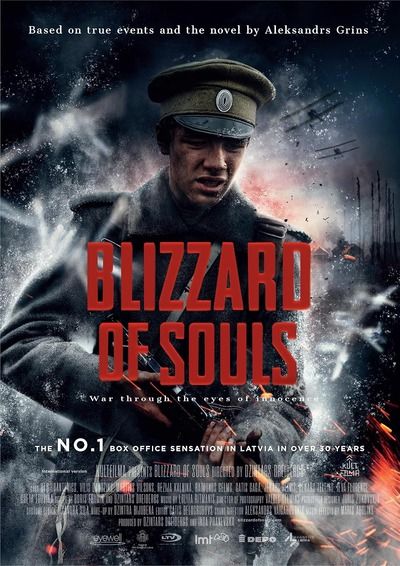 The setting is, as noted, the other area where it deviates from the norm. For Latvia was, at the time, part of the Russian Empire. So they were largely involved in a war not of their own making. If good came of this death and destruction, it was Latvia being able to declare independence in its wake, when the newly-formed Soviet Union was, indeed, otherwise occupied. This barely lasted twenty years, before first Germany and then Russia again took over. But it was still a slice of history I didn’t know about. You do have to piece things together. It was made for a local audience (becoming the most-watched film post-independence there), who presumably knew this stuff already.
While both movies are firmly grounded in history, I still preferred this significantly over the more-heralded Come and See. The protagonist here feels more of a real person, though the actors in both had no previous experience [and Brantevics hasn’t appeared in anything since, turning instead to politics]. I was left genuinely interested in reading the source material, Aleksandrs Grīns’ novel based on his time as a soldier in World War I. It’s not often a movie manages to be both entertaining and educational. Dreibergs strikes an impressive balance, and what could have been a dry recounting of events has a good deal of heart as well.
This is part of our World in Action feature, covering action movies around the globe.