
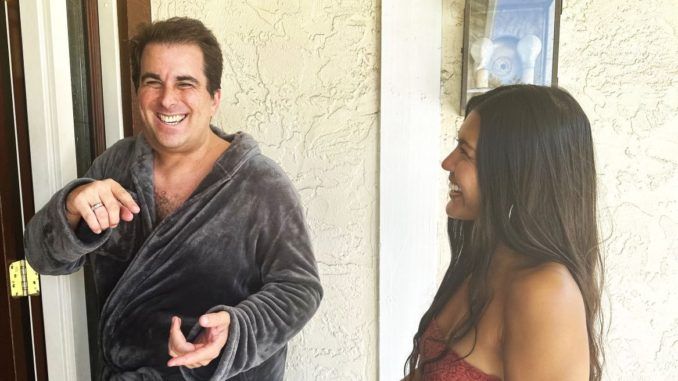
How did you get started? When I was around 12, my dad bought a camcorder to shoot family vacations and things like that. I quickly took it over and started making movies. I couldn’t get enough of it (and still pretty much can’t).
“I think people like a genre that’s candid about nightmares and mortality.”
Intrusive. It is like a debt I felt I owed to myself. I wanted to see if I could carry a note of creepiness across a whole movie’s runtime. It’s a bit short for a feature (66 minutes), and that’s partially because I was cutting to the creep factor; I didn’t want it easing up. Jimmy White, the producer and the gentleman who came up with the story line, made it possible; he supported the film one hundred percent and brought endless creativity to it. We were trying to get at the feeling of a silent scream. The story is about two women entangled in a disquieting relationship. The lead actresses, Sherill Quinn and my wife Rhoda Jordan Shapiro, both got way under my skin — in a good way! They were there carrying that note.
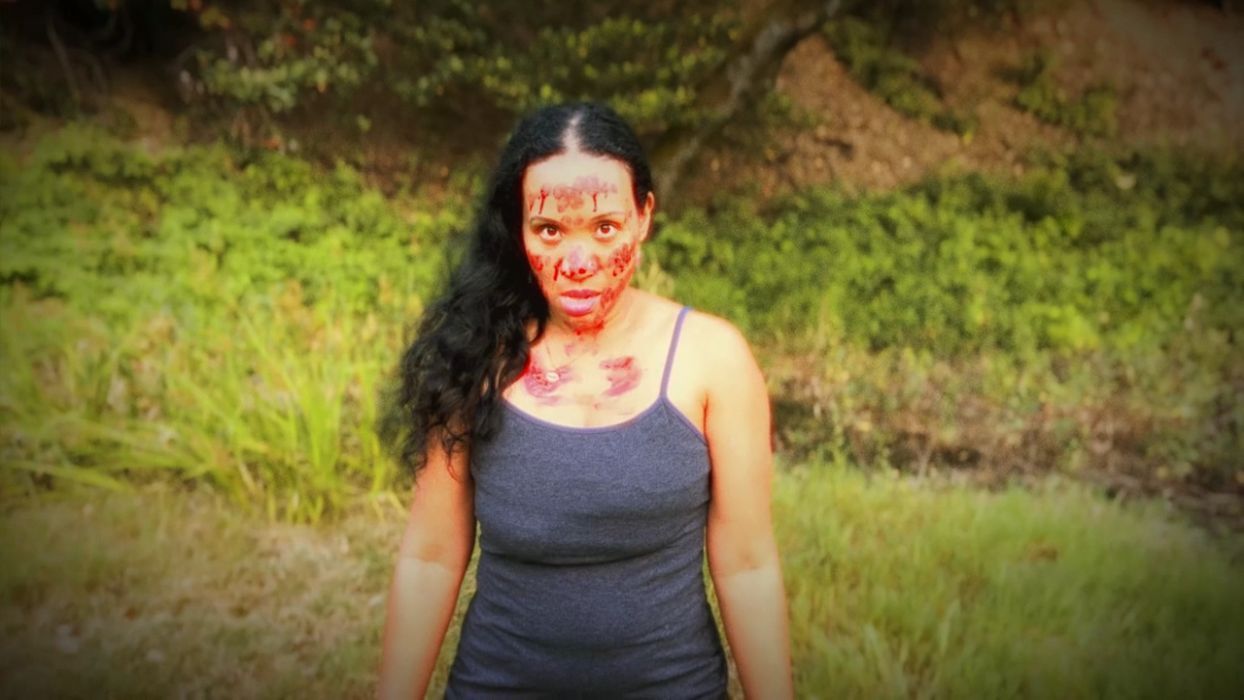
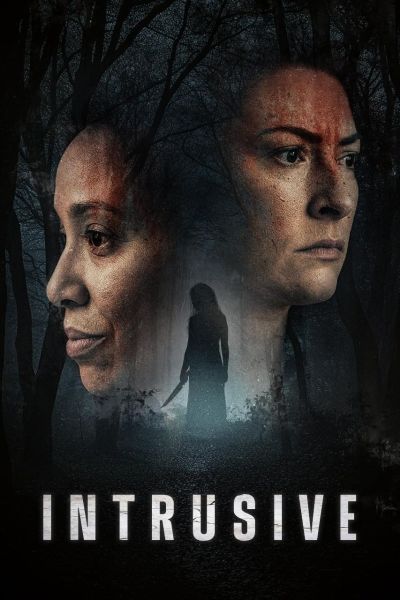
Intrusive (2024)
Rating: C
Dir: Eric Shapiro
Star: Rhoda Jordan, Sherill Quinn, Richard Caines, Tricia Brooks
I’ve often said one of the keys to low-budget cinema is working within your limitations. If you can’t afford a car chase, don’t write one into your script. Shapiro certainly keeps things restrained here. A cast basically of four, and two locations: a hotel room and a park. That’s not going to break the bank of any low-budget production. Well, unless the people in the hotel really go wild on room service. However, the tricky part is trying not to seem cheap, and this is less successful there. Even at not much more than an hour, it’s often no more than two people talking to each other. Which breaks, albeit not disastrously, another rule of cinema: show, don’t tell.
In the hotel room, we have the troubled Sabina (Jordan), who is concerned about the voices in her head. She has called on healer Kelly (Quinn), who avoids calling herself the P word – psychic – to try and help using hypnotherapy. But when Kelly encounters Phentara, the other persona inside of her patient, it begins to look as if this might be outside her skill-set. Initially, she suspects psychosis, and suggest a trained psychotherapist. But perhaps a priest might be better equipped, given responses like “I have slept a thousand years, I am perfectly rested.” Separately, Kelly’s boyfriend, Paul (Caines) is out with their child, a trip which is plagued by increasingly bizarre events, and a perplexing call from Kelly’s doctor (Shapiro in a cameo).
 Do not expect levitating beds, spinning heads or flying pea-soup. As possessions go, this is strictly low-key, expressed through words rather than actions. For the majority of the time, you’ll be on the fence about whether Sabina is just mentally ill. As a consequence, it’s the kind of film which will live or die throughout, almost entirely on whether or not the performances can hold the viewer’s attention. These are a mixed bag. I actually found the Jordan and Quinn pairing more effective. The direction is kept very simple, with static camera shots that focus on the performers, and I found this section more interesting than you might expect. For a moment, I wonder if it was going to go full Cody Clarke, and just be two people in one location for the duration.
Maybe it should have been, for instead, the movie switches over to Paul and his situation. Despite some occasionally creepy moments, and while it does all end up tying together at the end (though not without questions), I felt this was the section where the film struggled, in both story and performances. For example, I am fairly sure no health insurance company will immediately accept some random woman saying “Yes, I am Ms. X” as proof of identity. Can we say, “HIPAA violation”? That’s why we have PIN numbers, etc. Yet it’s an essential plot-point here. I also didn’t like Paul much. While this turns out to be for good reason, his man-bun may have prejudiced me…
Shorts vs. Features. I’ve made more shorts than I can count, and most of them came after one of the worst periods in my life. A few years ago, there was a string of health emergencies in my family’s home. When it finally ended, Shannon had started launching the Horrorboku production, so I bought a bunch of new film-making equipment and began to practice. I recruited my two kids, who were eight and eleven at the time, into the process, and we became ambitious; we kept trying to outdo ourselves. The kids put them on the IMDb, so my catalog there now looks insane, but I stand by the movies. They were practice for directing Horrorboku and Intrusive, and a great way to heal from the trauma of what we’d all been through. A bunch of them are on this channel.
“Anyone who wants to make a feature film should start with shorts.”
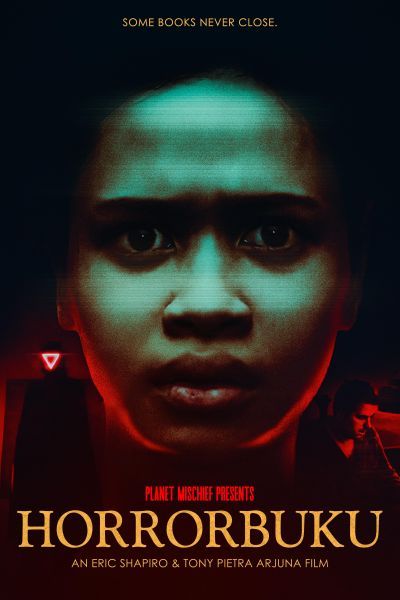
Horrorboku. This movie’s raison d’etre was to design a movie that could be scored and sound-designed by Shannon Callahan at Planet Mischief. She and her partner Jaime Morales produced it, and since I’m a big fan of their music, before there was even a story I had a visual rhythm and color scheme and metabolism in my head. I knew I wanted there to be a ton of camera angles and a sense of kinetic momentum. But I also wanted Tony Pietra Arjuna to be a part of it; we’d talked for years about collaborating for an anthology film; this isn’t an anthology, but it’s a situation where I directed half the movie and he directed the other half, and it’s all held together by Planet Mischief’s sound.
Along the way, I came up with the idea of playing a troubled writer and Tony’s storyline being the dramatized version of my character’s book, and it kept growing and getting crazier from there, but the soul and momentum of it was always the music. The movie’s a head trip. We wanted it to be open to interpretation and didn’t want it to function in too terribly literal terms. Plus, in making it, I got to see Tony operating as a filmmaker and I learned a ton from him. He’s a terrific guy and an ace at what he does.
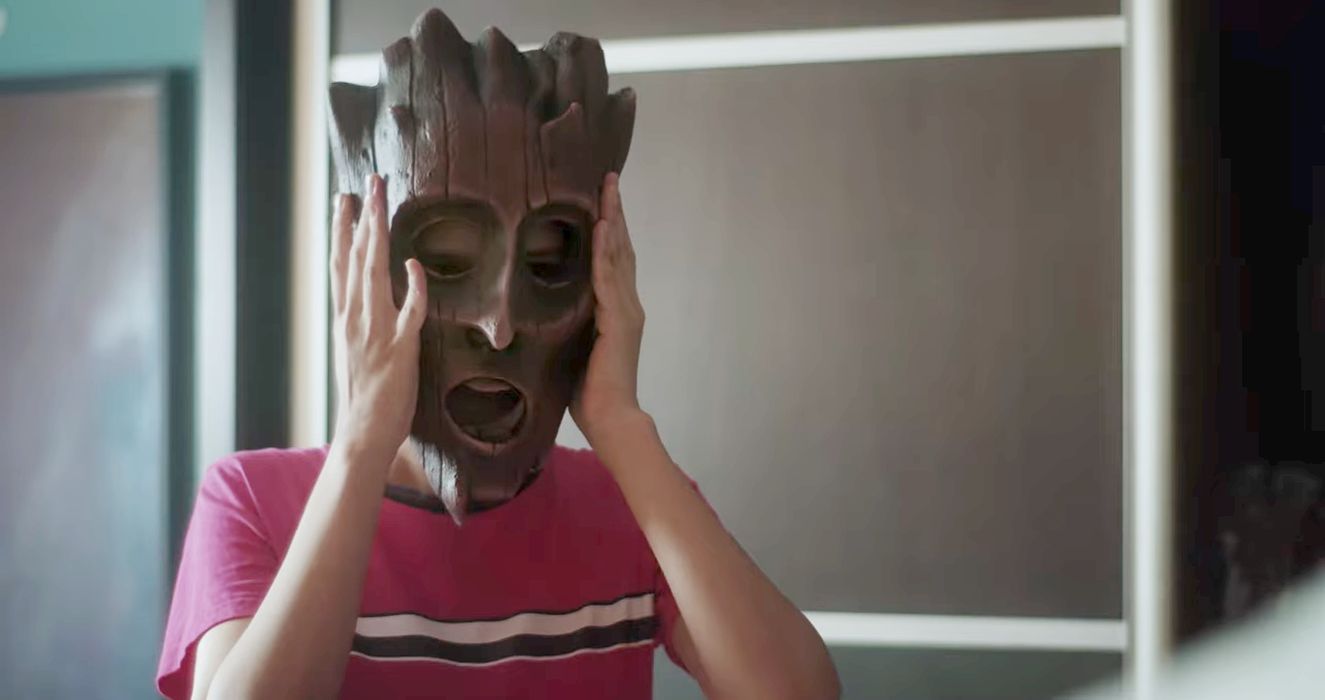
Horrorbuku (2026)
Rating: B
Dir: Eric Shapiro and Tony Pietra Arjuna
Star: Eric Shapiro, GiGi Tasse, Zarith Zalikha, Gen Darwish
Initially, this is a little like Intrusive, in that it’s mostly two people in the same location, talking to each other. Except here, it’s the same person. I should probably explain. Anthony Poffo (Shapiro) is a horror writer, struggling to complete his trilogy of novels. The issue is, for his creative inspiration, he seems to have unwittingly tapped into another dimension. Or a parallel universe. Or something. Because a mysterious wooden mask shows up. And then a doppelganger of the writer. Except the double is different. Brash, abrasive and self-confident: everything the “real” Anthony is not. It’s bad enough when the alternate version is in the house, berating him. What if it gets out?
Naturally, this is a situation difficult for Anthony to explain to his therapist (Tasse), freely admitting the scenario sounds borderline psychotic. Things get even more bizarre when Anthony becomes convinced a telephone number he came up with for the book is real, and if he dials it, will connect him to one of his characters. So, he calls. Again, a little like Intrusive, the film then switches focus. The second half takes place in Malaysia, and focuses on a pair of siblings, Dania (Zalikha) and Faris (Darwish). Their mother is dead, but Dania is convinced she speaks to Mom’s ghost by a nearby tree. Their father, Amir, fears his wife was involved in witchcraft, and wants to take the children away. But he has some local “issues” to be dealt with first.
 How much of this is really happening, and how much is inside Anthony’s head? Viewers who want a definitive answer might be left less than satisfied. However, if you’re simply willing to along for the ride, without needed a complete explanation, there’s a good deal to enjoy in this. The first half almost feels like a horror-skewed remake of Jim Carrey’s The Mask – though for whatever reason, I was getting Tony Bourdain vibes off Anthony v2.0. It is obviously far more restrained than The Mask. I’d still have liked to have seen where it might have gone: the idea of a deranged alter-ego is also reminiscent of Doctor Jekyll and Mister Hyde.
Meanwhile, the second half is something which merits its own movie too. The mask shows up again as well, though there are other unexplained elements in this segment. Who are the figures, resembling Squid Game guards that mysteriously appear? Are these real people, whose experiences Anthony is unwittingly tapping into? Or just another figment of his deranged imagination? Once more, your opinion is as valid as mine, I’d say. Such indecisiveness on the part of the script might, under other circumstances prove annoying. Here though, I found myself reeled in to what is basically a novel genre mash-up. Put it this way: I don’t think I’ve often put the “crime” and “ghosts” tag on the same film before. Add “insanity” as well and, yeah, this could be a unique little item.
[The film will be out on streaming services later this year]
Which version of Anthony is most like you? Man, I’m so glad you asked that, because neither is! The doppelgänger is a ball-busting, narcissistic prick and the main guy is a self-absorbed, overthinking, earnest doofus. I think I probably have more self-awareness and irony in me than either of them.
“I think of [AI] as The Great Cheapener.”
What’s next? I’m editing a feature film called The Plumber about a plumber who snaps. I play him, too. He’s probably more like me than both the Horrorbuku guys, but also not even close!