
Rating; C+
Dir: Vilan Trub.
Star: Alexander Kollar, Maya Murphy, Stanley Trub, Dino Castelli.
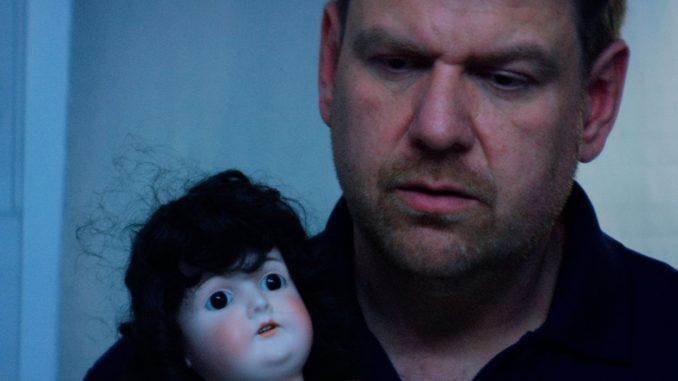
Initially, this seems as if it’s just another entry in the “creepy doll” subgenre of horror. After burying her not exactly lamented mother, Jane Gajewski (Murphy) brings back the deceased’s possessions to the house she shares with her husband, Mark (Kollar), and their young son, Brian (Trub). This includes the previously mentioned Creepy Doll™, and discussion ensues as to whether the antique should be sold or thrown out. Pending a decision, it’s not long before Brian is the first to start acting strangely. The first target is his baby-sitter, who vanishes when she is supposed to be looking after him. On her return, she is near-catatonic, and has little to say for herself, except “Brian is evil.”
Things escalate after Mark visits an expert in dolls. He discovers it is of 1940s Germany origin. And it’s hair is real, of uncertain but potentially… not socially acceptable origin, shall we say. Well, I did Nazi that coming. [Sorry] Mark develops a sudden interest in military history of the World War II era. Jane is uncertain as to whether her husband listening to the Horst Wessel Song is just a midlife crisis thing. After all, her neighbour’s husband recently took up collecting baseball cards. Mark starts experiencing weird, extended hallucinations, of an entirely convincing nature, and also strikes up a relationship with a distinctly odd delivery driver (Castelli). Through the doll expert, he contacts a medium, Ethelinda, who is so freaked out by his home, she won’t enter until it has been cleansed. Bit of a red flag, perhaps.
 The best thing about this is definitely Kollar. His depiction of Mark is so thoroughly down to earth, it sells the (admittedly, fairly silly) situation with surprising effectiveness. His reactions are convincingly natural, even as the weirdness around him escalates. The same goes for supporting characters like his friend Gary, who keep things more grounded than I expected – and sometimes darkly humourous, which was also a surprise. The doll, as such, never does anything of note. It just sits there, looking creepy, and apparently influencing the family. Which may or may not be a political metaphor in some way. The director says, “While not a political film, it exists in a climate where Nazism is invoked as a weapon to slay perceived enemies.”
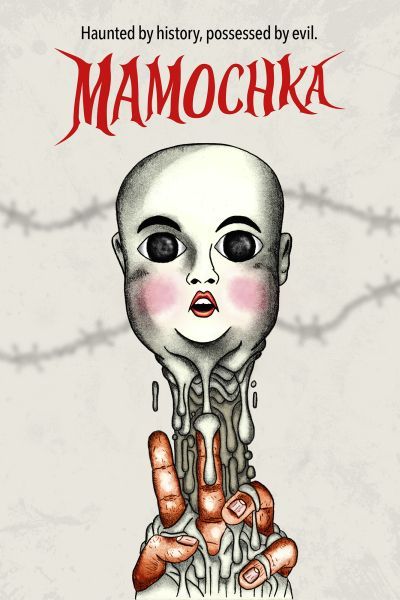
There are a number of elements which would typically annoy the hell out of me. The vague and open ending would be one, and an approach I could describe as neo-Lynchian is another. I’m still unsure of the title’s significance: it’s an affectionate term for mother, but is Russian, not German? However, once I got past a fairly rough start, where the movie takes some time to establish its wavelength, I didn’t mind these aspects too much. More annoying was a tendency to bury scenes in shadow. While these have their purpose, when you are simply watching two people having a chat in a bar, it’d be nice to see them. Flaws aside, this still managed to offer new twists on a well-trodden path, and I’d say there are enough good moments to justify your time.
[The film is now available on Amazon Prime, in both the US and UK, with a Blu-Ray available to pre-order]