

You wait ages for an Irish entry to our Jim’ll Watch It section, and then two come along at once. Well, I can’t say I had actually been waiting, but the second half is true. In a remarkable degree of synchronicity, I ended up watching two Irish movies, both in the action area – at least vaguely – which certainly qualify, despite being separated by twenty years. What they share, in addition to being from the Emerald Isle, is a single-minded dedication by the creator to getting them made. In one case, this required fighting through a lack of resources to achieve that goal. In the other, resources were not a problem. However, what was desperately needed, was someone to say “No” to the creator. It’s an interesting contrast.
I think I am generally more sympathetic to the former approach. Film-making is hard, when you don’t have a lot of money. It requires a degree of fortitude and commitment, as well as ingenuity to work around the problems which will inevitably crop up. The results may be… Well, variable, to put it mildly. But a lot of the time, the heart and the passion comes through, and that only be lauded. Egosploitation films are a lot harder to love. Though in cases where the same film-maker keeps tilting at cinematic windmills, again and again, you have to respect the sheer bloody-mindedness. In the case we will be covering below, it does appear more of a dilettantish diversion into cinema, than a dedication to the artform.
But we begin with a low-budget martial arts film. I suspect action is likely rivalled only by horror, in genres favoured by the low-budget field. While both may not require much in the way of money, they do still require a certain element of skill and experience to execute. The results when these are (to varying degrees) not present, are why we are here…
Fatal Deviation (1998)
Rating: B-
Dir: Shay Casserley, Simon Linscheid
Star: James P. Bennett, Nicole O’Sullivan, Mikey Graham, Johnny Murray
The list of properly Irish martial-arts films is a short one. As far as I know, in fact, this is it. OK, you could argue a case for Moving Target, in which Don ‘The Dragon’ Wilson accidentally buys a six-pack of Beamish in Galway, containing nuclear detonators intended for an IRA splinter group. But it’s about as authentic as a Texan wearing a “Kiss me, I’m Irish” hat. This, on the other hand, is the real deal. It was made by then-teenage star Bennett, on a budget of under ten thousand Irish pounds. The intention was for it to act as a show-reel for Hong Kong producers. Let’s just say, Bennett’s career in Hong Kong never materialized.
It is, basically, as terrible as you would expect, given the resources, amazingly generic title, and near-total lack of experience in narrative cinema of anyone involved. Co-director Linscheid, however, did compete in the bobsleigh events for Ireland at the Winter Olympics that year. So there’s that. The other director, Casserley, brought on board after the original Hi-8 camera broke, shot wedding videos. Most of the cast was recruited from the town of Trim, County Meath – population at the time, around five thousand. For instance, the chief villain, Loughlan, is played by local solicitor Michael Regan, who was given the role in exchange for his help funding the film. But in a major casting coup, they were able to obtain – albeit for only a few hours – the services of Graham, at the time a member of top Irish pop band, Boyzone. Unfortunately, not an actor.
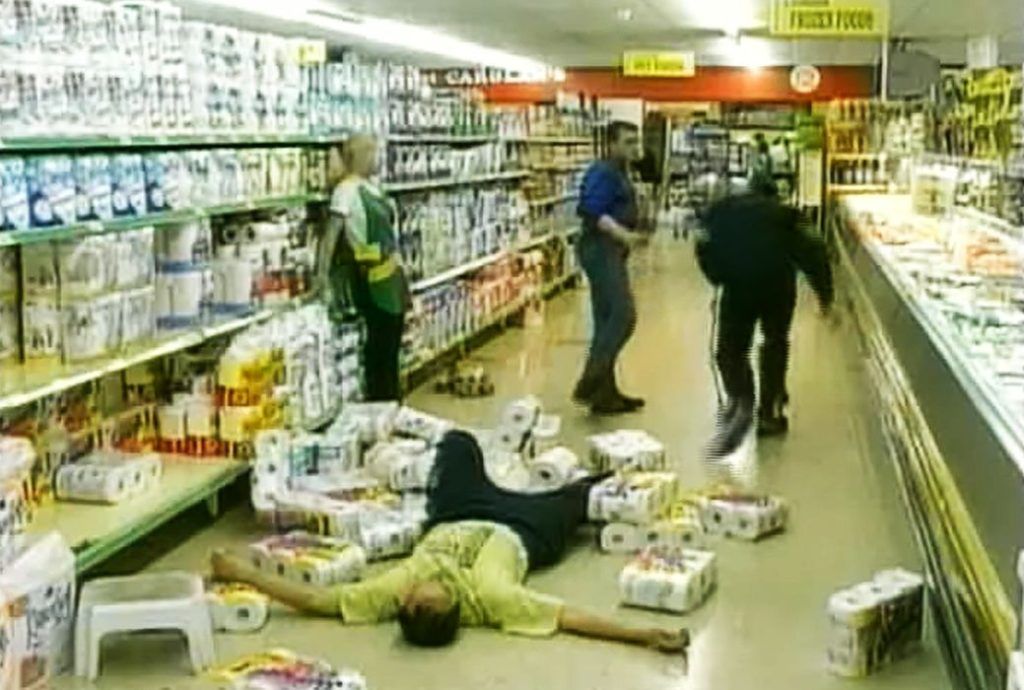
 The story is roughly equal parts martial-arts movie cliché, and batshit crazy WTFness. Jimmy Bennett (played by Bennett, you will be astonished to hear) gets out from St. Claude’s Reform School after ten years there, for reasons never explained. Returning to Trim, he wants to discover who was responsible for killing his kung-fu master father. He makes an enemy of Mikey (Graham), the son of Loughlan, who has his eye on local supermarket hottie, Nicola (O’Sullivan). Jimmy rescues her from Mikey’s thugs – including some supermarket-fu (below) – and the couple begin a relationship. It is presumably why we get an extended sequence of them attending a local funfair, because it serves no purpose. It does allow you to wonder how Jimmy lives, since there’s no indication of gainful employment.
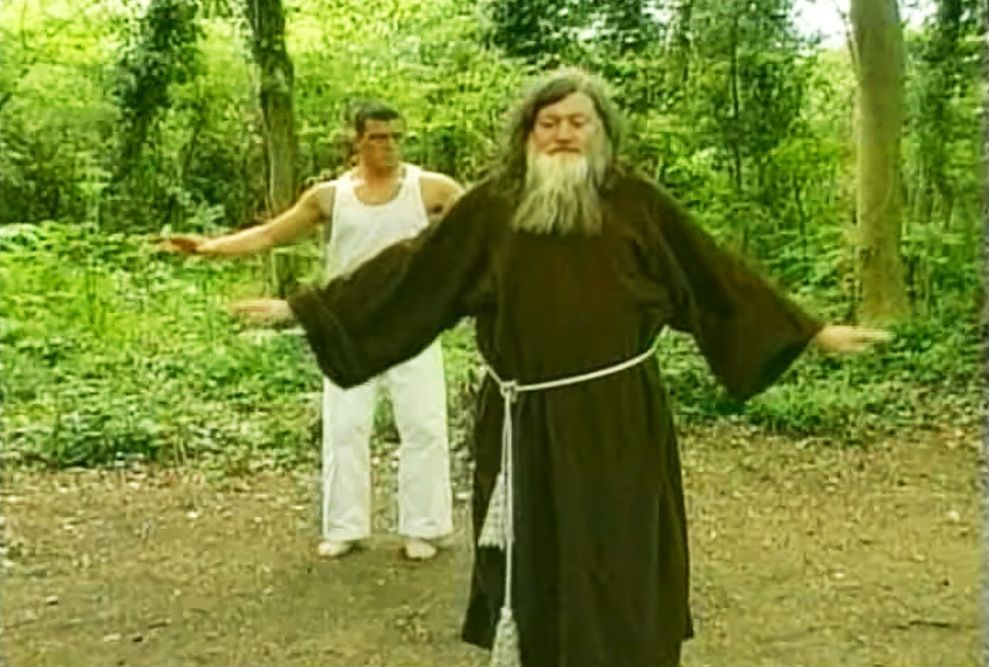
After besting Loughlan’s goons on a number of occasions, he is contacted by a monk (Murray), member of a mysterious order who run an underground fighting tournament. As you do. Actually, this is a genuinely amusing idea, taking the Shaolin monk concept from the East, and making it… Franciscan. Why they train Jimmy, or why he is compelled to compete is unclear. Nor why Loughlan cares, to the point of bringing back a guy from Hong Kong, named Seagull, to take part. Just to be sure Jimmy doesn’t win, Loughlan kidnaps Nicola, and sends a note to Jimmy stating, and I quote, “Loose or else.” He manages to get the gist, rather than interpreting it as a comment on his girlfriend’s sexual history.
The subsequent tournament is the most boring part of the movie. The action in general elsewhere is competent, mostly because Bennett clearly knows some martial-arts. He looks the part too, with muscles in all the right places, though has a disturbing fondness for wearing trousers pulled up to his bellybutton. He has clearly also seen too many Jean-Claude Van Damme video-tapes, shamelessly copying JCVD’s moves, such as the elevated splits. But the tournament becomes a lengthy jumbled mess of fights between people we don’t know or care about. The result turns out to be of no significance either. Jimmy still has to head off and rescue Nicola from the caravan in which she’s being held, then face off against Loughlan. It’s as exciting as you’d expect a brawl with an elderly solicitor to be.
I won’t deny, this is entertaining. In part due to unhinged creative choices, like the insertion of incongruous songs, stumbling in from a romantic comedy on the next shelf. Nor do I have a clue what the title means. However, there is a genuine sense of energy here, and this leaves me feeling warmer towards it than I might have expected. Another review described it as Ireland’s answer to Who Killed Captain Alex?. That’s not quite the case, because it doesn’t reach the same, sustained level of insanity. Yet is the comparison entirely inaccurate? Both films are made by people, who decided they weren’t going to let practical difficulties stop them, and that’s an attitude I can only respect and admire.
It feels like it was fun to make, an aspect you can see in the finished product. Most obviously, this infuses the outtakes at the end, including an entirely accidental car-crash they used anyway. Yet there are elements where I’m left to wonder if it was all intended as a deadpan parody. Witness lines like, “You made me look bad. And that’s not good.” Or this exchange between Jimmy and Loughlan, just before their (not-so) climactic battle:
Loughlan: You killed my son. Now I’m going to kill you, just as I killed your father.
Jimmy: You killed my father. Now I’m going to kill you, just like I killed your son.
That is either genius or terrible writing. I will listen to arguments for either.
More than twenty years later, Bennett announced a sequel, Fatal Deviation: Krakatoa, to be filmed during 2020. COVID nuked that, but last update, the movie was now called Triple Deviation, and perhaps including another genre staple: twin brothers. We will have to see if anything comes of this, and whether it can capture the same “can do” spirit. Yet there was already a happy ending for Bennett. While Hong Kong stopped returning his phone calls, he did end up in professional cinema (including an uncredited role in Moving Target). Moving to America, after a spell in construction, he got to work alongside his hero Van Damme in a number of productions, such as Kickboxer: Retaliation. Who said dreams don’t come true?

Blackbird (2018)
Rating: D
Dir: Michael Flatley
Star: Michael Flatley, Eric Roberts, Nicole Evans, Ian Beattie
I’ve always been a little suspicious of Flatley’s fondness for self-aggrandizement. As long ago as 1998, I wrote about Flatley’s split from Riverdance, instead launching his own show, Lord of the Dance, in which he basically played Jesus Christ. Klaus Kinski could probably have given him a few hints, as to why that might not be a good idea. Flatley and I then parted ways: I didn’t think much about him over the next couple of decades, and I imagine he reciprocated. But in 2018, Michael re-entered my sphere when he decided to enter the world of cinema. Naturally, he decided to write, finance, produce, direct and star in a narrative feature film – despite precisely zero previous experience in any of those elements.
What happened to the film after completion of filming in March 2018 is telling. A cast and crew screening took place quickly enough, just a couple of months later in June. However, it was then more than four years after that, before any public screening for the film happened, the film finally getting released in September 2022. The reviews were scathing: “Lord of the Awful 007 Rip-off” is one of the kinder lines. “By far the best performance in the film is by Flatley’s seemingly endless collection of hats,” said Empire. The film has since all but vanished again. Here in the US, it never received a physical release, and has remained completely unavailable on any official streaming service – this, in a world where all six entries in the Death Toilet franchise are available at the click of a button.
Of course, somebody uploaded it to YouTube.
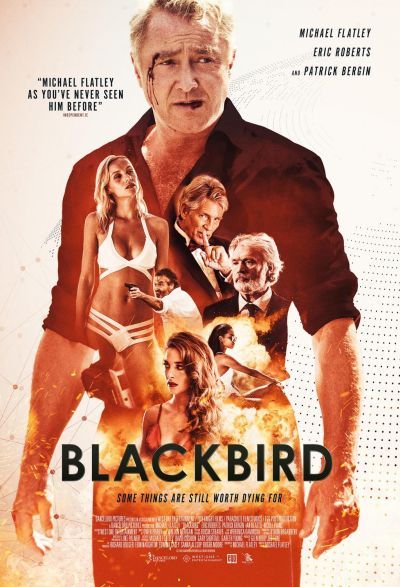
It’s often described as Ireland’s equivalent to The Room, and in all honesty, that’s not a bad way to describe it. Like that, there must have been a fair amount of money put into it. This is not some poverty-row nonsense like The Creeping Terror. Even though Roberts has now become synonymous with “Don’t send me the script, just send me the cheque”, this was when his presence still had genuine marquee value, and a price. Patrick Bergin, too, is a genuine name as the spy boss. This also filmed in London and Barbados, in addition to Flatley’s country estate in Cork. That kind of shit is not cheap. But it’s not a vanity project. Dear me, no. He told The Hollywood Reporter, “It would have just taken too long to raise the money, and I didn’t know what I’d be doing next year.”
 Sure. Why bother to wait until you can devote the appropriate amount of time to a major project like this, when you can just bang out a globe-trotting feature? It begins with a funeral in the pouring rain, which seems appropriate since the project basically killed off Flatley’s movie career [He announced that pre-production work was already under way on his second film, Dreamdance, in October 2018, but absolutely nothing has been heard about it since] Who is being buried? Fucked if we know. Maybe the woman seen in a flashback? Maybe not. “You did what you had to do,” Victor Blackley (Flatley) is told by his former colleague in a shadowy Irish group called the Chieftains. Not to be confused with the Irish folk group called The Chieftains, presumably.
He’s basically James Bond. If James Bond was aged 60 – older than any Bond actor in any Bond film – and possessed an irreparably damaged spine, a balky left knee, two ruptured Achilles tendons, and a recurring broken bone in his foot. Which is why there have been many more active Bond girls than Victor Blackley. But he is still spoken about in hushed whispers in intelligence circles, despite doing absolutely nothing to justify such a reputation, and irresistibly attractive to any woman. I repeat: not a vanity project at all, dear me, no. But what’s the plot? Something about a missing formula being sold on the black market. There’s arms dealer Blake Molineux (Roberts), engaged to Blackley’s old flame, Vivian (Evans). You just know he’s going to have to come out of retirement from his Caribbean nightclub and…
That’s part of the problem. Blackley – I just wrote Flatley by accident, and may well do so again – doesn’t do very much, beyond sporting one or other of those hats (top), at a jaunty angle that operates in lieu of any actual personality. The script rarely gets beyond the clichéd, particularly in the dialogue which contains such well-worn lines as: “She wasn’t overly keen on being recognized, if you catch my drift,” “That big guy’s got trouble written all over him,” and “You can tell much about a man by the company he keeps.” Oh, these are all said by the same character, within a thirty-second spell. He’s not along in this department. “Aren’t you going to say something?” says Vivian after they dance silently cheek-to-cheek. “I just did,” replies Blackley. What? I’d have said three minutes of vigorous Irish set dancing might have been clearer.
Not helping matters: we’re close to an hour through the 88-minute running-time before Victor has agonized sufficiently that he does come out of retirement, to stop the bad guys from… whatever. “You can’t go on living without love,” says Vivian, in more dialogue written by spinning the Wheel O’ Clichés. Evans may actually be a worse actor than Flatley, capable of taking side-splitting lines like “I always loved you, and you know that. And you know you loved me too”, and robbing them of every vestige of their comedic potential. Wait, it wasn’t supposed to be funny? Ah, my mistake. Anyway, she steals the SIM card containing the formula from Molineux and gives it to Blackley.
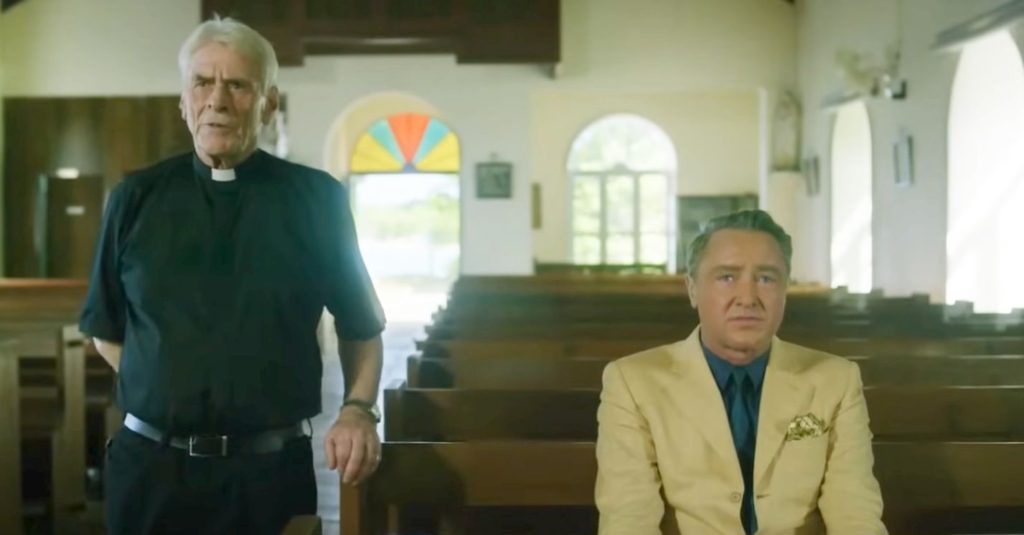 Somehow, this leads to a poker game between the two men which is both a shameless rip-off of Casino Royale, and even duller than that card game. “The stakes are far higher than you can afford,” snarls Molineux. “I’ll take my chances,” replies Blackley, though it’s hard to hear their lines over the Wheel O’ Clichés going BRRRRRRRR. We then get the closest this has to an actual action scene, with Blackley getting into a fist-fight with one of Molineux’s minions. This lasts less than twelve seconds from the first punch being thrown, to the henchman lying unconscious on the floor, having failed to land a single blow. We eventually get a flashback which might explain Victor’s angst, but is mostly an excuse for Flatley to put into practice the skills learned in his acting correspondence course. “Lesson #3: Pulling anguished faces.”
It all ends in a gunfight which, amazingly, lasts even less time than the fist-fight: a staggering five seconds before the film cuts away. It’s preceded by Flatley as Blackley saying, “Shall we dance?” – about as close as this comes to a moment of self-awareness. I will say, it very much looks like a proper movie. Whatever the flaws, the cinematographer – who, in a rare decision to leave that shit to the experts, is not Michael Flatley, but someone with actual experience in Luke Palmer – did his job and did it well. This very much looks like a proper movie. Indeed, when Flatley isn’t on screen, it could almost pass for one, since some of the pieces are there. For example, Roberts is credible enough as a bad guy. Plug someone else in as Blackley, give them a better script and this could be no worse than most Netflix Originals.
Though if you did all that, it would be a completely different film, one which likely came and went without making much of a ripple in public consciousness (see also: just about every Netflix Original). We’d then have missed out on the monument to hubris which resulted. It is an object demonstration – possibly even an abject one – of the fact that talent is a non-transferable commodity. Turns out, just because you’re world-class at waving your legs around in a rhythmic fashion, this does not necessarily make you any good as a screenwriter, director or actor. Who knew? Well, given by Flatley’s cinema career apparently being one and done, it appears he did at least learn this valuable lesson.