
Rating: C
Dir: Mel Brooks.
Star: Ron Moody, Frank Langella, Dom DeLuise, Andreas Voutsinas.
I’m not going to lie. Neither I nor Chris had even heard of this entry in the Brooks filmography. Despite coming between the twin landmarks of The Producers and Blazing Saddles, this was a critical and commercial flop, and has almost entirely been forgotten. The number of IMDb ratings proves this. Producers? 64,000. Saddles? 163,000. This? A mere 7,600. And, having watched it… Yeah, I can kinda see why. It’s based on a Russian novel by Ilf and Petrov, published in 1928, and adapted to film more than a dozen times. Mostly in Russian, but also including Sharon Tate’s last movie, and George Formby film Keep Your Seats, Please, in which he performed his signature song, When I’m Cleaning Windows.
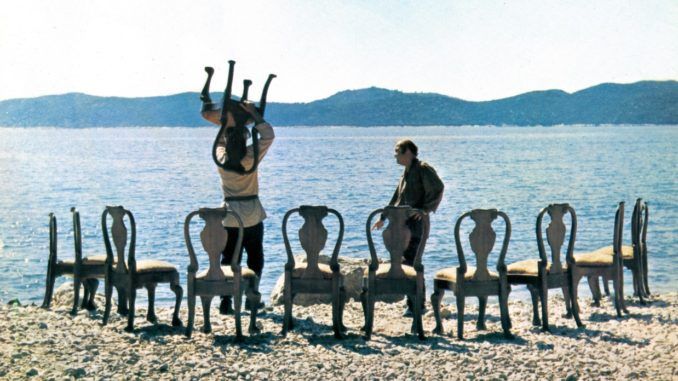
The basic premise is simple. Ippolit Vorobyaninov (Moody) overhears his mother-in-law confess on her deathbed about a fortune in jewels. This was hidden from the Bolsheviks, by being sewn into the seat of one of a set of a dozen chairs. Ippolit teams up with suave con-man Ostap Bender (Langella), to find the chairs, which were seized by the State after the Revolution. But they have a rival in the hunt, Father Fyodor (DeLuise), the priest who heard the confession. The resulting chase criss-crosses the entire Soviet Union, because the set has been split up. Though Brooks did change the novel’s ending, which originally saw Ippolit murder Ostap, to avoid the risk of sharing the loot. Ah, Russian literature: never change.
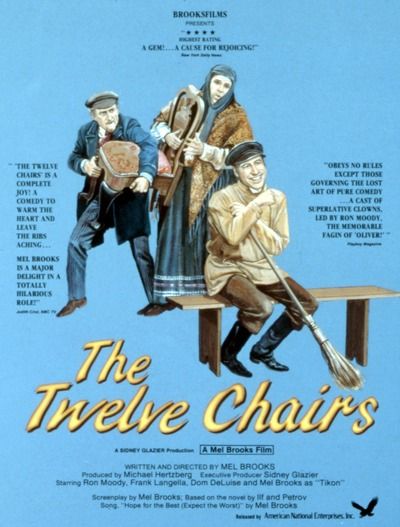 This generally fatalistic tone is captured in the movie’s opening song, a cheery ditty titled, “Hope for the best, expect the worst.” But I think the major problem is, the typical audience has no context in which to place this. This wasn’t Broadway or the Wild West. This was Communist Russia between the World Wars. I know I have nothing, and it’s quite possible the jokes simply went over my head. Oh, there were a few I got. The street name with Trotsky crossed out. Or when Ostap, trying to track the chairs, has to navigate the maze of Soviet-era bureaucracy. He goes past the “Bureau of Bureaus and Dressers”, eventually ending up in the Kafka-esque “Bureau of Furniture Not Listed in Other Bureaus.”
Chris thought it felt like a Carry On movie: Carry On Up the Revolution, perhaps. Oddly, she mentioned this in a scene featuring Diana Coupland, who would go on the next year to start playing Sid James’s wife in Bless This House. If I squint, I could imagine James in the Moody role, with Jim Dale as Langella, and Kenneth Connor replacing DeLuise. But beyond the occasional broader, slapstick elements – handled particularly well by DeLuise – this feels considerably more cerebral than the rest of Brooks’s work. Sex doesn’t raise its head either, save a brief moment where Ostap pretends to be giving a woman artificial respiration, in order to escape her husband. I’m guessing that probably wasn’t in the original Russian novel either. While Brooks considers it one of the films he’s most proud of, I suspect most viewers will be less impressed.