
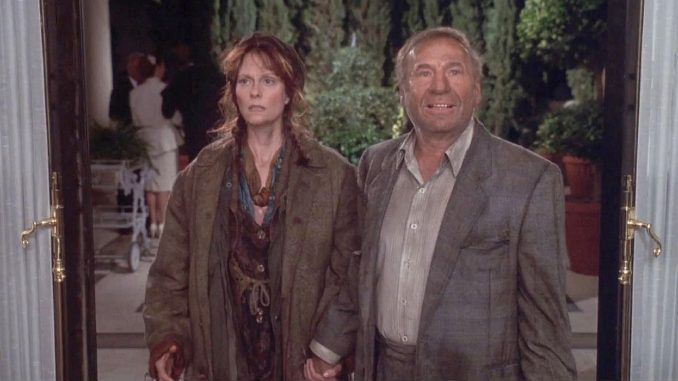
Rating: C+
Dir: Mel Brooks.
Star: Mel Brooks, Lesley Ann Warren, Howard Morris, Jeffrey Tambor.
Credit Brooks for, at least trying something different. It may not be entirely successful – and that’s putting it mildly. But it’s not just Brooks making obvious, vaguely pop cultural references. Indeed, this is not a parody of any other cinematic genre or movie. It’s a comedy-drama, without most of the typical Brooks tropes. No breaking of the fourth wall, for instance. Nor are there many of the usual suspects in the cast. After eight Mondays of what felt like relentlessly increasing broad farce, this step back was a breath of fresh air. Of course, Brooks being Brooks, buttons must be pressed. Who else would dare make a comedy about poverty and homelessness?
Mel plays Goddard Bolt, a CEO of no scruples, who is looking to take over a swathe of downtown LA, and redevelop it. The current residents? Who cares. But rival CEO, Vance Crasswell (Tambor), has his eye on the same turf. He talks Goddard into accepting a bet. If Bolt can survive thirty days in the area to be developed, on his own and without all the resources of his wealth, Crasswell will hand over his property to Bolt. Fail, and Bolt must do the reverse. It’s not long on the streets before Goddard is regretting his decision, and he’s taken under the wing of friendly bag-lady Molly (Warren). But will this be enough to counter the schemes of Crasswell, who intends to make Bolt’s homeless life as difficult as possible?
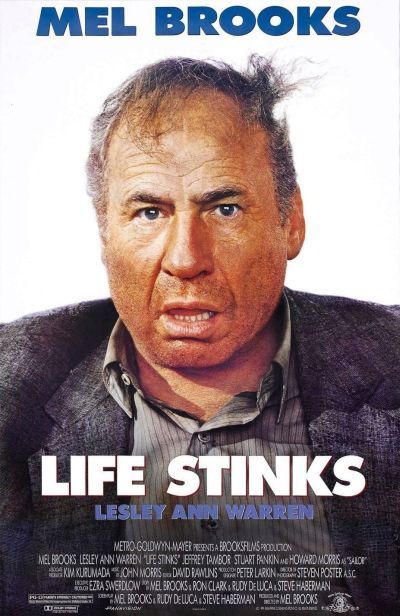 Of course, there’s nothing particularly subtle here. It’s obvious from the get-go that Bolt is going to learn that there are more important things in life than money. I always love it when Hollywood millionaires lecture us on that topic. However, it’s about the journey rather than the destination, and if hardly realistic, this does a bang-up job of reminding us that homeless people are… Well, people. The ones shown here, such as Sailor (Howard Morris, one of the few recognizable members of the Brooks repertory company) and Fumes (Theodore Wilson) are given genuine character. It’s all the more poignant hearing the latter talk about wanting to return as a bird after he dies, knowing Wilson actually passed away a week before this opened.
It does paint itself into a corner, and consequently has to wield the “With one lawsuit, he was free” card. Though I did enjoy the fight between two pieces of construction machinery, driven by the CEOs. It’s like something out of a Ray Harryhausen movie, and was an unexpected pleasure. Warren is also excellent in her role, and the neo-magical dance between Molly and Goddard is definitely a rare moment of beauty – both in the film, and in Brooks’s filmography as a whole. Moments like these do enough to dilute the overall obvious, and rather saccharine nature of proceedings. The results may be uneven, and you can see why Brooks would head right back to familiar territory. Yet this is memorable, just because it is different.