
Rating: C
Dir: Michael Haneke
Star: Isabelle Huppert, Anaïs Demoustier, Olivier Gourmet, Lucas Biscombe
a.k.a. Le temps du loup
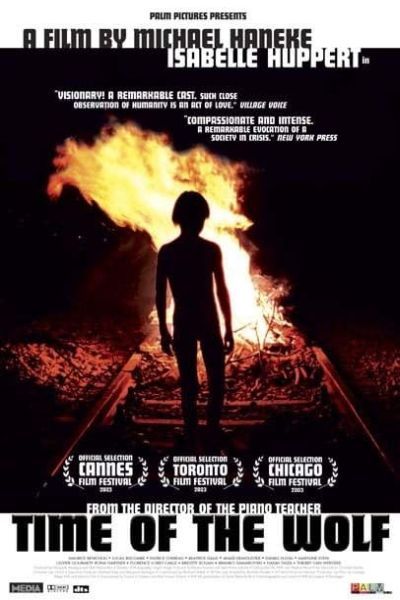
This is a post-apocalyptic movie by Michael Haneke. It is exactly what you would expect a post-apocalyptic movie by Michael Haneke to be like. If you are familiar with the works of Michael Haneke, you will understand what I mean by that. If you are not, you probably won’t want to watch this. Especially if you are fond of animals. It’s a bleak, unrelenting depiction of humanity falling apart. Though tearing itself apart might be more accurate. The apocalypse itself is nonspecific, and not important. We are entirely concerned with the aftermath. It begin in typical Haneke style, the opening credits playing out in stark, uncomfortable silence. Get used to it: there is no soundtrack music here.
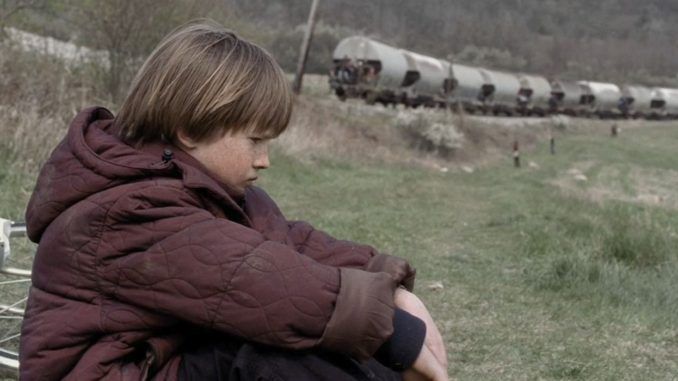
We join the Laurent family, heading to the sanctuary of their country cabin. Except, somebody is already there. A violent confrontation follows, and mother Anne (Huppert) is forced to flee, accompanied by daughter Eva (Demoustier) and son Ben (Biscombe). They’re entirely reliant on the kindness of others – and given the circumstances, that’s in understandably short supply. Eventually, they find sanctuary, of sorts, at a railway station, where there’s a community under the oversight of Koslowski (Gourmet). They are waiting for a train to arrive, which may be their salvation. Or maybe not. It’s far from certain whether help will get there before the increasing tensions – racial, sexual and personal – break the group apart. For the veneer of civilization is perilously thin.
 Haneke being Haneke, this is less about good vs. bad, perhaps closer to wolves vs. sheep. It feels like most of the characters fall into one or other category, and survival will require tapping into your inner animal. Let’s just hope that isn’t an equine. Because there’s one shocking moment of related savagery here, which I hope was somehow simulated. I really think it wasn’t. That would fit in with Haneke’s confrontational approach. I was expecting equal brutality when the killer of Anne’s husband shows up at the station. It doesn’t, petering out into a “he said, she said” awkward stalemate. That seems typical Haneke too. Easy resolutions are someone else’s cinema. Indeed, resolutions of any kind, going by the ending here.
It’s not the kind of film you can “like”. The director would potentially be insulted if you did, because the construction here seems calculated to be deliberately obscure, abrasive and hard to endure. When the food trucks stop coming, society won’t last long. It is quite impressive this was made seventeen years before COVID pushed us closer to the edge than is comfortable. However, I found the relentless cynicism wearing in the extreme. Love is dead. Affection is weakness. Charity is a character flaw. Beatrice Dalle shows up, momentarily suggesting this post-apocalypse might be fun after all. Spoiler: it is not. The ending is enigmatic in the extreme, and could be read as either hopeful or hopeless. I would not recommend betting on the former.