
Rating: C+
Dir: Rafaël Cherkaski
Star: Rafaël Cherkaski, Charles Dhumerelle, Roland David, Simon-Pierre Boireau
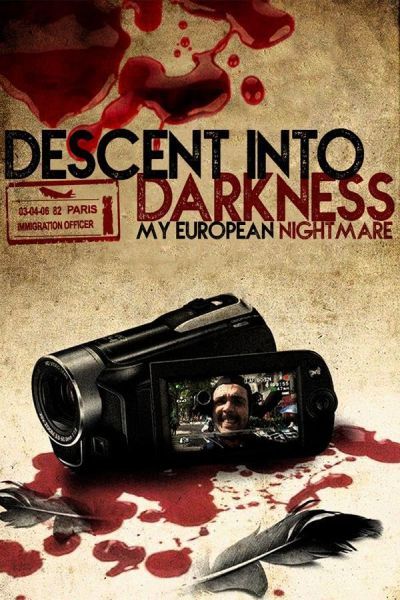
a.k.a. Descent Into Darkness or My European Nightmare
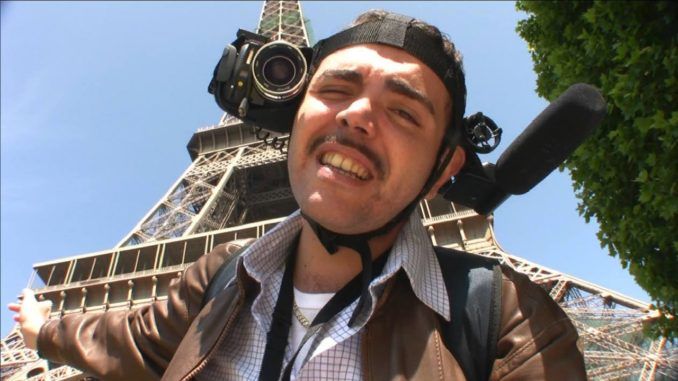
If you wanted a three-word summary of this: Borat Goes Bonkers. It begins with the arrival of bright-eyed and innocent Eastern European vlogger Sorgoï Prakov (Cherkaski) in Paris. He has been commissioned to do a video diary of his trip around Europe, beginning in the City of Light. However, it’s not long before the lustre begins to get knocked off the “European dream” he is seeking. While some people are friendly, others are not. He ends up having to spend his money on a replacement camera, meaning he can’t afford proper accommodation. This sets off a slow, downward spiral eventually triggering a full psychotic break in Sorgoï, including extremely violent outbursts.
Of course, this being a found footage film, you’ll have to suspend your disbelief significantly. Please accept that, no matter how loony the protagonist becomes – and the answer there is, “very” – he will always have his equipment to hand, with the batteries adequately charged, even as he becomes a homeless and destitute wino. The camerawork becomes a bit shakier: that’s about the extent of it. Even when carrying out the home invasion which forms the disturbing finale, Sorgoï still knows how to frame a shot. I’d shake him by the hand – if it wasn’t smeared in excrement. However, it doesn’t feel particularly as if the found footage approach was simply a cheap get-out clause, as is often the case for low-budget horror.
 I give Cherkaski the actor a lot of credit, for one of the more convincing depictions of a descent into madness I’ve seen this year. You do need to be patient, since it initially sets him up as a wide-eyed ingenu. Though considering a subsequent phone-call suggests the police are looking for Sorgoï in his native land, I’m wondering how much that is truly the case. Some of his interactions, particularly with women, do appear creepy (playing into the Borat comparison). I think the first half worked better for me, because the scenes appeared almost entirely natural. If you told me things like the conversation with a racist guy on the Metro were absolutely genuine, I’d be willing to believe you.
Once the violence kicks in, however, the staging becomes considerably more apparent, for reasons both obvious and subtle. I was therefore not able to buy into the conceit with the necessary level of commitment. It just becomes another “madman on the loose” film, with significantly wobblier cinematography. There are hardly any other characters of note: a hotel receptionist (Boireau) here, a homeless guy (David) there. Otherwise, you are stuck inside the head of Sorgoï, via his cameras, as the guard-rails fall away, and he goes off the deep end. I have a low tolerance for both found footage and watching people go mad. This pushes both well past their limits: within those constraints, it probably comes close to as good as you could hope.