
Rating: C-
Dir: David Butler.
Star: El Brendel, Maureen O’Sullivan, John Garrick, Marjorie White.
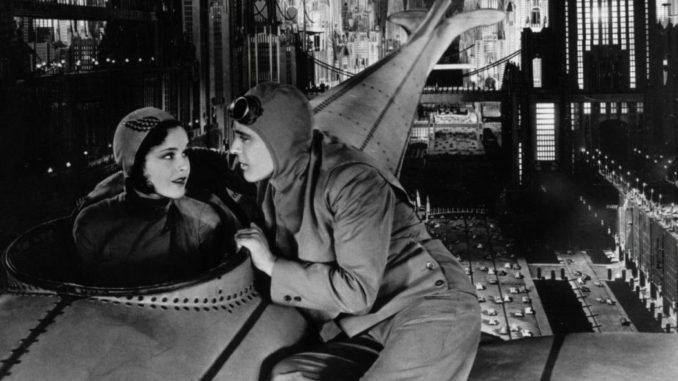
I love retro-futurism. By that, I mean previous ideas – typically, wildly inaccurate – as to what the future would be like. This is right in that wheelhouse. Made in 1930, it begins by looking back fifty years, to the peace and quiet of 1880. It then reaches forward the same amount, to imagine what 1980 would be like. Safe to say, that’s a swing and a miss. It may be the source of the “In the future we will all have flying cars” meme. Those and entire meals in pill form are featured here: still waiting for either. In this future, “Everyone has a number instead of a name, and the government tells you whom you should marry,” according to the opening voice-over.
Not quite true. Names are now in the format J-21 (Garrick) or LN-18 (O’Sullivan), and marriage proposals can only be made by men. In the event of competing offers, the government decides who gets the bride. That drives the plot here, because J-21 lost his case, and LN-18 will now marry another. J-21 decides to join a mission to Mars instead, hoping it will prove his suitability in the upcoming appeal. Meanwhile, Peterson (Brendel), a man who died in 1930, is revived by science, and is amazed by the advancements in technology. Though he notes that some things have not changed. “Women are still causing trouble. You’d think, in fifty years they could have found a good substitute for them,” he says, before stowing away on the Mars rocket.
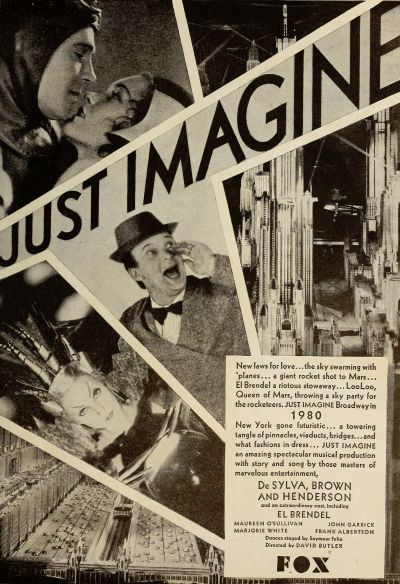 Easily the best thing this has going for it, is the production design. The film was Oscar nominated in that category, becoming the first SF film to receive an Academy Award nod. The model cityscape is genuinely impressive, and if the electrical apparatus used to revive Peterson seems familiar, it’s because it was re-used the following year in Frankenstein. But when not depicting the city of the future, it’s pretty bad. To start off, the makers decided science fiction wasn’t enough, and decided to turn it into a musical, J-21 whipping out his ukulele. Brendel’s schtick of a dumb immigrant passes the point of no amusement after about five minutes, and in general the attempts at comedy might be worse than the songs.
It’s not even a period thing, since the film bombed on release. The studio ended up selling it for parts: for instance, the spaceship became Dr. Zarkov’s spaceship in the Flash Gordon serials. The scenes on Mars are particularly mad, although the planet’s inhabitants are surprisingly gender-fluid for the thirties. “She’s not the queen. He is!” quips Peterson. Probably goes with their fondness for Busby Berkeley style musical numbers. While initially amusing, in a “WTF am I looking at?” way, the novelty wears off, as on Earth. Three years earlier, Germany had made Metropolis, a vision of the future which still resonates, a century later. The sad thing is, this might be the closest Hollywood came, and despite occasional hits like video-phones, it’s barely in the same solar system.