
Rating: B+
Dir: Genki Kawamura
Star: Kazunari Ninomiya, Yamato Kochi, Naru Asanuma, Kotone Hanase
“Liminal spaces” are in right now, following the startling success of Backrooms. But this beat it to the cinematic punch by almost a year, though both were based on pre-existing properties. In this case, the video-game of the same name, released in 2023. But what are liminal spaces? Per Wikipedia, “empty or abandoned places that appear eerie, forlorn, uncanny, and often surreal.” They are “commonly places of transition”, like hallways, but may simply be normally occupied spots that are deserted, such as an abandoned shopping mall. This film is almost entirely based on the creep factor they possess, in this case the location being the maze of tunnels exiting a Japanese metro station.
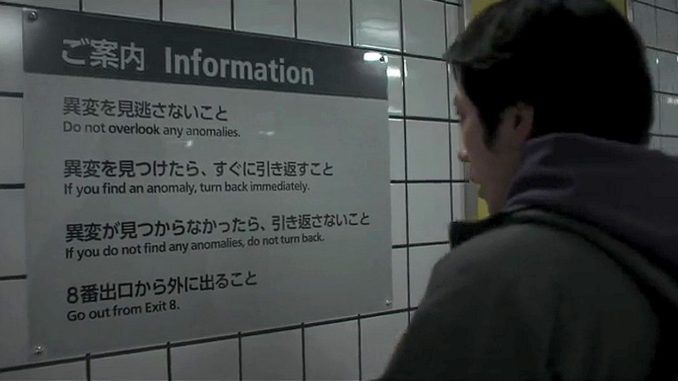
The nameless protagonist (Ninomiya) finds himself stuck in an endless loop of these, unable to escape. There are other people he encounters, most notably a salaryman (Kochi) and a young boy (Asanuma). But they are more or less in the same situation, trapped in what’s effectively a three-dimensional Mobius strip. There are rules – in typically Japanese fashion, posted on wall in tidy form for your convenience (top). Spot an anomaly? Turn around. Otherwise, keep going. But whether you can follow them in order to reach the titular exit and return to the normal world, is a much harder question. A single false step sends you back to the beginning, and there are no save points. It’s a simple idea, yet endlessly fascinating, and kept me completely engrossed throughout.
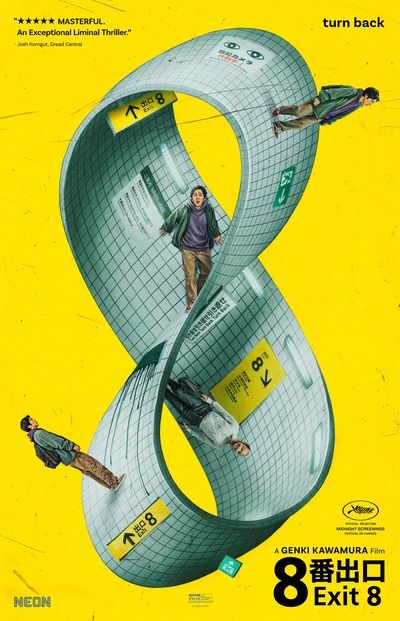 The first half is devoted to generating a building sense of unease, as you gradually realize (along with the main character) there’s something wrong. The landscape and the people in it repeat, with the salaryman in particular a source of dread. Then, gradually, we learn exactly how wrong things can be, in the shape of the anomalies. While most of the movie is quite low-tech, there are some truly bizarre, monstrous creatures, part-human and part-animal. They’re effective, in part because of the sharp contrast to the generally implied nature of the horror elsewhere in the movie. You’re also never quite sure what is real. Or what the word even means any more. In terms of capturing the feeling of a nightmare, this is firmly on point.
Although made on a far larger budget than One Cut of the Dead (2017) (at least relatively; $1.4 million is a fraction of the cost for Backrooms), it feels cut from similar cloth. By which I mean, it’s a film where the high concept is key, and showing the power of a well-written script in the right hands, regardless of resources. Here, we know hardly anything about the protagonist. He recently broke up with his girlfriend, who just told him she’s pregnant. But the performance of Ninomiya is still sufficient to get you firmly on his side, and the final moments make for among the most satisfying endings I’ve seen this year. Bonus points for an excellent and effective soundtrack, mixing Debussy, Ravel and repeated cues to underscore the eerieness of proceedings. If there’s a more unsettling film in 2026, I don’t want to see it.