
Rating: C-
Dir: Leslie Arliss
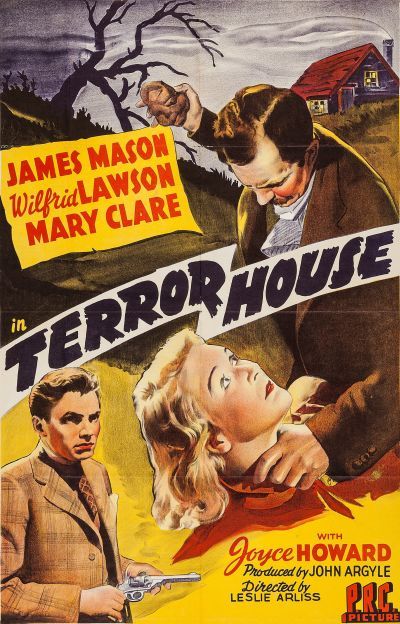
Star: Joyce Howard, James Mason, Tucker McGuire, Mary Clare
a.k.a. The Night Has Eyes
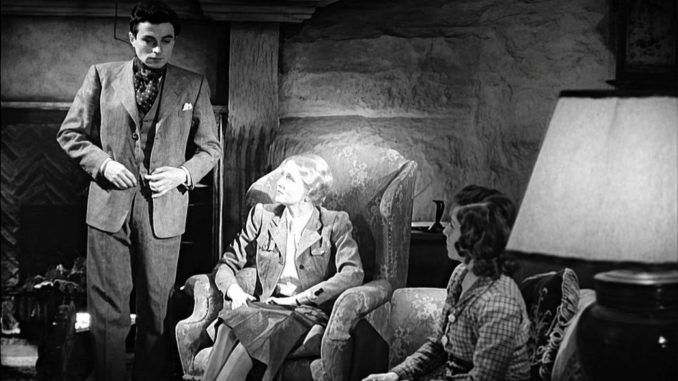
This British quickie features a performance from a pre-Hollywood Mason, and certainly starts off right. Young teachers Marian Ives (Howard) and Doris Drake (Clare) are delighted it’s time for their summer holidays, despite the sniffy disapproval of their elder pedagogues. “I sometimes wonder what is your favourite game,” remarks one with disdain. Doris spits back a remarkably risque riposte for the era: “If you really want to know, it’s one I couldn’t possibly teach the kids.” Of course, she clarifies she meant golf. Though even that has its double-meaning to a modern audience, given the next line is, “I suppose you two are off on some gay adventure.” Sadly, any such wit is missing thereafter.
Instead, the pair are off to the Yorkshire moors, partly in search of Evelyn, a colleague who went missing in the region the previous year. A storm forces them to seek shelter in the large, old and spooky house belonging to Stephen Deremid (Mason). He is a reclusive composer, who is now suffering from what would now be called PTSD, resulting from his experiences in the Spanish Civil War [It’s interesting the makers didn’t use the ongoing Second World War as the source of Stephen’s issues] Marian, the quiet and sensitive one, falls for Stephen, but – what are the odds! – there’s increasing evidence he may have been involved in the disappearance of Evelyn. How deep and dark do his issues run?
 It’s the kind of film which largely requires everyone to act in direct contradiction to common sense. For instance, Stephen warns his guests, “I don’t want you to go ferreting about the house,” in particular, drawing attention to the fact he keeps his bedroom and study locked. No prizes for guessing what the young women do, literally before he’s down the driveway. Similarly, even after Marian finds some extremely damning evidence in the attic – oddly, not one of the rooms he keeps locked – and flees the house, she then voluntarily returns. This seems to be purely so the rest of the plot can happen, with the truth about Stephen’s condition revealed. I will reveal, he’s not the werewolf at which the film has been vaguely hinting, in full moon-related dialogue.
Apparently made on a trivial budget of just fifteen thousand pounds, it doesn’t particularly flaunt its poverty, although the “moors” are not particularly convincing. The bulk of the film takes place inside the house, and its a suitably atmospheric venue. Mason delivers an nicely ambivalent performance, though I wish we’d seen more of the feisty Doris. She seems far livelier than than the solemn and serious Marian, but gets shuffled off almost entirely in the second half. It all works better as a horror-thriller than a dramatic romance. It’s a shame the film takes rather too long to realize this. I can’t blame Doris for her early departure. Watching the cautious Marian and damaged Stephen circling each other isn’t my idea of enormous fun either.