
Rating: B
Dir: Drew Hancock
Star: Sophie Thatcher, Jack Quaid, Megan Suri, Lukas Gage
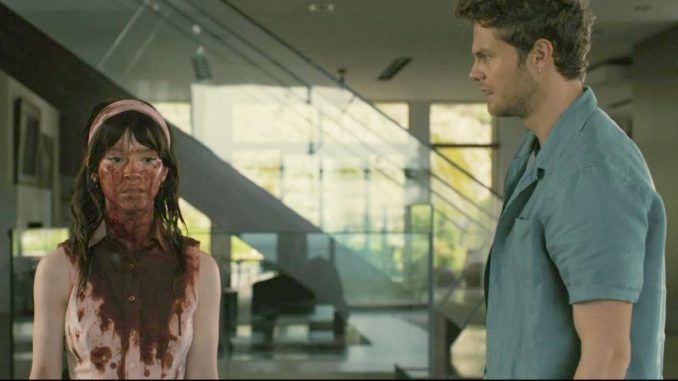
Spoilers follow, though the film itself doesn’t delay things too long before revealing things (the poster below kinda gives it away too). Still, it is probably best if you go into this knowing as little as possible. The grunt of surprise coming from the armchair to my right, followed by a lower level than usual of Chris scrolling on her phone, demonstrated this. Presuming you don’t know otherwise, the first twenty-five minutes will seem more like a dark relationship drama, with Iris (Thatcher) and Josh (Quaid) having a meet-cute, and going to visit Sergey, a dubious rich friend, in the country. He seems a bit controlling. Things take a chillier turn still, when their host tries to rape Iris, and she stabs him to death (above).
Then we get the needle drop. She’s a robot, made specifically to act as a girlfriend to Josh. Literally everything she remembers is a lie. Iris was jailbroken by him, settings for things like aggression manipulated and safety checks bypassed, in order to take the fall for the murder. This is part of a plan to acquire twelve million dollars of Sergey’s money. She is not exactly happy at this revelation, and the changes made also give her the freedom to escape, clutching the tablet Josh uses to adjust her configuration. Naturally, this new-found independence poses a big problem for him. Complicating matters further, she is not the only companion bot present in the house, which proves to be very much a double-edged sword.
 Strong Black Mirror vibes here, with a story of technology being manipulated, and coming back to bite the manipulator. I also found myself humming Don’t You Want Me to myself: “I picked you out, I shook you up and turned you around, turned you into someone new… It’s much too late to find, you think you’ve changed your mind. You’d better change it back or we will both be sorry.” Oddly appropriate lyrics for the Iris/Josh relationship, considering he literally made her into the woman she is today (see also Raptus, shot back in 2022). It feels the film is trying to say something about this, though it’s light enough in touch for me not to be annoyed. It is definitely reflecting loneliness, a perhaps inevitable result of our terminally online culture.
The film makes Iris the protagonist, and intends for the audience to empathize with her. But the reality is, she’s still a machine, not a human – just a convincing simulacrum of one. There’s a discussion to be had in regard to what it is to be human and, Blade Runner-like, what that means. This film bypasses this entirely, and jumps straight to, “You go, robo-girl!” While I enjoyed this thoroughly at the time, and the rating reflect that, the more I think about it, the more it seems built on faulty foundations. Our coffee-maker gave up the ghost today, after four years of faultless daily brewing. I ain’t going to mourn it, just get a working replacement. In reality, and despite the movie’s best efforts, I’d probably feel the same about Iris.