

Rating: C+
Dir: Just Philippot
Star: Guillaume Canet, Patience Munchenbach, Laetitia Dosch, Suliane Brahim
Should you go into this blind, you may be wondering if you are the victim of some administrative error. For rather than the apocalypse expected from the synopsis, you begin with some kind of protest in the workplace, which ends in a visit from the riot squad, and Michal (Canet) being arrested. Did I click on a social drama by mistake? Somewhat. It does feel as if Philippot wants to make “elevated disaster porn”, spending an unexpected amount of time building his characters and their relationships. This, of course, is not why we are here. We are here to see precipitation capable of melting faces, and when the film delivers on this, it’s pretty decent, I must say.
I did find myself diverted in the middle, looking into what was the most acidic rain ever recorded. Turns out, it was actually recorded in NW Scotland in 1987, when rain fell in Inverpolly Forest with a pH of 1.87. That’s more acidic than lemon juice or vinegar. It is capable of melting your face? Well, certain brands of salt ‘n’ vinegar crisps do make the inside of my mouth peel a day or two later, so I guess: sorta? That I am writing about this, in preference to the domestic soap-opera affecting Michal, his estranged wife Elise (Dosch), their teenage daughter Selma (Munchenbach), and various current other halves, should tell you I was considerably less interested in such things than Philippot.
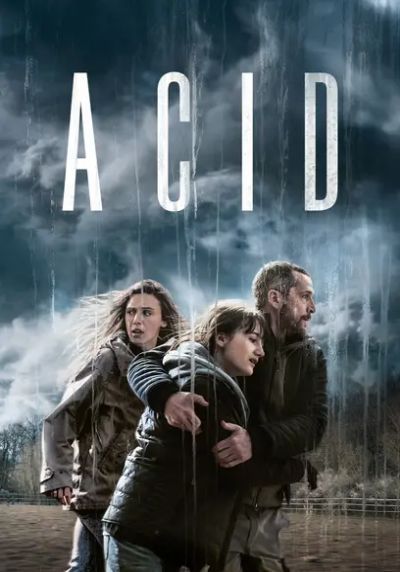 It’s exactly the same issue which plagued his last film, The Swarm. [Pun intended – it was about locusts, y’see, hence “plagued”. Oh, never mind…] But at least here, the carnage works well enough to leave me feeling my time hadn’t been entirely wasted. There is a sequence with Michal and Elise driving to the boarding school where Selma is out and about on a riding lesson [a case of #FirstWorldProblems if ever I saw one], in order to get her inside and away from the impending acid rain. This is crisp, tense and well-handled. Subsequently, when the family are forced to proceed on foot, and must cross a bridge weakened by the damaging deluge, this is also memorable stuff. Because acid rain will eventually lead to acid rivers…
Does it make scientific sense? Probably not. Does that matter? Probably not. You do get the feeling the specifics of the problem here, are mostly intended as a useful rod with which the director can belabour his preferred targets. Capitalism is to blame for everything, from Michal’s initial arrest, through to the pollution which caused the atmospheric disruption and, probably, the underwhelming response from the authorities. They are not exactly depicted in a shining light, when they are present at all. Michal is largely thrown onto his own resources instead, and these are frequently found wanting. It does remain an improvement on The Swarm, although I suspect the director will continue jamming his agenda into places where I’d rather he didn’t stick it.