
Rating: C+
Dir: Milton Rosmer
Star: Tod Slaughter, Sophie Stewart, Eric Portman, D.J. Williams
The inspiration for this was a notorious real-life murder from 1827, where Maria Marten was shot dead by lover William Corder at the titular location. He was eventually caught, confessed and hung for the crime, his body being given to science. The case caused enormous popular interest. The story was first adapted as a play before Corder was even executed, the barn was reportedly turned into souvenir toothpicks, while Corder’s skin was tanned and used to bind an account of the murder. Which seems deliciously harsh. This stage version makes Corder into a older man – in reality, he was a couple of years younger than the victim – and Marten an innocent, rather than the unmarried mother she actually was.
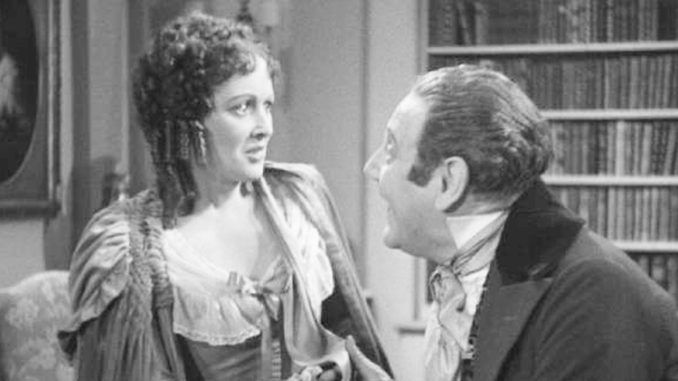
It’s the fifth film adaptation, after silent ones in 1902, 1908, 1913 and 1928, though only the last has survived. The origins as a play are hardly concealed here: it begins with a “reverse curtain call”, introducing the various cast members and their characters. Slaughter was familiar with the part, in addition to on stage, he played it in a BBC radio play, broadcast in November 1934. However, there’s no denying the relish he brings to the villainous role of Squire William Corder, as he seduces Maria (Stewart) away from her true love, Carlos (Portman), part of the local Gypsy community, only to discard her. When Maria discovers she’s pregnant, her father (Williams) blames Carlos and kicks her out. Corder, meanwhile, has already moved onto his next target, a rich spinster. Fearing Maria’s interference, he lures her to the barn. Of course, no villain in a Victorian melodrama ever gets away with their crimes.
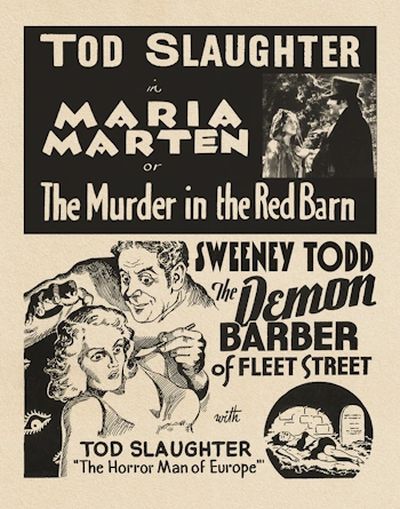 It’s clear from the start that Squire Corder is a slimy and morally bankrupt character. Yet there’s still charisma, apparent in the opening scene at the village dance. It certainly works on Maria, who goes from zero to loss of virtue (implied, anyway) with remarkable speed – say, compared to Tess of the Durbevilles. But she is still a generally sympathetic character, for similar reasons to Tess, being guilty of not much more than naivety. While Carlos can be a bit stalkery at times, this is an unusually sympathetic portrayal of a Romany for this era. He never wavers, despite being the prime suspect in Maria’s disappearance, largely due to prejudice and circumstantial evidence, and gets the last laugh, becoming Corder’s executioner.
Slaughter turned fifty the year his screen debut was released, and in his performance, you can tell he has more experience in the theatre. It’s a very “stagey” approach, and particularly in close-up, could be seen as chronic overacting. However, given the material, I would be hard-pushed to call it inappropriate here. The actor goes increasingly over the top after Corder’s own dog discovers Maria’s grave, and the landowner is made to dig it up. This uncovers first his pistol – conveniently, one of a matching pair, the other recently handed to a bystander – then the corpse of his victim. By the time his hopes of a stay of execution are snatched away, near-hysteria is probably understandable. Subtlety? It’s clearly vastly overrated.