

Rating: C-
Dir: Diana Galimzyanova
Star: Rashid Aitouganov, Irina Gevorgyan, Marina Voytuk, Kolya Neukoelln
After the complete bafflement provoked by the director’s subsequent feature, Plan 9 From Aliexpress, I am somewhat relieved to report that this is considerably more straightforward. Well, at least relatively. It’s still probably not a good sign when, twenty minutes in, you find yourself Googling for a plot synopsis, because what’s unfolding remains borderline incomprehensible. However, “borderline incomprehensible” is still almost mainstream compared to Plan 9. I do admire Galimzyanova’s almost wilful indifference to narrative convention. Doesn’t necessarily mean I want to watch it though, events here unfolding both backwards and forwards. The relatively simple bit involves three passengers on a train, on which a serial killer, nicknamed “The Fruiterer”, has been operating for the last six months.
In a carriage are three people (top). Musin (Aitouganov), a private eye who suffers from blackouts, and is heading to take charge of a relative’s estate; Elina (Voytuk), a concert pianist who saw one of The Fruiterer’s murders; and Arina (Gevorgyan), a screenwriter working on a video-game about the killer, who is conducting research for her creation. I’d probably have been fine with this. Except, as the trio hurtle through the countryside, their pasts are slowly revealed in a series of irritatingly fragmentary flashbacks, which also unveil a sinister therapist (Neukoelln), who really does not seem to have the best interests of her patients at heart. Keeping track of who is doing what, and when, requires greater diligence than I was able to provide. And possibly a notebook.
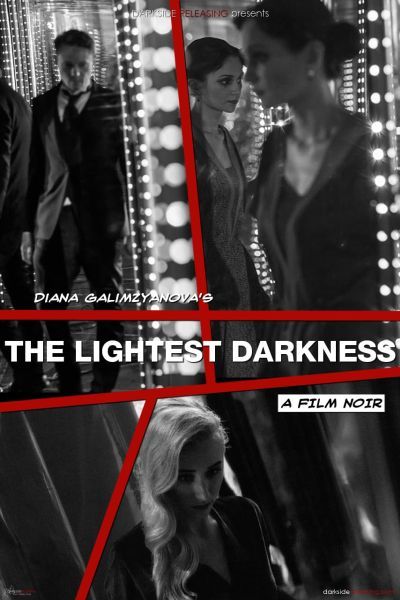 I was, consequently, largely reduced to admiring the look of the film, which is literally retro-modern. By that, I mean it’s a deliberately anachronistic combination of elements which are antique and contemporary. The train is a steam one, and everyone looks like they have stepped out of a forties film noir [So many hats…]. Then Arinza pulls out her laptop, and gets on a video call with her boyfriend. Yet once you get used to this, it’s an effective approach. I also noticed an almost constant motif of mirrors, with characters observing each other’s reflections, or being watched. As with quite a lot of the plot, I have no clue what it’s intended to mean, and just let it wash over me.
The performances are a bit of a mixed bag. While the film is in Russian, there were a number of times where the line reading seemed to be rote to the point of flat-lined. There wasn’t anyone here to whom I felt any significant attachment: Musin might come closest, and he was still a cypher due to those (convenient?) gaps in his memories. The final scene reveals the truth about who is the murderer, though whether it provides a logical resolution would likely require going back and watching this again. To which my response would be, “I’m good, thanks.” Not unless someone is prepared to re-edit this into a chronological and coherent timeline, anyway. Otherwise it’s a visually impressive example of why I’m averse to this kind of thing.