

Rating: B-
Dir: George King
Star: Tod Slaughter, Marjorie Taylor, Eric Portman, Graham Soutten
This certainly begins in an unusual way, with eight minutes of effectively a BBC radio variety show broadcast. There’s a comic song from due Flotsam and Jetsam (a predecessor to Flanders and Swann), an interview with a cats’ meat man about his trade, and then – finally relevant – Slaughter appears to promote the film we are watching (which seems curiously pointless, since we are, in fact, already watching it). Asked if he has a favourite method of murder, he says, “I keep a perfectly open mind on the matter. I murder by strangulation, poisoning, shooting, stabbing or with a razor.” He mentions his roles both in Maria Marten and Sweeney Todd, by way of an introduction to the “old new melodrama” which then unfolds.
This does vary from other entries in a couple of ways. Firstly, it isn’t an adaptation of a previous story, but an entirely new tale. Secondly- and definitely a plus – there’s no inappropriately young love interest for Slaughter. Instead, he’s the titular money lender, who moonlight at a serial killer, baptised by the press with the glorious name of “The Spine-breaker”, in reference to his preferred way of dispatching victims. It’s never quite clear why he does this: robbery seems a partial motive in some cases, but the first we see him, he murders a young boy. Nobody initially suspects Hawke, who has an adopted daughter, Julia (Taylor). She is in love with Matthew (Portman), the son of Hawke’s business partner, Joshua Trimble.
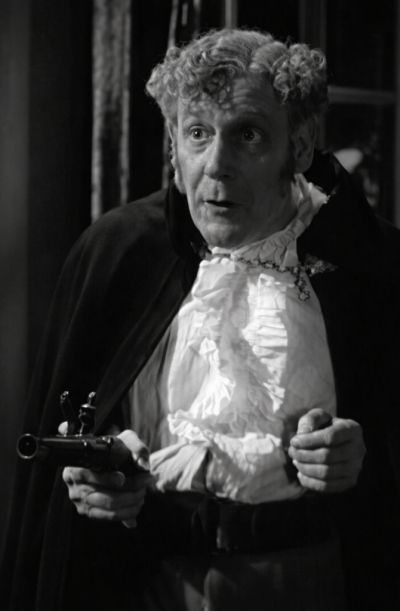 Joshua eventually discovers Stephen’s alter ego, after seeing him snap a statue with his abnormally strong hands, and, inevitably, is quickly dispatched. However, he left a document incriminating Hawke, and when Matthew finds out the truth, he gives the killer a chance to run before beginning pursuit: “You shall be like a hunted animal. But as a fox is given a chance to run for his life, so should you be allowed to flee. For Julia’s sake, I hope you’ll elude me.” Julia is rather ambivalent about this, and with her guardian no longer around, is co-opted into an unwanted, blackmail-fuelled engagement. This, intriguingly, ends up putting the fugitive Stephen and the hunter Matthew on the same side, both intent in stopping Julia’s marriage.
The dialogue here is particularly sharp, such as Hawke telling his next victim, “Perhaps you’d allow me to call on you one night alone. Then we could get to grips with the matter.” When the unsuspecting man asks, “You will back me up?”, he is told, “Definitely. You’ll find me behind you…” This might be a result of the script being directly written for the screen, rather than being an adaptation of a stage play. It’s also notable that Hawke is not the psychopath we have seen Slaughter play previously: he genuinely cares for Julia, which makes his predilection for back-breaking work all the more inexplicable. But it’s no less entertaining for this – and educational too, with regard to now long-lost, feline-related professions.